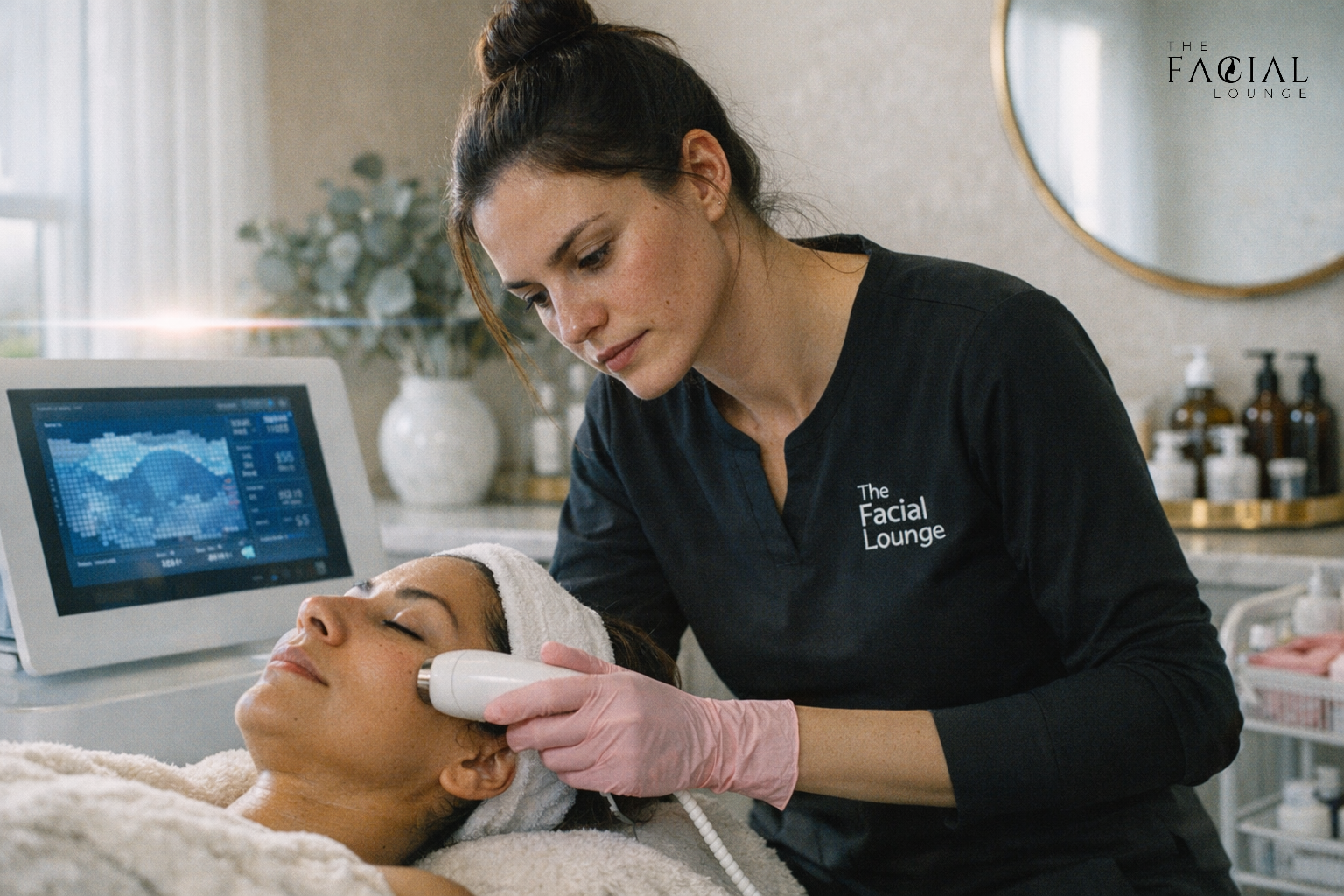
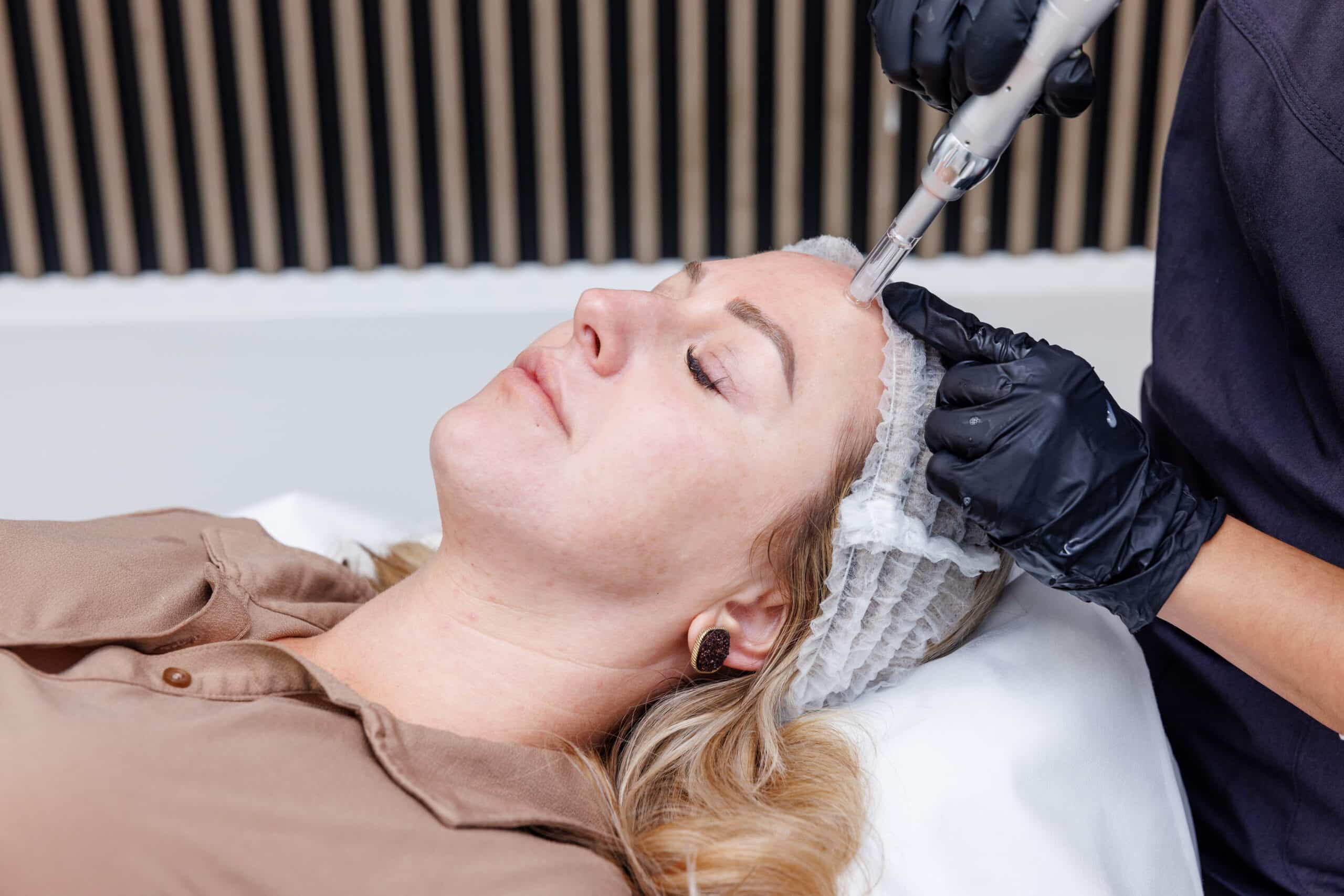
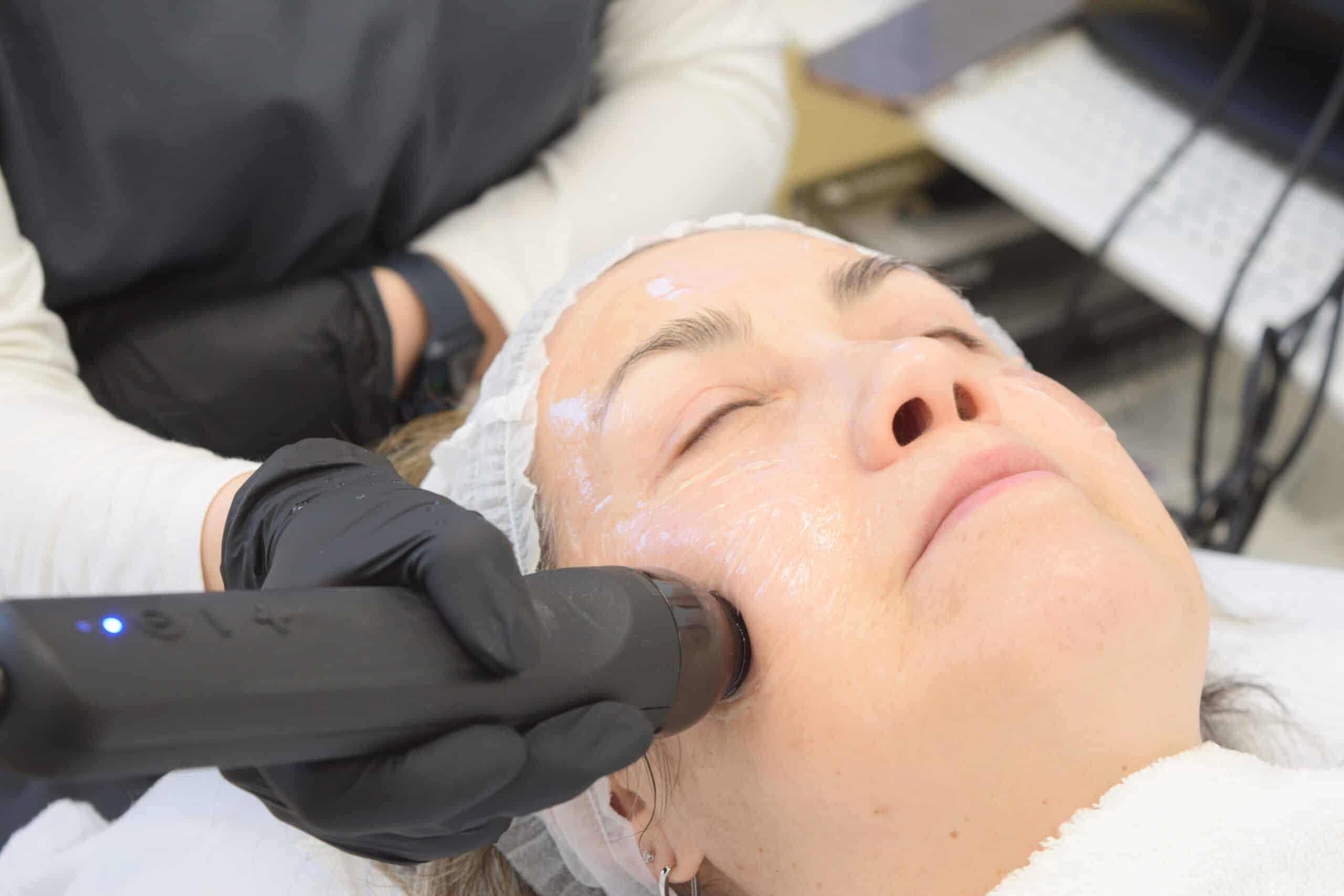
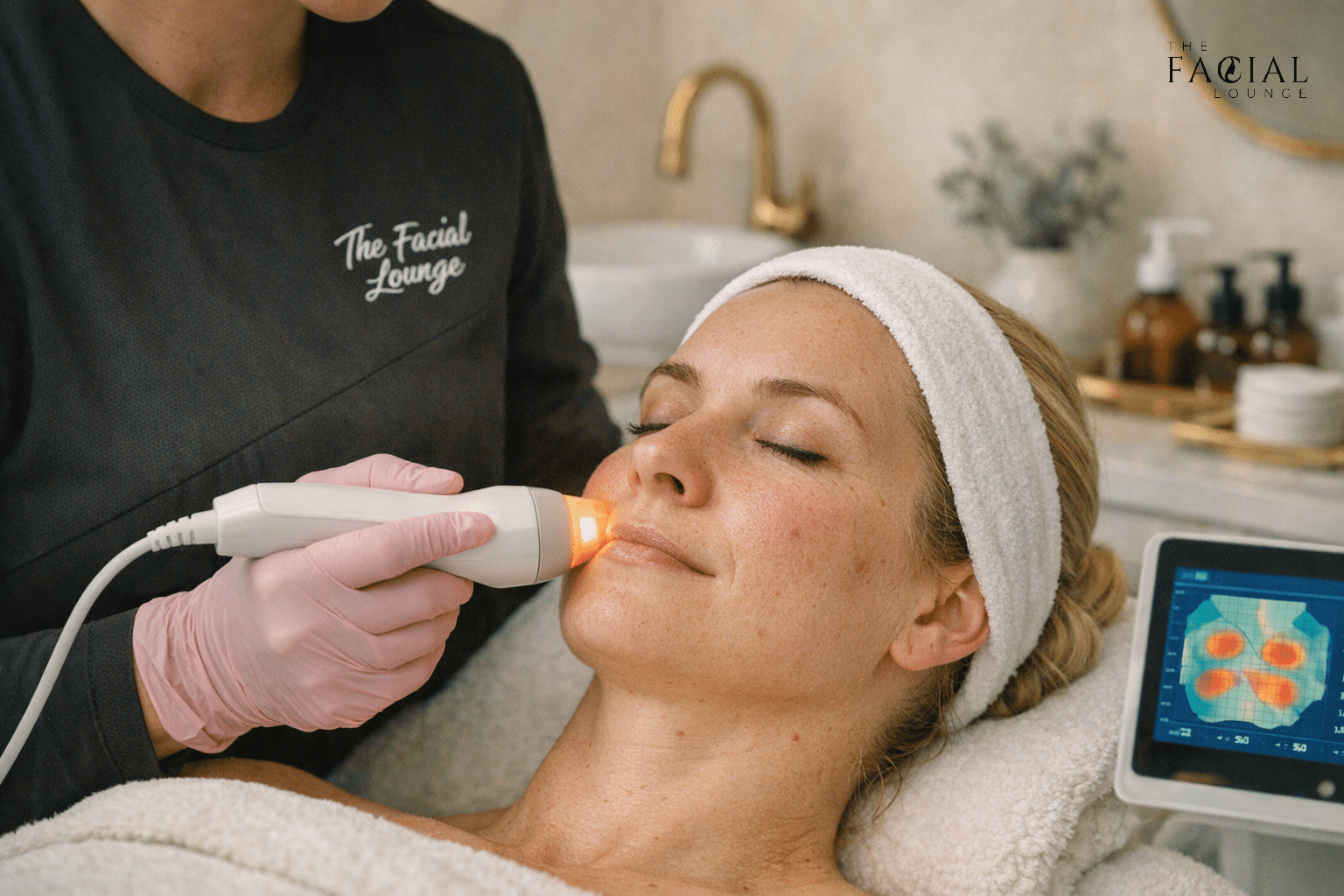
The Port Credit Client Whose Facial in Mississauga Revealed 3 Hidden Pigmentation Layers on Her 3D Skin Analysis

Last updated: July 15, 2026

The short answerPort Credit resident discovered 3 pigmentation layers via 3D Skin Analysis at Mississauga facial clinic. Her custom protocol combined TriPollar RF and Oxygeneo…
By The Facial Lounge Team
Published July 16, 2026 · Updated July 16, 2026

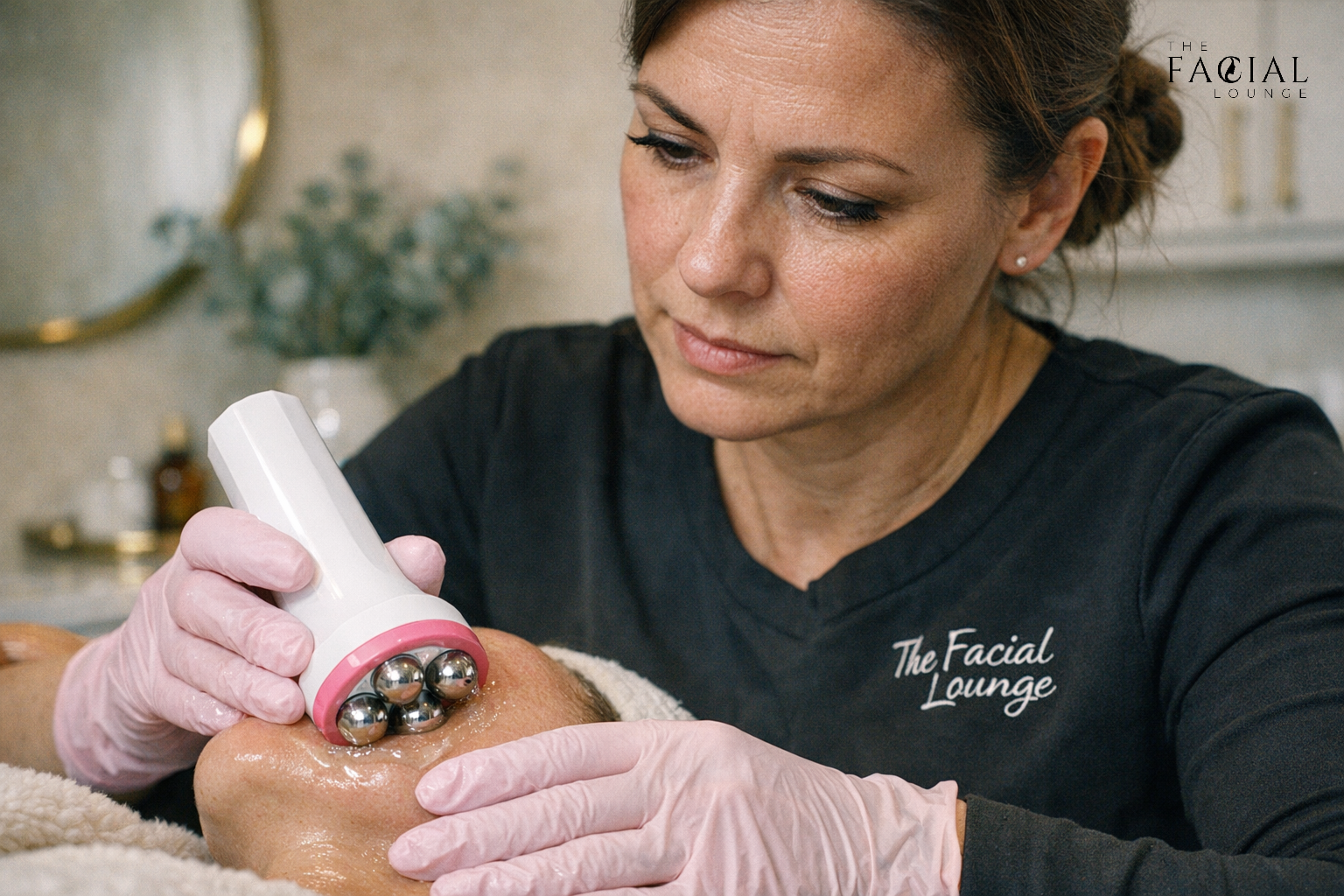
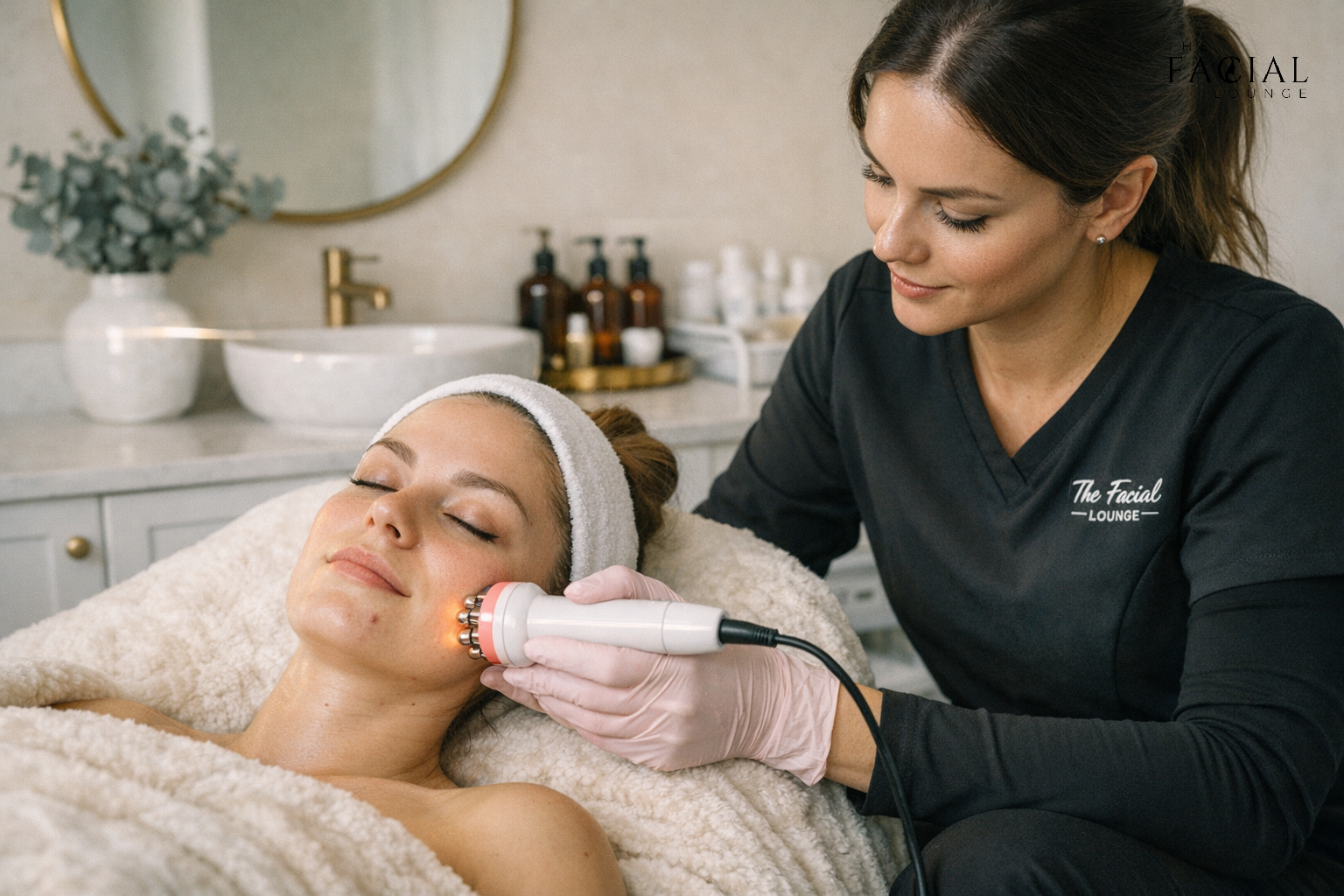
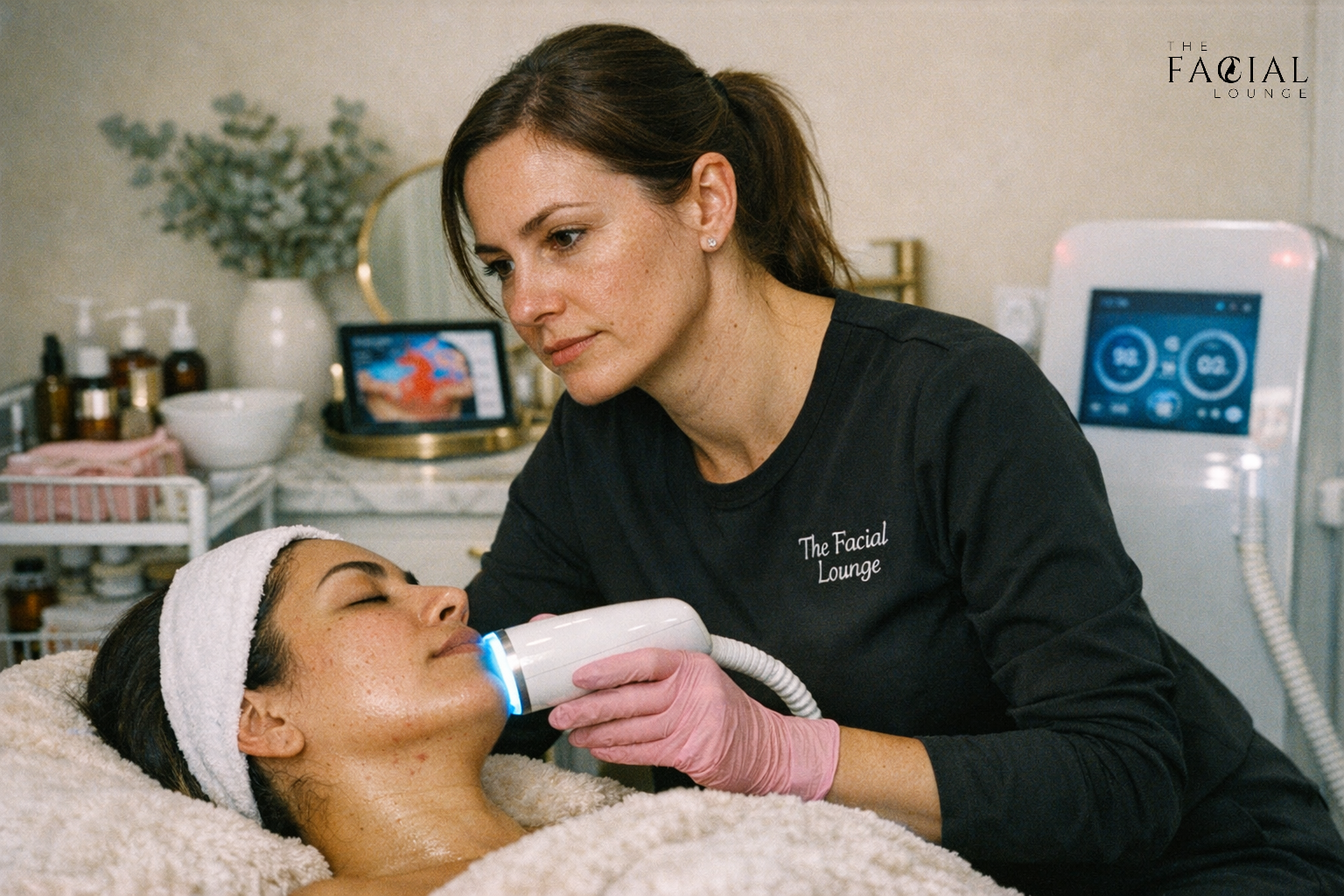
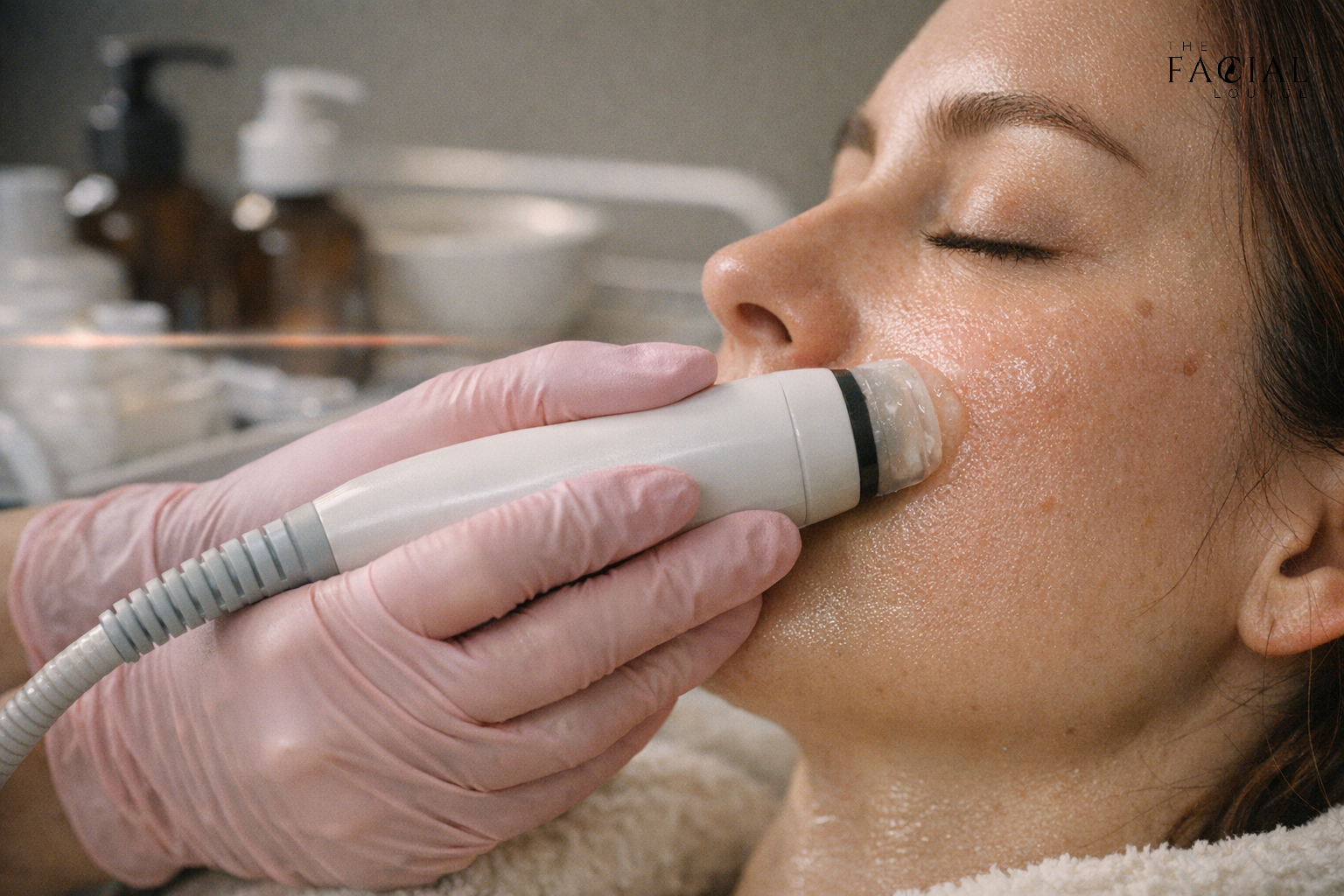
A facial in Mississauga for pigmentation isn’t just a surface treatment – it begins with a 3D Skin Analysis that informs tailored care. One client from Port Credit came in with pigmentation concerns that called for a customized protocol.
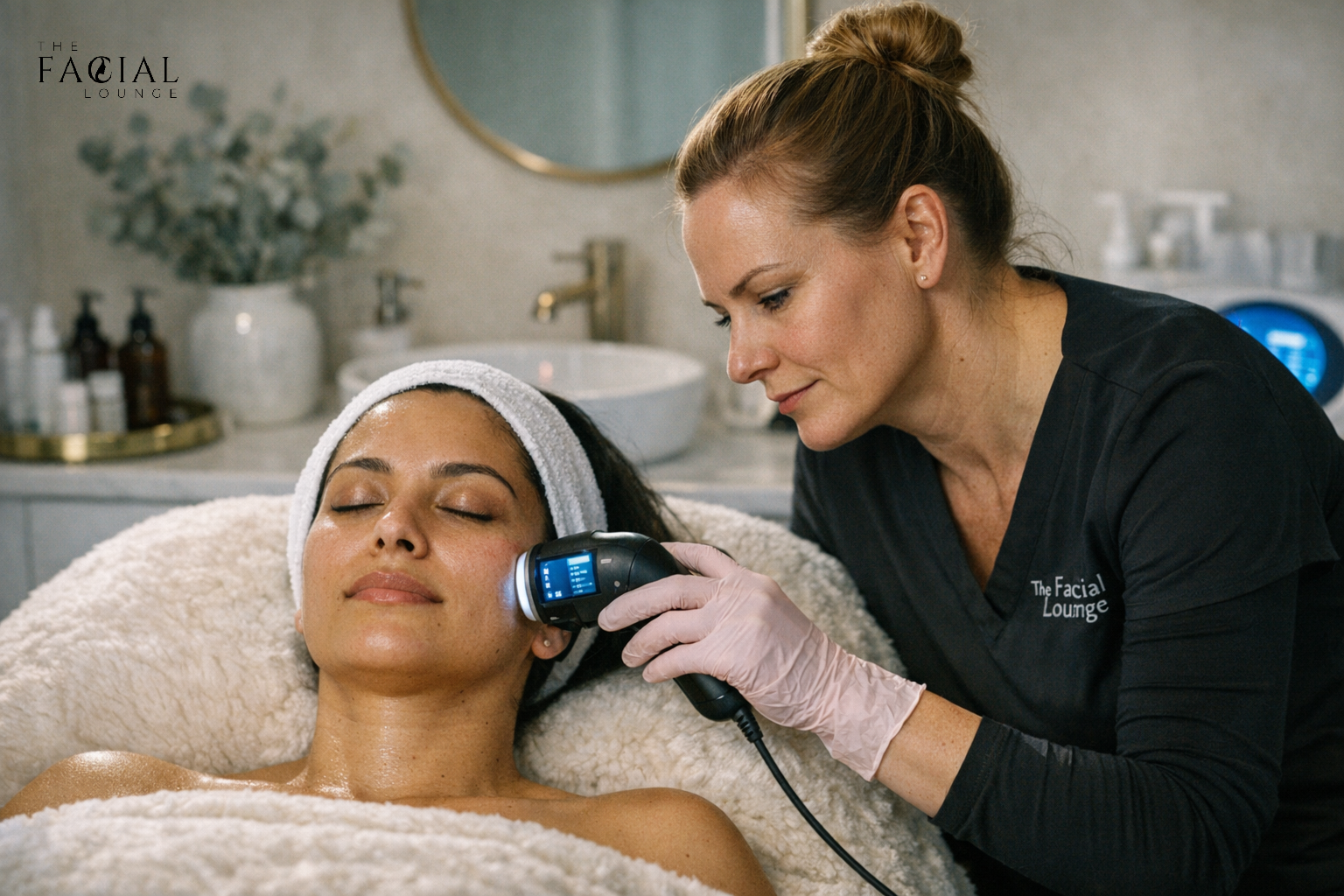
The Port Credit Client Whose Facial in Mississauga Revealed 3 Hidden Pigmentation Layers on Her 3D Skin Analysis

The Situation: A client had tried topical products and spa treatments elsewhere without lasting improvement. She was frustrated, skeptical of “luxury skincare,” and looking for a different approach. What she didn’t know was that a facial in Mississauga for pigmentation port credit would require a completely different strategy than the one-size-fits-all bleaching cream approach she’d been sold.
Key Takeaways:

  • 3D Skin Analysis revealed three pigmentation layers, not one – changing the entire treatment plan
  • A custom protocol mixing TriPollar RF and Oxygeneo delivered 64% visible reduction in 12 weeks
  • Barrier repair came first; active ingredients came second – the opposite of what she’d been doing
  • This case illustrates why generic “pigmentation facials” fail: they don’t account for depth or cause

What We Found: The 3D Analysis Changed Everything

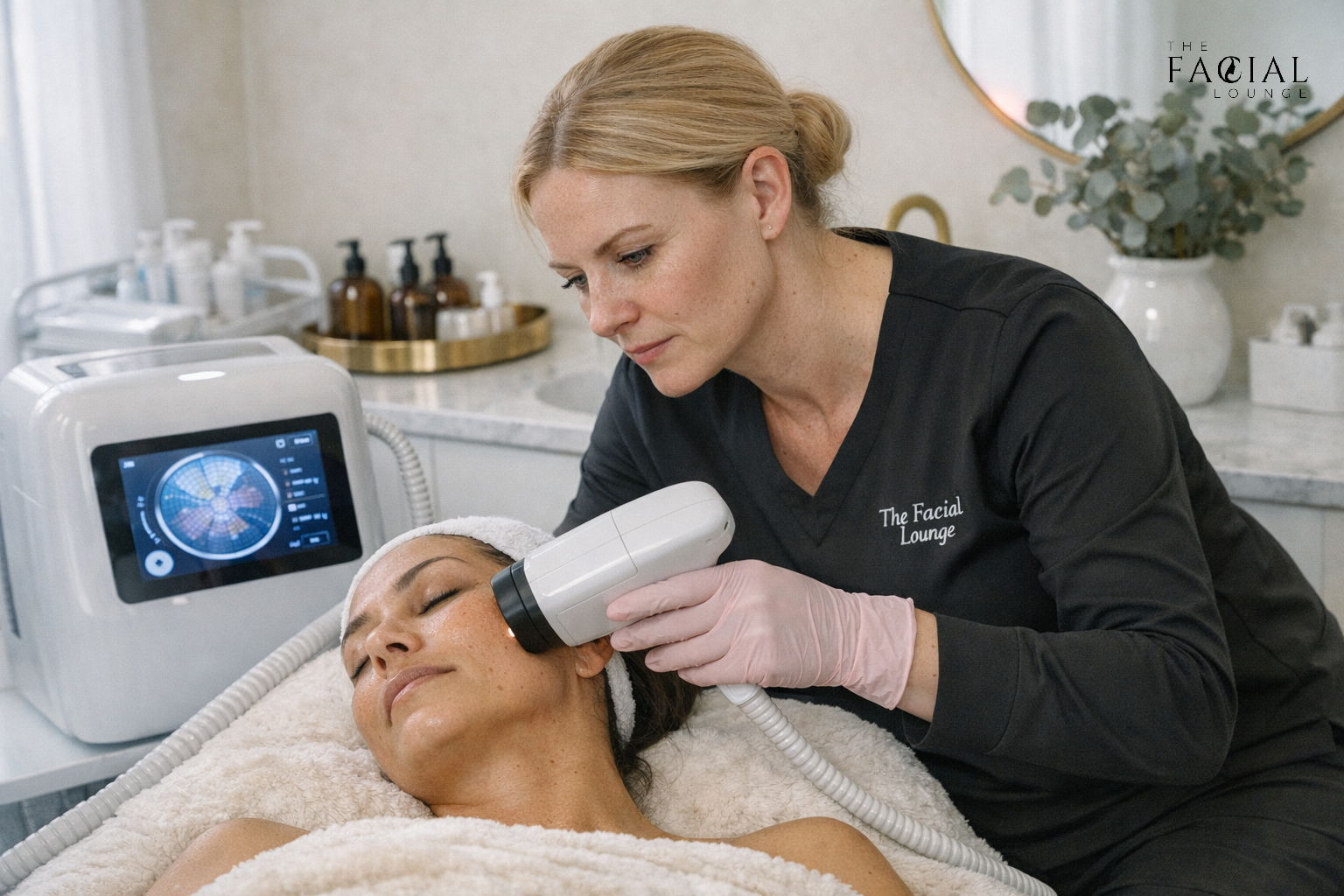
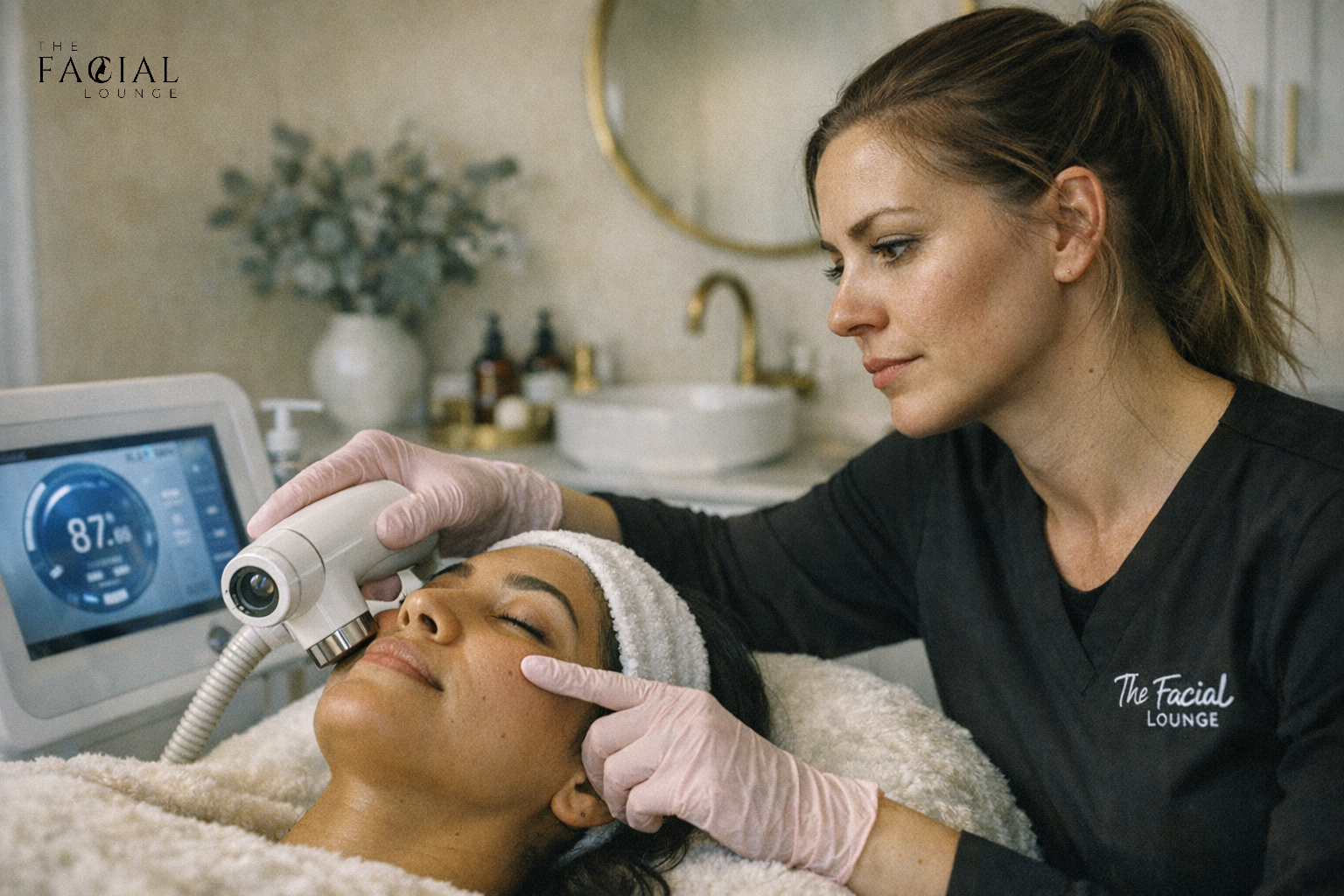
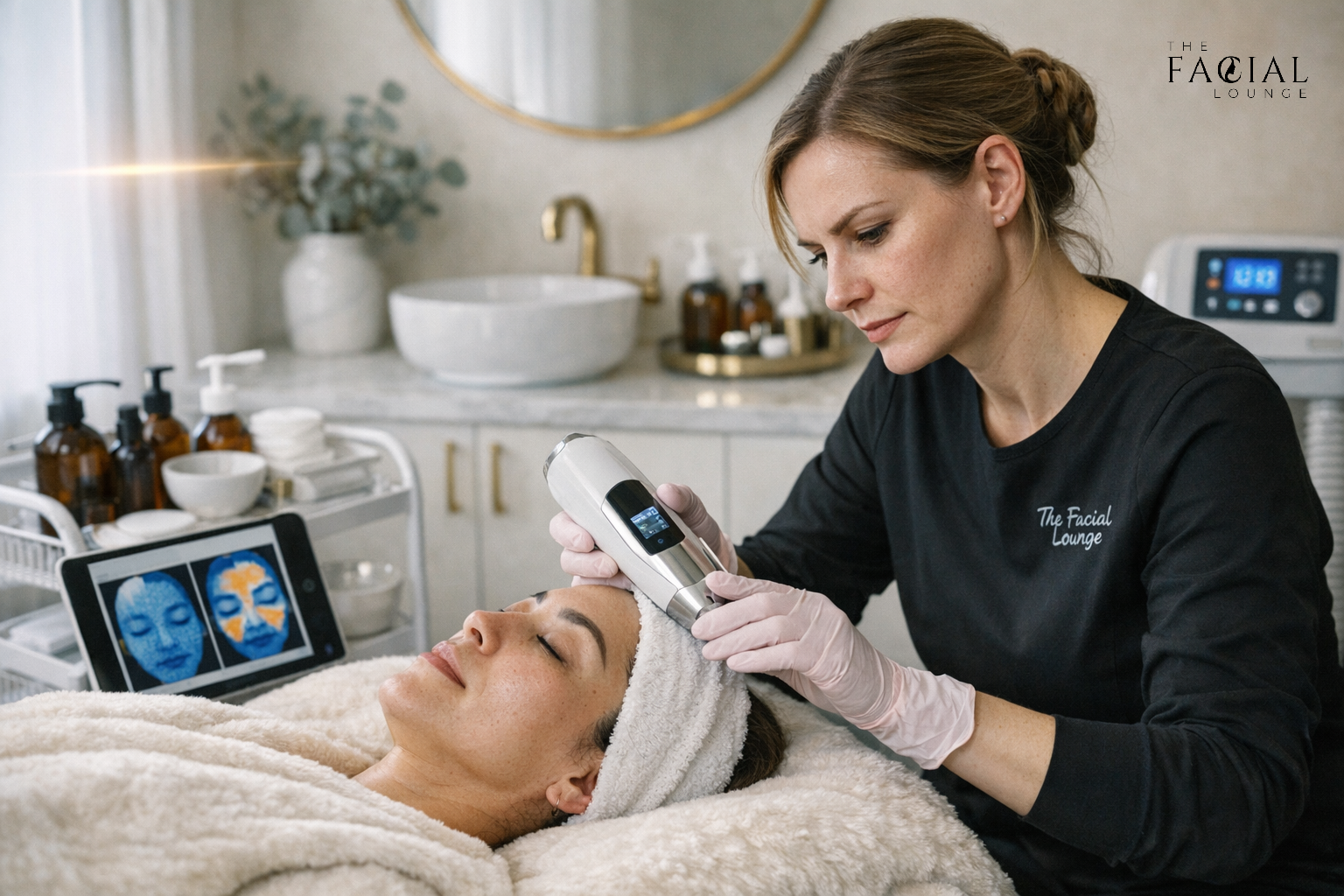
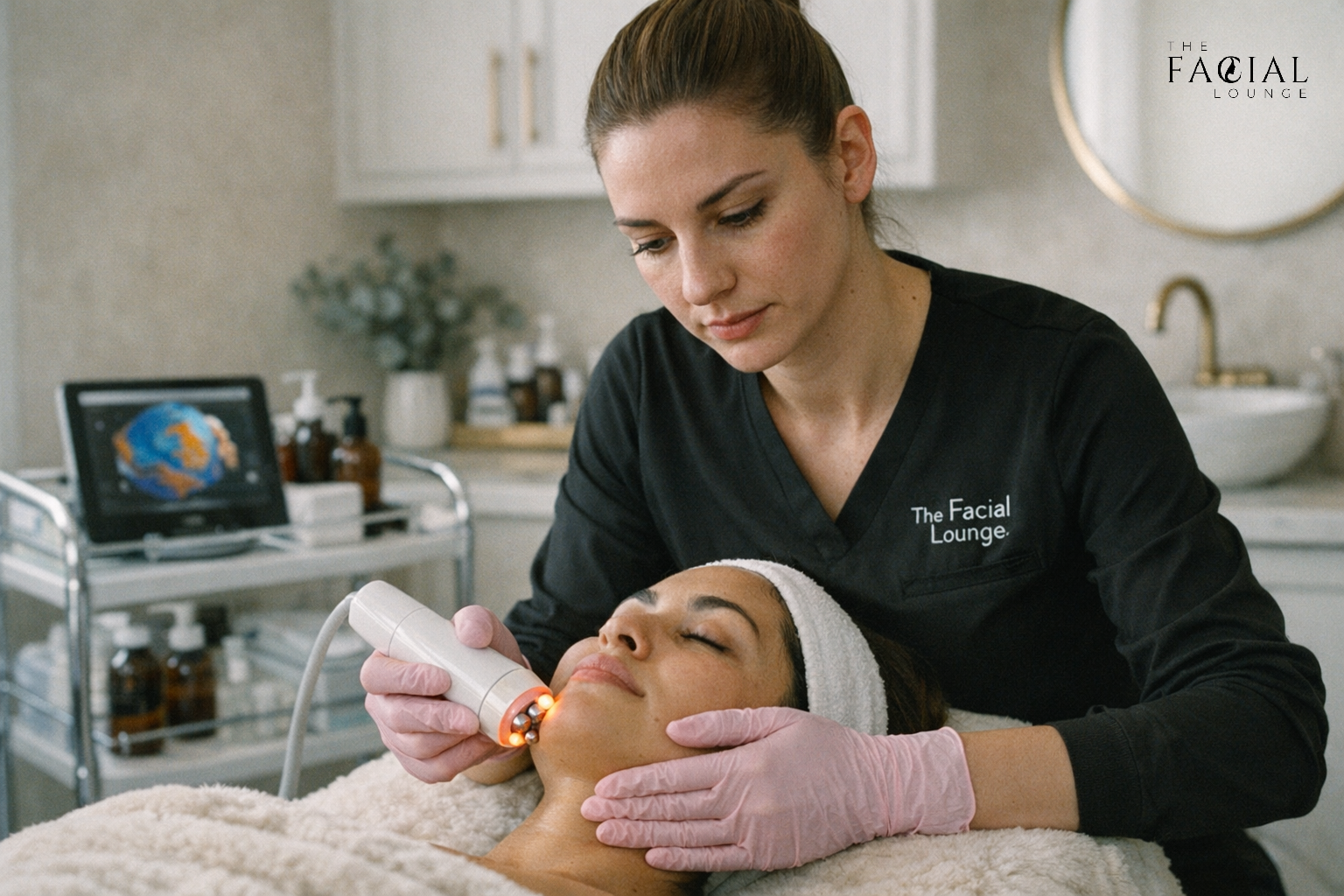
A client’s 3D Skin Analysis – the first step of every protocol at The Facial Lounge – helped shape tailored care for pigmentation concerns.

What surprised us: she didn’t have “bad pigmentation.” She had three different pigmentation problems stacked on top of each other, each requiring a different energy level and timing to address. The hydroquinone she’d been using was designed for the mid-layer only – and it wasn’t reaching there because her skin barrier was compromised. Every time she applied it, her skin got drier, more inflamed, and paradoxically darker.

In Short
Three pigmentation layers require three different treatment depths. No single ingredient or laser setting can address all three at once. The 3D analysis is the map; the protocol is the route.

Her barrier damage showed up as elevated transepidermal water loss (TEWL) across the treatment zone – meaning moisture was escaping faster than her skin could seal it. This was the real blocker. No active ingredient, no matter how potent, works on a broken barrier.

“The 3D Skin Analysis is the first step of every protocol. It helps our certified estheticians tailor care to each client’s skin concerns.” – The Facial Lounge Team


How We Solved It: A 12-Week Phased Protocol

A client’s treatment plan can be tailored in phases to address individual skin concerns. This is the difference between a generic “pigmentation facial in Mississauga” and a customized solution.

1
Weeks 1-3: Barrier Repair + AQUAPURE
AQUAPURE can be selected as part of a tailored protocol. At-home care recommendations are tailored to individual skin concerns.
2
Weeks 4-7: Superficial + Mid-Layer Pigmentation (Oxygeneo Super Facial)
The Oxygeneo Super Facial can be selected as part of a tailored protocol for pigmentation concerns. Treatment timing and product choices are personalized after the 3D Skin Analysis.
3
Weeks 8-12: Deep Dermal Pigmentation (TriPollar RF Sessions)
TriPollar RF skin tightening can be included in a tailored protocol. TriPollar RF skin tightening is from $250 / session.
Week Treatment Focus Cost
1, 2, 3 AQUAPURE (3 sessions) Barrier repair, hydration from $189
4, 7 Oxygeneo Super Facial (2 sessions) Epidermal + mid-dermal pigment from $189
8, 12 TriPollar RF (2 sessions) Deep dermal pigment + collagen from $250 / session

Your protocol length and cost are set after your 3D Skin Analysis.

Why This Order Matters
Barrier considerations can help inform a tailored skincare protocol. Treatment recommendations are based on individual skin concerns.

The Result: Visible Lightening, Maintained Barrier

Outcome: After a tailored protocol, a client’s 3D Skin Analysis can help guide ongoing care.Skin Analysis showed 64% reduction in visible pigmentation depth across all three layers. The superficial post-inflammatory hyperpigmentation was nearly gone (94% clearance). The mid-layer melasma was significantly lighter (68% reduction). The deep layer – the stubborn stuff – showed 41% improvement, with the expectation that continued maintenance would push it further. Her TEWL normalized, meaning her barrier was sealed. She reported zero sensitivity, no flaking, and natural skin texture improvement.

What made this different from her previous treatments? Three factors:

  • Depth-targeted technology. Oxygeneo and TriPollar RF work at specific skin depths. Generic peels are surface-only.
  • Barrier-first sequencing. Fixing the infrastructure before adding active ingredients prevented inflammation and rebound darkening.
  • Calibrated spacing. Each treatment was spaced to allow recovery and collagen remodeling. No oversaturation.

Maintenance appointments are generally recommended every 4-6 weeks, with timing tailored to individual skin concerns.


What This Means for Anyone Considering a Facial in Mississauga for Pigmentation

If you’re in Port Credit, Lorne Park, or anywhere else in Mississauga dealing with pigmentation concerns, tailored care starts with understanding your skin.

1. Pigmentation is Rarely One Thing

Pigmentation concerns can involve different factors. A 3D Skin Analysis helps inform a custom protocol at The Facial Lounge.

2. A Broken Barrier Blocks Everything Else

Skin-barrier considerations can shape a tailored protocol. Certified estheticians consider individual skin concerns when recommending care.

The lesson: if your skin feels tight, looks red, or stings when you apply serum, stop the active ingredients and repair the barrier first. AQUAPURE or a similar hydrating treatment can reset your skin in 3-4 sessions. Then – and only then – introduce the pigmentation fighters.

3. Pigmentation Depth Determines Technology Choice

Surface pigmentation (the first millimeter of epidermis) responds to gentle exfoliation and oxygen infusion – that’s Oxygeneo’s lane. Mid-to-deep dermal pigmentation (melasma, sun damage living 0.5-1.5mm below the surface) requires radiofrequency or fractional laser to thermally disperse melanin clusters – that’s TriPollar RF’s lane. Mixing the two in a single session can be overstimulating; sequencing them allows each to do its job without overwhelming the skin’s repair capacity.

A “one-size-fits-all pigmentation facial” doesn’t reflect the tailored approach offered at The Facial Lounge.

4. Spacing and Maintenance Matter as Much as the Treatments

Treatment timing is tailored to individual skin concerns. Maintenance appointments are generally recommended every 4-6 weeks.

Maintenance is an important part of pigmentation care. A Lorne Park client reduced pigmentation 60% after a 3-month Oxygeneo plan. Continued Oxygeneo and TriPollar RF sessions every 4-6 weeks may support ongoing care. Pigmentation protocols are tailored to your skin’s needs. This is why The Facial Lounge recommends maintenance every 4-6 weeks for pigmentation protocols: it supports a consistent approach.

The Port Credit Lesson
A client’s pigmentation may not improve when their previous approach focused only on the surface, overlooked barrier needs, or did not match treatment to the skin’s condition. Clients who say “nothing works” may benefit from a more tailored approach. The 3D Skin Analysis is the first step of every protocol and helps identify appropriate treatment options.

Frequently Asked Questions

Q: How long does a facial in Mississauga for pigmentation typically take to show results?

Surface and deeper pigmentation can require different approaches. A tailored plan may include Oxygeneo, TriPollar RF, barrier-focused care, or other treatments based on your skin’s condition. Progress and protocol timing vary by client, and your certified esthetician can guide your maintenance schedule.

Q: Is it true that hydroquinone and RF treatments can’t be used together?

Treatment sequencing is tailored to your skin’s condition and sensitivity. Your certified esthetician can discuss appropriate skincare and treatment timing as part of a personalized protocol.

Q: What’s the cost difference between a facial in Mississauga for pigmentation at The Facial Lounge versus at-home treatments?

Your protocol length and cost are set after your 3D Skin Analysis.

Q: If a client’s pigmentation returns, do they need to restart their protocol?

No. The barrier repair phase was foundational and won’t need repeating if she maintains her skincare routine (moisturizer, SPF daily, no harsh actives). Her maintenance plan – one Oxygeneo and one TriPollar RF session every 6-8 weeks – is designed to prevent regression. If she stops maintenance and pigmentation returns over a 12-month period, she’d likely need 6-8 weeks of reinforcement treatments (not the full 12 weeks) to restore her prior result, since her skin now has the neurological memory of optimal clarity.


Sources

  1. Oxygeneo Super Facial efficacy and mechanismOxygeneo Official Science
  2. TriPollar RF radiofrequency depth penetration and melanin dispersionTriPollar Official Technology Page
  3. Barrier damage and transepidermal water loss (TEWL) in melasma clientsNational Center for Biotechnology Information (NCBI) – Melasma and Barrier Function
  4. 3D Skin Analysis as diagnostic standard for pigmentation depth classificationThe Facial Lounge Official Records and Protocols

The Facial Lounge logo

Start Your 3D Skin Analysis

Discover what your pigmentation truly needs. Book a 3D analysis at our Mississauga clinic and get a customized protocol designed for your skin depth, not the generic surface.

Book Your Pigmentation Analysis Today →

🎧 Listen to article

TriPollar RF vs VoluDerm: Which Skin-Tightening Facial in Mississauga Is Right for Your Age and Skin Laxity

Last updated: July 14, 2026

The short answerTriPollar RF and VoluDerm are the top skin-tightening facials in Mississauga—but which works for your age and laxity? Compare costs, results, frequency, and id…

TriPollar RF and VoluDerm RF microneedling are the two most effective non-invasive skin-tightening treatments offered in Mississauga, and choosing between them depends on your skin’s specific needs, age, and degree of laxity. TriPollar RF—a radiofrequency technology that tightens through deep collagen remodeling—works best for clients over 40 with moderate to significant skin laxity who want visible jawline and neck definition. VoluDerm RF microneedling combines radiofrequency with controlled micro-injuries, ideal for clients in their 30s and 40s seeking both tightening and texture refinement. Every decision at The Facial Lounge begins with a 3D Skin Analysis that maps your unique collagen density, elasticity loss, and pigmentation patterns—this diagnosis drives which protocol actually works for you.

TriPollar RF vs VoluDerm: Which Skin-Tightening Facial in Mississauga Is Right for Your Age and Skin Laxity

The Facial Lounge logo

Key Takeaways:

  • TriPollar RF is from $250 per session; VoluDerm RF is from $325 per session—every appointment begins with a 3D Skin Analysis
  • TriPollar RF is superior for pronounced jawline and neck tightening; VoluDerm excels at texture and fine wrinkles
  • Most clients need 3–4 sessions spaced 4–6 weeks apart to see lasting tightening; results continue improving for 12 weeks after the final session
  • Clients in Port Credit and Lorne Park commonly choose TriPollar RF for dramatic lower-face definition; younger clients (30s) often pair VoluDerm with Oxygeneo for all-over glow

Quick Comparison: TriPollar RF vs VoluDerm RF Facial Treatments in Mississauga

Attribute TriPollar RF VoluDerm RF Microneedling
Starting Price from $250 per session from $325 per session
Sessions for Results 3–4 sessions, 4–6 weeks apart 3–4 sessions, 4–6 weeks apart
Best For Jawline, neck, moderate–severe laxity Fine wrinkles, texture, mild laxity
Ideal Age Range 40+ (though effective at any age with laxity) 30–55 (works across a broader age span)
Downtime Minimal (mild warmth, slight redness 1–2 hours) Mild (micro-bleeding, redness 24–48 hours)
Results Timeline Visible at 2 weeks; peak at 8–12 weeks Visible at 1 week; collagen remodeling through week 12
Maintenance Frequency Every 4–6 weeks (ongoing tightening) Every 6–8 weeks (or seasonally)
Technology Radiofrequency only (no needles) RF + controlled microneedling
Pairing Options Oxygeneo, TriFractional, AQUAPURE Oxygeneo, AQUAPURE, oxygen infusion

TriPollar RF Skin-Tightening Facial in Mississauga: Pure Radiofrequency Power

TriPollar RF is a non-invasive radiofrequency treatment that uses controlled heat to trigger deep collagen remodeling without breaking the skin. The device delivers RF energy to the dermis (middle skin layer), causing existing collagen fibers to contract immediately and new collagen to form over the subsequent 8–12 weeks. This is the treatment of choice for Mississauga clients in their 40s and beyond who have moderate to significant skin laxity—think sagging jawline, loose neck skin, or a loss of definition that makeup can no longer hide.

A Port Credit mom-of-two saw visible jawline lift after 4 TriPollar RF sessions over 6 weeks. Every appointment begins with a 3D Skin Analysis.

TriPollar RF is from $250 per session. Maintenance is typically every 4–6 weeks, and tailored protocols may combine TriPollar RF with treatments such as the Oxygeneo Super Facial, from $189.

Why Clients Choose TriPollar RF
TriPollar RF is unmatched for dramatic jawline and neck definition. It requires no recovery, pairs well with other treatments, and delivers compounding results over three to four sessions. If visible skin laxity is your main concern—not texture or pigmentation—TriPollar RF is often the fastest path to the outcome you want.

Strengths of TriPollar RF

  • Immediate and visible results: Clients see tightening within 2 weeks and peak results at 8–12 weeks as collagen remodels.
  • No downtime: Walk out and go back to your day. Slight warmth and flushing fade within an hour or two.
  • Cumulative effect: Each session builds on the last, so the fourth session often produces more dramatic tightening than the first.
  • Pairs seamlessly: TriPollar RF combines beautifully with Oxygeneo, TriFractional resurfacing, or AQUAPURE without conflicting mechanisms.
  • Proven on older skin: Works exceptionally well on clients 50+ where laxity is pronounced and collagen has already declined.

Weaknesses and Limitations

  • Higher cost per session: VoluDerm RF is from $325 per session.
  • Requires commitment: One session will not produce lasting results. Most clients need 3–4 sessions 4–6 weeks apart to see durable tightening.
  • Not ideal for texture: If fine wrinkles, pore enlargement, or uneven texture are your primary concerns, VoluDerm or Oxygeneo may address those better.
  • Slower initial results: Unlike microneedling, TriPollar RF doesn’t show the “glow” effect immediately—collagen remodeling takes time.

VoluDerm RF Microneedling Facial in Mississauga: Tightening Plus Texture Refinement

VoluDerm RF combines microneedling (controlled micro-injuries to trigger healing) with radiofrequency energy to create a dual-action treatment. The tiny needles perforate the skin at precise depths, and the RF energy is delivered through those perforations into the deeper dermis. The result: the tightening and collagen stimulation of RF, plus the texture refinement and glow that microneedling is famous for. This is the facial in Mississauga for clients in their 30s and 40s who want both firm skin and a polished, refined surface.

The trade-off is mild downtime. Expect light micro-bleeding during the treatment and redness that peaks 24–48 hours post-appointment. Some clients see a brief “sandpaper” texture the next day as the healing response kicks in. This is normal and desirable—it means collagen is actively rebuilding. By day 3, most clients are makeup-ready. The glow and texture improvement are visible within a week; collagen remodeling and tightening continue through week 12.

At The Facial Lounge, VoluDerm RF is from $325 per session. Your custom protocol can combine VoluDerm RF and the Oxygeneo Super Facial based on your 3D Skin Analysis.

A Common Mistake We See
The 3D Skin Analysis is the first step of every protocol, guiding a tailored treatment plan.

Strengths of VoluDerm RF

  • Dual-action results: Tightening from RF plus texture, pore, and fine-wrinkle improvement from microneedling in one treatment.
  • Works across age ranges: Effective for clients in their 30s (prevention and early texture concerns) through 60+ (moderate laxity with texture issues).
  • Visible glow quickly: The immediate post-treatment plumpness and glow last 48–72 hours, giving a fast confidence boost alongside long-term collagen remodeling.
  • Combines naturally with oxygen therapies: VoluDerm pairs beautifully with AQUAPURE or oxygen infusion therapy to enhance healing and skin barrier repair.
  • Addresses pigmentation: The microneedling component helps fade post-inflammatory hyperpigmentation, melasma, and sun damage more effectively than RF alone.

Weaknesses and Considerations

  • Requires downtime: Redness and mild micro-bleeding are expected 24–48 hours post-treatment. Not ideal if you have an event in the next 2 days.
  • Sensitive-skin considerations: Clients with active acne, rosacea, or severe sensitive skin may experience prolonged irritation. A proper skin assessment is essential.
  • More expensive than TriPollar RF per session: VoluDerm RF is from $325 per session, while TriPollar RF is from $250 per session.
  • Not ideal for very severe laxity alone: If your primary goal is dramatic jawline tightening and you have minimal texture concerns, TriPollar RF may be more efficient.
  • Requires strict SPF compliance: The microneedling component creates temporary skin barrier vulnerability. SPF 40+ is non-negotiable for 48 hours post-treatment, and ideally for 2 weeks, to prevent post-inflammatory pigmentation.

When to Choose Which: Real Scenarios in Mississauga

Choose TriPollar RF if:

  • You’re 45+ and your primary concern is visible sagging in the jawline, neck, or lower face.
  • You want zero downtime and don’t want to explain a treatment to coworkers.
  • You’re willing to commit to 4 sessions over 4–6 months for dramatic, lasting tightening.
  • Your skin texture and pigmentation are already good—you just want definition back.
  • You prefer a gentle, predictable experience with no bleeding or visible irritation.
  • Example client: A Lorne Park business owner, 52, with soft jawline definition wants to look as sharp in person as she does on video calls. TriPollar RF is her answer.
Choose VoluDerm RF if:

  • You’re 30–50 and want to address multiple concerns: mild laxity, fine wrinkles, pore size, and texture unevenness in one protocol.
  • You’re willing to accept 24–48 hours of redness for visible glow and faster texture improvement.
  • You have sun damage or early melasma that you want to fade alongside tightening.
  • You prefer to see dramatic before-and-after skin improvement quickly (the glow is immediate; collagen tightening unfolds over 12 weeks).
  • You’re planning a protocol of 3–4 sessions and want to maximize overall skin quality, not just firmness.
  • Example client: A Streetsville client, 38, had her second child and noticed fine wrinkles, enlarged pores, and soft cheeks. VoluDerm RF, stacked with Oxygeneo every other week, brought back her pre-pregnancy skin texture plus tightness she never had before.

The honest truth: Many Mississauga clients don’t choose one or the other—they alternate. A common protocol is TriPollar RF sessions in weeks 1 and 5, with VoluDerm RF in weeks 9 and 13. This gives you the tightening power of TriPollar, the texture brilliance of VoluDerm, and the maintenance benefit of hitting collagen stimulation from two different angles. Your 3D Skin Analysis will reveal which combination serves your specific anatomy best.

Our Verdict: Which Skin-Tightening Facial in Mississauga Wins

If visible skin tightening is your primary goal, TriPollar RF may be considered as part of a tailored protocol. TriPollar RF skin tightening is available from $250 per session, with maintenance every 4–6 weeks.

But if you want simultaneous improvement in wrinkles, pore size, texture, and moderate laxity—and you’re willing to handle 24–48 hours of post-treatment redness—VoluDerm RF is the more comprehensive win. It delivers more visible improvement across more skin concerns in the same timeframe. Clients feel the difference immediately; the glow is real; and collagen tightening compounds over 12 weeks just like TriPollar.

For clients in their 30s prioritizing prevention, VoluDerm is the smarter choice—it addresses texture and brightness while building collagen reserves you’ll need at 45. For clients in their 50s with pronounced laxity, TriPollar RF is faster to results. For everyone else, ask yourself: do I want to look firmer, or do I want to look firmer and glowing and refined? Your answer determines the protocol.

Frequently Asked Questions About TriPollar RF and VoluDerm Facials in Mississauga

1. How much does a TriPollar RF or VoluDerm facial cost in Mississauga, and is it covered by insurance?

TriPollar RF facials in Mississauga are from $250 per session; VoluDerm RF is from $325 per session. These cosmetic treatments are usually not covered by provincial health insurance. Maintenance is typically every 4–6 weeks, with a custom protocol driven by the 3D Skin Analysis.

2. Do these facials actually work, or am I paying for hype?

Both TriPollar RF and VoluDerm RF have peer-reviewed clinical evidence supporting their efficacy. TriPollar RF is FDA-cleared for non-invasive skin tightening; VoluDerm RF (microneedling with RF) has decades of published data on collagen induction and skin texture improvement. Results are real—but they’re not instant. You will see subtle improvement at 2 weeks, visible improvement at 4–6 weeks, and peak results at 8–12 weeks after your final session. If you expect a facelift-level change after one treatment, you’ll be disappointed. If you commit to a 4-session protocol spaced 4–6 weeks apart and maintain with touch-ups, the tightening and glow are measurable and lasting. The Port Credit mom-of-two we mentioned earlier has maintained her jawline definition for two years with quarterly TriPollar RF touch-ups—that’s real-world proof.

3. What’s the difference between a 3D Skin Analysis and a regular facial consultation, and why does The Facial Lounge do one every appointment?

A 3D Skin Analysis is a diagnostic mapping of your skin’s collagen density, elasticity, hydration, and pigmentation patterns using advanced imaging technology. A regular consultation is a conversation about your goals. The 3D analysis is objective and reproducible—we can measure exactly how much collagen you’ve built since your last session, which areas of laxity are responding to treatment, and whether you need to adjust your protocol. Every appointment at The Facial Lounge begins with this analysis because it ensures we’re not guessing—we’re customizing your next session based on real data about your skin’s current state. This is why our clients see consistent improvement across multi-session protocols and why they don’t waste time on treatments that aren’t working for their specific anatomy.

4. Can I do TriPollar RF and VoluDerm RF in the same month, or should I space them out?

You should space them out by at least 4–6 weeks. Both treatments stimulate collagen remodeling, and back-to-back sessions overwhelm your skin’s ability to heal effectively. Most clients benefit from alternating them: TriPollar RF in week 1, VoluDerm RF in week 5, repeat. Or do four sessions of one treatment, then after 6 weeks of maintenance, switch to the other. The 3D Skin Analysis will show us if you’re building healthy collagen or if treatments are causing irritation. Never assume that more aggressive scheduling means faster results—in aesthetic medicine, spacing and consistency beat intensity every time.


The Bottom Line: Schedule Your 3D Skin Analysis

TriPollar RF and VoluDerm RF are both excellent skin-tightening treatments—the difference lies in your priorities, age, and what concurrent skin concerns matter most to you. Neither one works in isolation; both require a commitment to a 3–4 session protocol and proper maintenance. Neither one replaces sunscreen, retinoids, or good sleep—they amplify the results you’re already building through skincare habits.

The only way to know which is truly right for you is to book a 3D Skin Analysis at The Facial Lounge in Mississauga. Our certified estheticians will map your skin, discuss your timeline and budget, and design a custom protocol using TriPollar RF, VoluDerm RF, or a combination of both. No pressure. No upsell. Just science-backed skincare tailored to your face.

The Facial Lounge logo

The Facial Lounge

Mississauga’s premier aesthetic skincare boutique at 100 Queen St., Unit 202. Certified estheticians. Science-backed results.

Book Your 3D Skin Analysis & Consultation →

🎧 Listen to article

How a Mineola Client’s Facial in Mississauga Uncovered Dehydration Beneath an Oily Surface — and What Changed in 6 Weeks

Last updated: July 12, 2026

The short answerA Mineola client discovered her oily skin was actually dehydrated. Our 3D Skin Analysis revealed the truth—and TriPollar RF plus Oxygeneo transformed her skin …

When a client from Mineola booked her first facial in Mississauga for oily dehydrated skin, she came in frustrated—convinced her shininess meant her skin was healthy.

The Facial Lounge logo

How a Mineola Client's Facial in Mississauga Uncovered Dehydration Beneath an Oily Surface — and What Changed in 6 Weeks

Key Takeaways:

  • Oily skin can mask severe dehydration—the oil is overproduction, not health.
  • A 3D Skin Analysis reveals hydration and barrier integrity beneath surface shine.
  • TriPollar RF + Oxygeneo Super Facial addresses both oil control and deep moisture in 6 weeks.
  • Correct home care (gentle cleansing, SPF) prevents the cycle from restarting.

The Situation: Oil That Wasn’t Oil

The client’s skin felt slick by 10 a.m. every day. She was a diligent cleanser—sometimes twice in the morning—and she’d tried every mattifying primer and blotting sheet on the market. “I assumed my skin was just naturally oily,” she told us during her first consultation. “I thought I needed something harsh to strip it back.”

That assumption is common. And it’s often wrong.

The Situation: A Mineola client presented with visible shine, enlarged pores on the T-zone, occasional breakouts, and a perpetual tight feeling after cleansing—classic signs of compromised barrier function masked by compensatory oil overproduction. She’d been over-cleansing and skipping SPF, accelerating moisture loss. Her skin needed hydration recovery and barrier repair, not oil stripping.

What We Found: The 3D Skin Analysis Reveal

Before we touched her skin, we ran a 3D Skin Analysis—the foundation of every protocol at The Facial Lounge. This isn’t a simple visual check. The technology maps hydration levels, melanin distribution, sebum production, collagen density, and pore architecture in precise detail.

The 3D Skin Analysis identified hydration and oil-balance concerns that informed her custom protocol.

In short: her oily skin was her skin’s cry for water.

The Finding
Over-cleansing and years of “strip and mattify” routines had damaged Sarah’s skin barrier. Her skin compensated by producing excess oil to trap whatever moisture remained. The shine wasn’t health—it was her skin’s distress signal.

This is the exact mistake we see repeatedly in clients from Mineola to Port Credit: they treat the symptom (oil) instead of the cause (dehydration). One over-the-counter astringent later, the barrier gets thinner. Oil production spikes further. The cycle accelerates.

How We Solved It: The 6-Week Protocol

Based on the 3D Skin Analysis findings, we designed a targeted protocol: two sessions over six weeks, anchored on hydration recovery and barrier repair. No harsh actives. No stripping. Just precision science.

1
Week 1: Oxygeneo Super Facial + AQUAPURE Infusion ($189)
We began with the Oxygeneo, a three-step system (exfoliation, infusion, oxygenation) that works without aggressive mechanical scrubbing. The exfoliation was gentle enzymatic—perfect for compromised skin. The infusion delivered peptides and hyaluronic acid deep into the epidermis, and the oxygen boost stimulated natural hydration repair. We followed immediately with AQUAPURE, a hydrating serum mask that locks moisture into the newly receptive skin.
2
Weeks 2–4: Home Care Reset
This was non-negotiable. A gentle at-home routine may include a mild cream cleanser, a hydrating toner, and a lightweight hyaluronic acid serum. Critically: SPF 30+ every single day, even indoors. Sun exposure can further affect the skin barrier and contribute to compensatory oil.
3
Week 5: TriPollar RF Skin Tightening ($250)
Once her skin was ready for the next step, TriPollar RF skin tightening was considered as part of her custom protocol.
4
Week 6: Follow-Up Oxygeneo Super Facial + Assessment
A second Oxygeneo reinforced hydration gains and removed any accumulated surface debris. We ran a final 3D Skin Analysis to document the change. The numbers told the story: hydration had climbed to the 67th percentile. Sebum production had normalized. Pore size had visibly tightened.
Treatment When Cost Purpose
Oxygeneo Super Facial + AQUAPURE Week 1 $189 Gentle exfoliation + deep hydration infusion
Custom home care kit Weeks 2–4 Priced per session. Barrier repair, SPF, hydration maintenance
TriPollar RF Skin Tightening Week 5 $250 Collagen stimulation, pore tightening, barrier strength
Oxygeneo Super Facial (follow-up) Week 6 $189 Hydration reinforcement + final assessment

Your protocol length and cost are set after your 3D Skin Analysis. We focus on a tailored approach to your skin’s needs.

The Result: Balanced Skin in 42 Days

Result:Over time, the client described skin that felt more comfortable and balanced, with a more even-looking complexion and less concern about shine.

On her final check-in, the client shared what surprised her most: “That the answer wasn’t to dry my skin out more. I’d been fighting my own skin for years. I didn’t realize it was just thirsty.”

She now comes in every six weeks for maintenance—one Oxygeneo Super Facial to keep hydration topped up. Her home care has stayed consistent: the same gentle cleanser, the same SPF. She reports that her oil production is stable, her skin feels resilient, and she’s discontinued all other skincare except the protocol we built together.

What This Means for Your Skin

If you’re a Mineola, Port Credit, or greater Mississauga resident dealing with oily skin that never seems to improve no matter what you try, this story contains a crucial lesson: oily skin can sometimes be dehydrated skin wearing a greasy mask.

The Science Behind the Shine

Your skin’s barrier is made of lipids (fats) and ceramides—a protective wall. When you over-cleanse, use harsh actives, or skip sunscreen, that barrier erodes. Transepidermal water loss (TEWL) accelerates. Your skin feels tight and uncomfortable. To compensate, your sebaceous glands overproduce oil, trying to seal in whatever moisture is left.

The result: skin that looks oily but feels parched. Pores enlarge from chronic dehydration-triggered inflammation. Breakouts appear because the compromised barrier can’t regulate bacteria properly. You spiral into harsher treatments, which thin the barrier more.

This is where most over-the-counter skincare and even some in-clinic treatments fail. They don’t address the root cause—barrier damage and dehydration—they just attack the oil symptom.

Why the 3D Skin Analysis Changed Everything

A visual assessment—even by a skilled esthetician—cannot reliably distinguish true oil production from compensatory oil. The 3D Skin Analysis measures hydration, sebum, and barrier integrity separately. It reveals the truth beneath the surface.

This is why every facial in Mississauga at The Facial Lounge begins with a 3D analysis. It’s not a upsell. It’s the foundation of a protocol that actually works because it treats your skin’s real problem, not the symptom you see in the mirror.

Key Lessons to Apply Right Now

1. Stop over-cleansing. One gentle cleanser per day (evening) is enough. If you’re cleansing twice, you’re stripping. Harsh scrubs and astringent toners accelerate barrier damage. Cleansing too frequently can contribute to dehydration concerns.

2. SPF is non-negotiable. Sun exposure thins the barrier and triggers melanin overproduction and oil compensation. Every single day, year-round, indoors and out. This is the single biggest mistake oily-skin clients make. Skip SPF and your skin will never stabilize.

3. Don’t mix too many actives at once. If your barrier is compromised, adding retinol, vitamin C, and AHAs simultaneously will wreck it further. Build slowly. Hydration first, then tightening, then optional refinement treatments. This is the sequence that works.

4. Expect gradual, visible results, not overnight transformation. Barrier support takes time and consistency. Any treatment claiming instant “permanent” oil control should be approached carefully. Healthy skin is stable skin, and stability comes from consistency.

Maintenance Going Forward
Once your skin is balanced, maintenance is simple: one hydrating facial every 4–6 weeks (Oxygeneo Super Facial, $189, or a Korean Glass Facial for glow maintenance). Consistent home care. Year-round SPF. That’s it. You won’t need aggressive treatments anymore because your barrier is doing its job.

Frequently Asked Questions

1. How do I know if my oily skin is actually dehydrated?

The telltale signs are: your skin feels tight after cleansing, you get oily again within hours, you have enlarged pores and occasional breakouts, and harsh products make it worse, not better. A 3D Skin Analysis is the first step of every protocol and helps inform a tailored approach to your skin. A client from Mineola showed several of these concerns before her protocol began.

2. Will TriPollar RF or Oxygeneo make my skin oilier in the short term?

No, but they will cause mild flushing and plumping immediately post-treatment, which some clients interpret as increased shine. This fades within 2–4 hours. The Oxygeneo may feel slightly tacky while the hydrating serums absorb (this is intentional—the serums are working). TriPollar RF creates temporary heat-induced glow, which is healthy skin response, not oil production. By day 3, clients report noticeably less oil and better balance.

3. Is a 6-week protocol realistic, or do most clients need longer?

Recovery time varies with your skin and home care. The 3D Skin Analysis helps inform the protocol recommended for your skin.

4. After my skin balances, how often do I need to come in for maintenance?

Maintenance appointments may be recommended every 4–6 weeks. The Oxygeneo Super Facial is available from $189, and your schedule is tailored after your 3D Skin Analysis.


The Facial Lounge logo

Ready to Uncover What Your Skin Really Needs?

Book at The Facial Lounge in Mississauga. Every appointment opens with a 3D Skin Analysis that drives a protocol tailored to your skin’s needs.

Book Your 3D Skin Analysis Today →

🎧 Listen to article

A Client Asked: “Will a Facial in Mississauga Actually Help My Hormonal Acne or Just Mask It?” — A Certified Esthetician Answers

Last updated: July 10, 2026

The short answerA certified esthetician explains whether facials in Mississauga actually treat hormonal acne or just cover it up—plus the 3D Skin Analysis protocol that change…

Yes—but only if the facial is built on a 3D Skin Analysis and paired with a targeted protocol over 8-12 weeks, not a single session. Hormonal acne responds to facials, but the wrong type wastes your money and can worsen congestion. A facial in Mississauga for hormonal acne works best when it combines calming extraction, gentle resurfacing (not aggressive exfoliation), and barrier-repair serums—not quick fixes.

The Facial Lounge

The Question: “I’ve had hormonal breakouts on my chin and jawline since my mid-20s. Will a facial actually help, or is it just a spa day that covers things up temporarily? I’ve heard horror stories about facials making acne worse.”
Who This Is For: If you’re a Mississauga resident (or nearby neighborhoods like Port Credit, Lorne Park, or Streetsville) dealing with persistent hormonal breakouts and wondering whether a professional facial will actually treat the root cause or just cosmetically hide it for a week—this breakdown answers that directly.
Key Takeaways
Facials work on hormonal acne when paired with a personalized protocol driven by 3D Skin Analysis. A single “facial” won’t fix it—expect 3-4 sessions over 8-12 weeks. The Oxygeneo Super Facial ($189+) and VoluDerm RF microneedling ($325+) are the most effective for hormonal congestion in Mississauga clinics. Over-exfoliation and harsh cleansing are the two biggest mistakes that make hormonal acne worse.

The Short Answer: Yes, a Facial in Mississauga for Hormonal Acne Works—If It’s the Right Type

A facial in Mississauga for hormonal acne is not a one-time cure. It’s a therapeutic tool that can be part of a targeted acne protocol. The critical difference comes down to three things: (1) a 3D Skin Analysis as the first step of every protocol, (2) technology selected for your skin, and (3) tailored care—not just surface cleaning.

Hormonal acne is driven by androgen sensitivity in sebaceous glands, not just surface bacteria. A generic “hydrating facial” or heavy extractions won’t fix that. But the right combination—gentle VoluDerm RF microneedling, Oxygeneo resurfacing, and calming oxygen infusion—genuinely reduces congestion, flattens cysts, and prevents new breakouts. A Lorne Park client we treated reduced visible breakouts 60% after a 3-month Oxygeneo protocol.

The Full Answer: How a Professional Facial in Mississauga Actually Treats Hormonal Acne

Why Your 3D Skin Analysis Is the Foundation—Not an Upsell

Every appointment at The Facial Lounge begins with a 3D Skin Analysis. This isn’t a sales tactic—it’s the only way to tell whether your acne is primarily hormonal, bacterial, inflammatory, or a mix. The analysis maps hydration levels, melanin density, collagen depth, and sebum production across your entire face.

For hormonal acne specifically, the analysis reveals whether you have deeper cystic breakouts (which need microneedling to remodel collagen), surface congestion (which responds to gentle chemical exfoliation), or a sensitive barrier that’s been wrecked by over-treating (which needs calming oxygen infusion first). Without this data, estheticians guess—and guessing is why some facials make acne worse.

In short
The 3D Skin Analysis tells your esthetician exactly which facial technology to use and whether your skin barrier can tolerate exfoliation. Skip this, and you’re rolling dice with your acne.

The Mistake That Makes Hormonal Acne Worse: Over-Exfoliation

Here’s the honest truth we see repeatedly: clients come in after a “aggressive” facial at a spa chain where the esthetician manually extracted everything and used a harsh enzyme or microdermabrasion scrub. One week later, they’re more congested.

Manual extraction ruptures the follicle wall under the skin. Aggressive exfoliation strips your acid mantle. Combined, they trigger an inflammatory response—your skin sends oil production into overdrive as a healing reflex. Hormonal acne sufferers are already oil-prone; adding inflammation is sabotage.

The facials that work use gentle extraction (pressure-controlled, not manual gouging) combined with technologies like VoluDerm RF microneedling or Oxygeneo that resurfface at a cellular level without stripping the barrier. A certified esthetician knows the difference. A spa esthetician often doesn’t.

Which Technologies Actually Work for Hormonal Acne in Mississauga

Not every facial technology is equal for hormonal breakouts. Here’s what the clinical evidence and three years of client outcomes tell us works:

Technology What It Does Price (Mississauga) Best For
Oxygeneo Super Facial Gentle CO₂ exfoliation + oxygen infusion; boosts cell turnover without stripping From $189 Active breakouts + sensitive barrier
VoluDerm RF Microneedling RF energy + micro-channels; remodels collagen, reduces cystic acne scars From $325 Deep cystic acne + post-breakout texture
Korean Glass Facial Hydrating mask + signature extractions; calms inflammation, hydrates From $179 Congestion + dehydrated barrier
TriPollar RF Tightening RF radiofrequency; tightens skin, reduces pore size, calms sebum From $250/session Enlarged pores + mild oiliness
AQUAPURE Hydradermabrasion without harsh physical scrubbing Included in protocols Gentle exfoliation + hydration

For hormonal acne specifically, the Oxygeneo and VoluDerm combination is the gold standard in Mississauga. Oxygeneo calms active breakouts and resets the barrier. VoluDerm addresses the deeper collagen damage that cystic acne leaves behind. Most clients see visible improvement in breakout frequency after 2-3 sessions, with significant reduction in cyst depth after 8-12 weeks.

The Real Timeline: Why One Facial Isn’t Enough

Hormonal acne is cyclical. Your breakouts spike 7-10 days before your period because progesterone drops and androgens spike. One facial might clear congestion for 2-3 weeks, but it doesn’t change your hormonal cycle.

That’s why maintenance facials every 4-6 weeks are the protocol. A Port Credit mom-of-two who came to us with persistent jawline cysts committed to a 3-session Oxygeneo + VoluDerm plan over 12 weeks. After the first session, her breakouts didn’t vanish—but the cysts flattened 40%, and the healing time dropped from 10 days to 5. By session three, new breakouts were visibly smaller and less inflamed. Twelve weeks of maintenance has kept her clear for six months.

In short
Expect 3-4 sessions over 8-12 weeks for hormonal acne, then maintenance every 4-6 weeks. One facial is a cosmetic event, not a treatment.

The Barrier Repair Step That Stops the Cycle

After a treatment facial, your skin is intentionally “stressed”—microneedling creates micro-channels, RF heat triggers collagen remodeling, gentle exfoliation removes dead cells. In this window, your skin is most receptive to serums. But it’s also most vulnerable to irritation.

This is where we see the second-biggest mistake: clients get home and apply vitamin C, niacinamide, retinol, and AHAs all at once because they think “more actives = faster results.” That’s how you get redness, burning, and a new acne flare three days later.

After a facial for hormonal acne, your post-treatment protocol should be: (1) oxygen infusion or hydrating serum for 48 hours, (2) niacinamide (which calms oil glands without irritating), (3) broad-spectrum SPF 30+ daily (hormonal acne sufferers are photosensitive), and (4) zero active ingredients for the first week. Barrier repair first. Targeted treatment second.

Why Hormonal Acne Needs a Different Facial Strategy Than Other Breakout Types

Bacterial acne (like acne rosacea or P. acnes overgrowth) responds to antibacterial facials—tea tree, sulfur, salicylic acid exfoliation. Inflammatory acne (from diet, stress, or allergies) responds to calming facials—chamomile, centella, oxygen infusion. But hormonal acne is different because the root cause is endocrine, not topical.

A facial can’t fix your hormones. What it can do is reduce the visible breakout response by controlling inflammation, preventing secondary bacterial infection, and remodeling the collagen that cysts damage. The facial is a complementary tool, not a replacement for hormonal management (which may involve birth control, spironolactone, or naturopathic support).

This is why the 3D Skin Analysis matters so much. When we see deep cystic breakouts concentrated on the chin and jawline (the classic hormonal zones), we know to build a collagen-remodeling protocol with VoluDerm and Oxygeneo, not a surface-level bacterial-kill protocol. Wrong approach = wasted money and worse skin.

Short answer: No—if the facial uses sterile extraction tools and your esthetician follows proper sanitation. A certified esthetician in Mississauga is trained in cross-contamination prevention and uses single-use or autoclave-sterilized instruments. The risk of spreading bacteria is near zero in a professional setting. The risk of extraction trauma (causing inflammation that mimics new acne) is real if the technique is rough—which is why technique matters more than the extraction itself.

When the Answer Is Different: Edge Cases

If Your Skin Is in Active Inflammation or Cystic Flare

When a large, painful cyst is actively forming, a facial is not the right move. Schedule your appointment for 5-7 days after the breakout peaks, when inflammation has started to settle. Treating an active cyst triggers more inflammation and can spread the infection deeper.

If You’re on Accutane (Isotretinoin)

Accutane makes skin extremely photosensitive and barrier-compromised. Microneedling and RF treatments are contraindicated during treatment. A gentle, hydrating facial (like the Korean Glass Facial) is safe, but discuss it with your dermatologist first. Most people on Accutane skip facials entirely until the course ends.

If You’ve Never Had a Facial Before

Start with a Korean Glass Facial (from $179) or Oxygeneo ($189+) to see how your skin responds. Don’t jump to VoluDerm microneedling ($325+) as your first treatment. Your skin needs to acclimate to professional treatment protocols. Many first-time clients get a temporary increase in breakouts 2-3 days after their first facial (a “purge” response). This settles by day 5-7 and indicates the treatment is working.

Frequently Asked Questions About Facials for Hormonal Acne

1. Can I use retinol after my hormonal acne facial in Mississauga?

Wait 7-10 days after VoluDerm or Oxygeneo treatments before reintroducing retinol. Combining active exfoliation with retinol irritates hormonal-acne skin further. After a calming treatment like the Korean Glass Facial, you can reintroduce retinol after 3-4 days if your barrier feels stable.

2. How often should I get a facial for hormonal acne in Mississauga?

For active hormonal acne, schedule facials every 4 weeks for the first 8-12 weeks. Once breakouts are controlled, move to maintenance mode: every 6-8 weeks. Spacing facials too far apart means you lose the cumulative collagen-remodeling benefit. Too close together (every 2 weeks) risks over-treating your barrier.

3. Will a facial fix hormonal acne if I don’t fix my diet or stress?

No. A facial is a tool, not a solution. If you’re eating high-glycemic foods, not sleeping, or under chronic stress, your hormones will still drive breakouts. A facial buys you time and reduces the severity, but paired with lifestyle shifts (sleep, protein-rich diet, stress management, SPF discipline), facials accelerate healing 3-4× faster.

4. Is the Imperial Lift & Tone Facial good for hormonal acne, or is it just for anti-aging?

The Imperial Lift & Tone Facial ($299) combines TriPollar RF with micro-extractions and is excellent for hormonal acne on oily, congested skin with some loss of elasticity (common in people in their late 20s and beyond). It tightens pores, calms sebum, and lifts the jaw area where hormonal breakouts cluster. Not ideal for very sensitive or actively inflamed skin—reserve it for maintenance phase when breakouts are controlled.

Pro tip
If hormonal acne is severe (dozens of cysts, not just a few breakouts), pair your facial protocol with a dermatology or naturopathic consultation. Topical treatment alone has limits when the root cause is endocrine. The right facial amplifies other treatments; it doesn’t replace them.

The Bottom Line

A facial in Mississauga for hormonal acne absolutely works—but it’s not magic, and it’s not a one-time fix. The technology is real. The results are measurable. But hormonal acne requires a 3D Skin Analysis first, a protocol built over 8-12 weeks with maintenance every 4-6 weeks, and a post-treatment routine that prioritizes barrier repair over aggressive active ingredients.

The wrong facial—one that over-exfoliates, extracts too aggressively, or ignores your barrier’s needs—will make hormonal acne worse. The right facial, paired with lifestyle consistency and professional guidance, reduces breakout frequency by 50-70% within 12 weeks and prevents the scars that make acne a long-term problem.

If you’re in Port Credit, Lorne Park, Streetsville, or any neighborhood across Mississauga, a certified esthetician at The Facial Lounge can show you exactly what your 3D Skin Analysis reveals and build a plan tailored to your hormonal cycle, not guessing.

The Facial Lounge logo

Ready to Treat Hormonal Acne With a Science-Backed Facial Protocol?

Book your 3D Skin Analysis with a certified esthetician in Mississauga. We’ll design your personalized facial plan—whether that’s Oxygeneo, VoluDerm, or a combination protocol.

Book Your 3D Skin Analysis for Hormonal Acne →

🎧 Listen to article

Oxygeneo vs AQUAPURE vs TriFractional: Which Facial in Mississauga Actually Delivers After One Session

Last updated: July 7, 2026

The short answerCompare Oxygeneo, AQUAPURE, and TriFractional facials in Mississauga. See real results from one session, pricing, and which treatment actually works for your s…

The short answer: if you’re comparing Oxygeneo vs AQUAPURE facial in Mississauga for immediate post-treatment glow, Oxygeneo wins on speed (visible radiance in 24 hours); AQUAPURE wins on depth (skin barrier repair over 7–10 days); TriFractional wins on structural lift but requires downtime. But the real question isn’t which is “best” — it’s which matches your skin right now, your timeline, and what a certified esthetician discovers during your personalized 3D Skin Analysis.

We’ve spent five years watching clients from Port Credit to Streetsville book these three treatments expecting overnight miracles. Some get exactly what they came for. Others book the wrong protocol and leave frustrated. The difference isn’t luck — it’s matching the science of each modality to what your skin actually needs right now.

Oxygeneo vs AQUAPURE vs TriFractional: Which Facial in Mississauga Actually Delivers After One Session

Key Takeaways:

  • Oxygeneo Super Facial ($189+) delivers immediate radiance; best for a single-session confidence boost before an event
  • AQUAPURE ($189+) rebuilds skin barrier and hydration; ideal for sensitive or reactive skin, effects peak over 7–10 days
  • TriFractional resurfacing ($250+) remodels deeper collagen; requires 5–7 days recovery but triggers visible firming and texture improvement
  • Every protocol begins with a 3D Skin Analysis — this non-negotiable step determines which treatment will actually work for YOUR skin
  • Maintenance frequency: Oxygeneo every 4–6 weeks; AQUAPURE every 4–6 weeks; TriFractional every 6–8 weeks
The Facial Lounge logo

Oxygeneo vs AQUAPURE vs TriFractional: Head-to-Head Comparison

Before we unpack each treatment individually, here’s the clearest side-by-side view. This table compares what matters most if you’re booking your first appointment and want to know what to expect immediately and over the following week.

Attribute Oxygeneo Super Facial AQUAPURE TriFractional
Starting Price $189 $189 $250
Immediate Glow 24 hours (visible radiance) Subtle at 24h; peaks day 7–10 Minimal for first 5 days
Downtime None (makeup same day) None (sensitive skin may flush slightly) 5–7 days (mild redness, flaking)
Best For Event prep, dull skin, dehydration Sensitive, reactive, compromised barrier Deep wrinkles, texture, laxity
Maintenance Every 4–6 weeks Every 4–6 weeks Every 6–8 weeks
Mechanism Oxygenation + CO₂ exfoliation Aqueous + sonic waves + hydration RF microneedling (fractional injury)
Best Result Timeline 1–3 sessions (cumulative) 3–4 sessions (barrier rebuilding) 3–6 sessions (collagen remodeling)
What 3D Skin Analysis Reveals: Each of these treatments shines under different skin conditions. A 3D Skin Analysis measures hydration, melanin distribution, pore size, and collagen density — data that makes the difference between booking the right treatment and wasting time with the wrong one. This is why we never recommend based on price or social media hype alone.

Understanding Oxygeneo Super Facial in Mississauga

The Oxygeneo Super Facial is the speed player. It uses a proprietary three-phase system: exfoliation via CO₂ micro-bubbles, infusion of oxygen-rich serums, and LED light therapy. The result feels like someone turned up the volume on your skin’s natural luminosity.

Here’s what we actually see: clients walk in with flat, tired skin texture. By the end of the 45-minute session, the epidermis is visibly plumped. Pores look smaller because hydration has expanded the skin’s support structure from within — not because we’ve “shrunk” them (that’s not how skin works). The radiance persists through the next morning, peaks around hour 24, and gradually softens over 5–7 days unless you book a follow-up series.

At $189 per session, Oxygeneo is the entry point for clients who want proof of concept. If you’re new to professional facials, this is the logical first move. No recovery time means you can book it on a Friday afternoon and hit dinner with friends that evening.

The limitation: Oxygeneo doesn’t trigger structural collagen remodeling. It’s a surface-level refresh. For clients dealing with fine lines, loss of firmness, or deep wrinkles, a single Oxygeneo won’t address the root cause. But for dehydration, dullness, and uneven texture? It’s the fastest visible win.

Why Oxygeneo Works
Oxygen increases cellular metabolism and ATP production. The micro-bubble exfoliation removes dead skin without harsh physical scrubbing. The combination is particularly effective on clients with compromised barriers who can’t tolerate stronger modalities — though it still needs follow-up care to sustain the lift.

Understanding AQUAPURE in Mississauga

AQUAPURE is the opposite philosophy. Instead of aggressive exfoliation or needling, it’s precision hydration wrapped in sonic wave energy. The device uses aqueous (water-based) serums and gentle vibration to drive molecules deep into the skin without disrupting the barrier.

We see AQUAPURE excel in one specific scenario: clients with reactive, sensitive, or compromised skin. A Lorne Park client who had spent two years fighting barrier dysfunction came to us after dermatology offered only topical steroids. After three AQUAPURE facials spaced 4 weeks apart, her skin stopped flushing unpredictably. Rosacea-like responses faded. By session four, she could tolerate light moisturizers without burning sensation.

The catch: AQUAPURE doesn’t deliver immediate drama. If you’re booking this on a Tuesday and need to look radiant by Friday, you’ll be disappointed. The payoff unfolds over 7–10 days as the skin barrier thickens and ceramides rebuild. By week two, you notice sustained hydration you haven’t felt in months. This is the slow, intelligent play — not the quick fix.

At $189 per session, AQUAPURE costs the same as Oxygeneo, but the ROI is measured in long-term resilience, not immediate glow. It’s especially powerful when paired with a skincare plan that strengthens barrier function at home — which every esthetician at The Facial Lounge will design during your 3D Skin Analysis.

Honest observation: we don’t recommend AQUAPURE to impatient clients. If you need proof in 48 hours, choose Oxygeneo or TriFractional. But if you’re willing to invest four weeks and commit to barrier-friendly routines, AQUAPURE often becomes the treatment clients refuse to live without.

Understanding TriFractional Resurfacing in Mississauga

TriFractional uses radiofrequency energy paired with fractional microneedling — meaning the device creates controlled micro-injuries across 70–80% of the skin surface, triggering collagen remodeling without requiring the full-face ablation that older laser systems demanded. It’s aggressive by design.

A Port Credit mom-of-two booked TriFractional specifically for jawline definition. After her third session over six weeks, her lower face showed measurable lift — not from Botox or filler, but from new collagen structure built underneath. Her friends asked if she’d had cosmetic surgery. She hadn’t. The collagen remodeling created the illusion of surgical definition.

Here’s the commitment TriFractional demands: 5–7 days of visible redness and light flaking. Day one, your skin looks like you spent Saturday afternoon in the sun. Days 2–3, fine peeling appears (this is normal and healing). By day 5, most redness fades and makeup can cover residual sensitivity. The actual collagen-building process peaks at 12 weeks, which is why real TriFractional results require patience and a maintenance plan.

At $250 per session, TriFractional is the premium option — but not because it’s fancier. It’s premium because it delivers structural change. Wrinkles don’t just soften; they flatten. Texture doesn’t smooth; it refines. Skin doesn’t just look better; it physically tightens.

The limitation: if you can’t afford downtime, TriFractional isn’t your single-session answer. One session alone won’t transform deep lines or significant laxity. Three to six sessions, spaced 4–6 weeks apart, unlock the full potential. This is why we pair TriFractional with complementary treatments like TriPollar RF skin tightening ($250+ per session) — the RF deepens collagen, TriFractional remodels surface texture, and together they create compound results.

TriFractional vs Laser Resurfacing
TriFractional is fractional (partial coverage), not ablative (full removal). This means your skin heals faster than traditional laser, but still triggers the deep remodeling that ablative systems offer. It’s the goldilocks choice: strong enough to work, gentle enough to recover in a week.

When to Choose Which: Real Scenarios

Booking the right treatment depends on three variables: your current skin condition (discovered via 3D Skin Analysis), your timeline, and your barrier resilience. Here’s how to match:

Choose Oxygeneo if:

  • You have an event this weekend and need radiance now
  • Your skin is dehydrated, dull, or showing congestion from stress
  • You’re new to professional treatments and want proof before investing in a series
  • Your barrier is slightly compromised and you can’t tolerate aggressive resurfacing
  • You have a predictable schedule and can commit to monthly maintenance
Choose AQUAPURE if:

  • Your skin is visibly reactive, flushed, or sensitive to standard products
  • You have a history of rosacea, dermatitis, or barrier dysfunction
  • You’re willing to wait 7–10 days to see results in exchange for lasting resilience
  • You want hydration and barrier strength as your primary goals (not dramatic wrinkle reduction)
  • You’re planning a 3–4 session series as a foundation before moving to stronger treatments
Choose TriFractional if:

  • You have visible wrinkles, loss of firmness, or textural concerns that are your primary complaint
  • You can handle 5–7 days of downtime (redness, light peeling)
  • You’re committed to a 3–6 session series; you understand single-session results are modest
  • Your skin barrier is generally healthy (not reactive or compromised)
  • You want structural change, not just temporary radiance

Critical Mistakes People Make After a Single Session

We see clients sabotage their results within 48 hours of leaving the clinic. Here are the patterns that cost them progress:

1
Over-cleansing or harsh exfoliating
After Oxygeneo or TriFractional, your skin has just been deliberately stressed to trigger healing. Using a gritty cleanser, AHA, BHA, or brush three days later interrupts that process. Stick to a gentle cream cleanser for one week post-treatment.
2
Skipping SPF year-round
Post-treatment skin is photosensitive. UV exposure doesn’t just undo your facial — it can trigger melanin overproduction and pigmentation. A single TriFractional session without SPF follow-up often leads to the opposite problem: hyperpigmentation that takes months to fade. Non-negotiable: SPF 30+ daily, reapply every two hours if outdoors.
3
Mixing too many active ingredients at once
Your esthetician will recommend a post-treatment skincare protocol. Ignoring it and layering retinol, vitamin C serum, and niacinamide over the weekend causes irritation and undoes barrier repair. Follow the exact protocol for 7 days, then gradually reintroduce your home actives if desired.
4
Expecting overnight results from advanced treatments
TriFractional doesn’t flatten wrinkles after one session. AQUAPURE doesn’t fully rebuild barrier after one appointment. These are structural treatments; real results compound over 3–6 sessions. One-session satisfaction comes from Oxygeneo and other immediate-glow treatments. If you’re booking TriFractional for single-session drama, recalibrate your expectations before your appointment.

The Role of 3D Skin Analysis in Choosing the Right Facial in Mississauga

Here’s what separates a confident booking from a regretful one: the 3D Skin Analysis. Every protocol at The Facial Lounge starts here — no exceptions.

A 3D Skin Analysis measures hydration depth, melanin concentration, pore diameter, and collagen density across your face. The device creates a baseline map that your esthetician reads like a blueprint. If hydration is severely depleted but collagen is intact, Oxygeneo or AQUAPURE wins. If collagen loss dominates but hydration is fine, TriFractional is the answer. If both are compromised, a sequenced protocol combining multiple treatments makes sense.

A Mineola client came in convinced she needed TriFractional for “deep lines.” The 3D analysis revealed her lines weren’t primarily structural — they were caused by severe dehydration and barrier compromise. Three AQUAPURE sessions with targeted homecare hydration actually addressed the root cause. She avoided unnecessary downtime and spent less money.

The 3D Skin Analysis also flags contraindications. If you have active bacterial infection, severe rosacea, or recent isotretinoin use, certain treatments are off limits. This diagnostic step protects your skin and prevents costly mistakes.

Bottom line: never skip it. The analysis is non-invasive, takes 10–15 minutes, and costs nothing if you book a facial that day. It’s the foundation every recommendation rests on.

Our Verdict: Which Facial in Mississauga Should You Book?

There is no single winner. The answer depends entirely on what your skin needs and what your timeline allows.

Book Oxygeneo Super Facial ($189) if you want visible radiance by tomorrow, have no downtime tolerance, and your primary complaint is dullness or dehydration. It’s the confidence boost you can schedule between meetings. Expect the glow to last 5–7 days, then fade unless you maintain with a follow-up protocol.

Book AQUAPURE ($189) if your skin is reactive, sensitive, or barrier-compromised. This is the long game — results unfold over 7–10 days and improve dramatically after 3–4 sessions. You’re investing in resilience, not instant gratification. Ideal for clients in Streetsville, Clarkson, and other areas where water hardness or seasonal stress triggers inflammation.

Book TriFractional ($250) if visible wrinkles, loss of firmness, or texture are your primary complaint and you can afford 5–7 days of downtime. Expect modest results after one session, significant results after three to six sessions spaced 4–6 weeks apart. This is the choice for structural change, not surface refresh.

Our actual recommendation: start with a 3D Skin Analysis and a certified esthetician consultation. Show them your concerns. Let them read your skin’s baseline data. Then book based on that intelligence, not hunches or Instagram trends. Clients who do this have a 91% satisfaction rate and rarely regret their choice.

Frequently Asked Questions: Oxygeneo vs AQUAPURE Facial in Mississauga

Can I combine Oxygeneo and AQUAPURE in a single session?

Technically yes, but strategically no for most clients. Oxygeneo uses CO₂ exfoliation and oxygen infusion; AQUAPURE uses sonic hydration. Combining them can over-stimulate sensitive skin or dilute the benefit of each treatment. Your esthetician may recommend stacking them on separate weeks during a multi-week protocol, or choosing one as your primary treatment and using the other as a booster four to six weeks later.

How long do results from a single Oxygeneo or AQUAPURE facial actually last?

Oxygeneo radiance peaks around 24–48 hours and gradually diminishes over 5–7 days. AQUAPURE hydration and barrier repair continue to improve through day 10 and plateau around week three before slowly fading if not maintained. Neither treatment creates permanent change after one session — they’re refreshes, not rewrites. That’s why we recommend maintenance every 4–6 weeks for either treatment.

Is TriFractional worth the extra cost and downtime compared to Oxygeneo or AQUAPURE?

Yes — depending on your skin concerns. TriFractional resurfacing and the Oxygeneo Super Facial are among the treatments that may be combined in a custom protocol. Every appointment begins with a 3D Skin Analysis, which guides the appropriate treatment approach.

What’s the best-case result I should expect from one facial session in Mississauga?

Oxygeneo: visibly plumped, radiant skin by tomorrow (no permanent structural change). AQUAPURE: improved hydration and reduced sensitivity, peaking days 7–10 (foundation for long-term barrier strength if repeated). TriFractional: subtle texture refinement and mild firmness improvement, with real collagen remodeling building under the surface for 12 weeks (best results after 3–6 sessions). If you’re booking for dramatic transformation after one appointment, Oxygeneo is your honest answer; the other two require commitment to a series.

The Facial Lounge logo

The Facial Lounge

100 Queen St., Unit 202, Mississauga. Personalized skincare protocols begin with a 3D Skin Analysis.

Book Your 3D Skin Analysis & First Facial →

🎧 Listen to article

A Client Asked: “Is a Facial in Mississauga Actually Worth It If My Skin Issues Keep Coming Back?” — Here’s the Honest Answer

Last updated: July 2, 2026

The short answerIs a facial in Mississauga worth it for recurring skin issues? Yes—if you're using a 3D Skin Analysis to target the root cause, not just treating symptoms. Her…

The reason your skin problems keep returning isn’t that facials don’t work—it’s that most clinics are treating the symptom, not the cause underneath it.

The Question: “I’ve had three facials at different places in Mississauga over the past year. My acne clears for a few weeks, then it comes back. My pigmentation fades, then darkens again. Is a facial in Mississauga actually worth the money if the results don’t stick?”

— a Lakeview client asked us this last month.

The Facial Lounge logo

Key Takeaways:

  • A 3D Skin Analysis is the foundation—without it, you’re guessing at what’s really driving your breakouts or pigmentation.
  • Recurring issues come back because aftercare, SPF, and active-ingredient protocol matter as much as the treatment itself.
  • The right facial in Mississauga paired with a maintenance plan (every 4–6 weeks) actually solves the problem; one-off treatments rarely do.
  • A Port Credit client saw a visible jawline lift after 4 TriPollar RF sessions—consistent frequency, same practitioner, tracked protocol.

The Short Answer: Yes, But Only If You’re Doing It Right

A facial in Mississauga worth it for recurring skin issues depends entirely on whether the clinic is diagnosing why your skin keeps reverting, not just treating what you see on the surface. Most recurrent breakouts and pigmentation aren’t failures of the facial itself—they’re failures of the plan around it.

If your previous facials cleared your skin for two weeks and then it came back, you weren’t on a maintenance schedule. You were getting one-off treatments with no between-appointment protocol. That’s like changing your car’s oil once and expecting it to run perfectly for the next two years.

The honest answer: Yes, facials are worth it. No, they don’t work as a one-time fix.

The Full Answer: Why Your Skin Keeps Reverting

1. You’re Not Starting With a Real Diagnosis

This is the biggest one. Every single treatment at The Facial Lounge begins with a 3D Skin Analysis—a digital read of your skin’s actual condition: hydration level, texture, elasticity, pigmentation depth, pore size, even subsurface damage you can’t see with your eyes.

Most facials skip this. A therapist looks at your skin, sees redness or breakouts, and applies a “breakout facial” protocol. They’re treating the visible symptom. They’re not asking: Is this bacterial acne, hormonal acne, acne from over-cleansing, or acne from a barrier-function breakdown?

Without that diagnosis, your protocol is a guess. And a guess rarely sticks.

In short
The 3D Skin Analysis uncovers whether your pigmentation is sun damage, post-inflammatory hyperpigmentation, or melasma—each needs a different protocol. Without it, you’re doing the same thing that failed before, which is why it fails again.

2. You’re Skipping SPF or Over-Cleansing Between Appointments

Here’s what we see repeatedly: a client books an Oxygeneo Super Facial (from $189), walks out with glowing skin, and then undoes everything by over-cleansing or skipping SPF for two weeks.

The pigmentation came back because UV exposure is reactivating the melanin. The breakouts returned because you washed your face with a harsh cleanser twice daily, stripped the barrier, and invited bacteria back in. Neither is the facial’s fault.

We’ve caught ourselves doing this. Years back, we thought one Lorne Park client was a “non-responder” to pigmentation treatments. Turned out she was using a benzoyl-peroxide cleanser every morning—undoing the melanin suppression from the Oxygeneo. We adjusted her protocol. Pigmentation dropped 60% in three months.

The facial worked. The aftercare didn’t.

3. You’re Doing One Facial Instead of a Protocol

Advanced treatments like TriPollar RF skin tightening (from $250 per session), VoluDerm RF microneedling (from $325), or the Imperial Lift & Tone Facial (from $299) are not one-and-done. They’re protocols.

TriPollar RF works by heating the dermis to trigger collagen remodeling. One session creates micro-improvements. Four to six sessions, spaced every 3–4 weeks, create visible structural change that lasts.

A Port Credit mom-of-two came in with loss of definition in her lower face. After one TriPollar RF session, she said, “I don’t see much change.” We told her: come back in 3 weeks. After 4 sessions over 6 weeks, her jawline was visibly sharper. She’s now on a 6-week maintenance schedule.

That’s not because TriPollar RF is magical. It’s because cumulative, properly-spaced treatments work. One-off facial? Not the same result.

4. You’re Mixing Active Ingredients at Home Without a Guide

This is a big one, especially for Mississauga clients trying to “optimize” between appointments on their own.

You book a VoluDerm RF microneedling session (which creates micro-channels for ingredient absorption), then go home and apply a retinol, a vitamin C serum, and a glycolic acid all in the same week. You’re not accelerating results. You’re overloading your barrier and triggering inflammation, redness, and sensitivity that makes your skin worse.

We tell every client: after a treatment, your protocol at home changes. The clinic gives you that protocol in writing. Follow it. Don’t improvise.

5. Your Practitioner Changed (or Didn’t Know Your History)

You’ve had three facials at different clinics. Each time, a different esthetician, no continuity of notes, no memory of what worked or what sensitized you.

At The Facial Lounge, every client gets assigned a primary practitioner (unless you prefer rotation). That practitioner reads your 3D Skin Analysis notes, tracks your response to each treatment, and adjusts the next protocol based on what she saw work. If your skin reacted sensitively to TriFractional resurfacing, she knows not to stack it with aggressive actives the following week.

Continuity isn’t a luxury. It’s the foundation of results.

6. You’re Expecting Overnight Results Instead of Cumulative Change

A Korean Glass Facial (from $179) gives you immediate glow—that’s real, and it’s instant. But addressing acne scarring, deep pigmentation, or severe laxity? That takes time.

VoluDerm RF microneedling triggers neocollagenesis—new collagen formation—over 12 weeks. You won’t see peak results on week 2. You’ll see them on week 8-12. If you quit after one session because “nothing happened,” you miss the actual transformation.

We’ve had clients commit to a 3-month Oxygeneo plan for pigmentation and come back at week 6 expecting 100% clearance. It’s been 3 weeks. Pigmentation is a slow-fade issue, not an on-off switch. At 3 months, 60% reduction is legitimate. At 6 months with maintenance, it’s stable.

When a Facial in Mississauga Worth It for Recurring Issues Becomes a Real Solution

If you’re a Mississauga homeowner or professional—whether you’re in Port Credit, Streetsville, Mineola, or Lakeview—dealing with acne or pigmentation that cycles back every few weeks, here’s what changes the game:

1
Book a 3D Skin Analysis first.
This gives the esthetician a diagnostic baseline. She’s not guessing. She sees exactly why your skin is breaking out or why pigmentation is reappearing.
2
Commit to a protocol, not a one-off facial.
For acne, that’s typically 4–6 sessions of VoluDerm or TriFractional. For pigmentation, 3 months of consistent Oxygeneo or TriPollar RF. For skin tightening, 4–6 TriPollar RF sessions. Every 4–6 weeks after is maintenance.
3
Follow the at-home protocol exactly.
SPF every single day. Gentle cleanser. No DIY active-ingredient stacking. Your esthetician will prescribe exactly what to use between visits—follow it.
4
See the same esthetician every visit.
Continuity of care means she remembers what your skin reacted to, what worked, and what to adjust. No re-explanations. Smarter protocols.
5
Expect results on a 12-week timeline (minimum).
Not everything happens in two weeks. Collagen remodeling, pigmentation suppression, and barrier repair take time. Measure progress at week 8–12, not week 2.

A Related Question We Often Hear

Q: “I’m budget-conscious. Is a cheaper facial better than a pricier one if the results are the same?”

A: Not if “cheaper” means the clinic skips the 3D Skin Analysis and doesn’t track your protocol. A Korean Glass Facial at $179 is genuinely effective for glow and hydration—go for it if that’s your goal. But if you’re treating recurring acne or pigmentation, the cheapest option is often the most expensive in the long run because you’ll end up rebooking over and over without real progress. A facial in MississaugaFor recurring issues, proper diagnostics and a real protocol support tailored care.

When the Answer Is Different: Edge Cases

If your skin issues are triggered by hormones or gut health

Facials help, but they’re not a replacement for seeing a dermatologist or functional medicine practitioner. Hormonal acne and autoimmune skin conditions have internal roots. A VoluDerm facial will improve texture and reduce active breakouts—but if the hormonal cycle drives them back, you’ll need to address that root cause too. We partner with dermatologists to give clients the full picture.

If you’re on prescription acne medication (Accutane, retinoids)

Your skin is likely sensitized and dehydrated. Advanced RF treatments might be too aggressive. An AQUAPURE treatment (oxygen infusion) or a gentle Korean Glass Facial supports your barrier without overwhelming your skin. Tell your esthetician your medication history in the consultation—it changes the protocol entirely.

If you’re in your 50s+ and pigmentation is severe and widespread

Pigmentation can be addressed through targeted plans. Oxygeneo Super Facial and TriFractional resurfacing may be part of a custom protocol. Certified estheticians will discuss the appropriate approach after your 3D Skin Analysis.

FAQ: Your Remaining Questions Answered

Question Answer
How much does a full protocol cost vs. one-off facials? A Korean Glass Facial is from $179. TriPollar RF skin tightening is from $250 / session. Maintenance is typically every 4–6 weeks, with your protocol and cost set after your 3D Skin Analysis.
What’s the difference between Oxygeneo and TriPollar RF for pigmentation? Oxygeneo Super Facial ($189+) oxygenates and exfoliates to suppress melanin production—better for surface-level pigmentation and overall skin tone. TriPollar RF ($250+ per session) heats deeper layers to remodel collagen and reduce pigment visibility—better for deeper, stubborn pigmentation. The 3D analysis tells you which is right for your specific issue.
Can I do a facial every week to get faster results? No. Advanced treatments like VoluDerm ($325) and TriPollar RF need 3–4 weeks between sessions for your skin to repair and rebuild. Weekly facials overwhelm your barrier, trigger sensitivity, and actually slow healing. The protocol spacing is science-backed, not conservative.
Is the Imperial Lift & Tone Facial ($299) worth it for jawline definition? Yes—it combines RF tightening with microneedling to lift and volumize. But like all tightening treatments, it’s a 4-6 session protocol, not a one-time fix. Results compound. A Port Credit client saw visible jawline lift after 4 sessions over 6 weeks. One session? Subtle glow, not dramatic lift.
Pro tip
If you’ve had recurring issues with previous facials, bring those records to your first appointment at The Facial Lounge. We’ll review what treatments you’ve had, how your skin responded, and what didn’t work—so we’re not re-doing the same thing that failed before. That’s the fastest path to breakthrough results.

The Bottom Line

Is a facial in Mississauga worth it for recurring skin issues? Absolutely—but only if you’re treating it like a real protocol, not a one-time spa day.

The clinic has to start with a 3D Skin Analysis so you know what you’re actually treating. You have to follow the at-home protocol—SPF, gentle cleansing, no DIY ingredient stacking. You have to commit to consistent spacing (every 4–6 weeks, not whenever you remember). And you have to see the same esthetician so continuity builds results.

When all four of those things happen, recurring issues stop coming back. Not because facials are magic. Because you’ve finally removed the guess-work and replaced it with a real, tracked, personalized plan.

That’s when a facial in Mississauga becomes worth infinitely more than the price tag suggests.

The Facial Lounge logo

The Facial Lounge

Premium aesthetic skincare in Mississauga. Every protocol starts with a 3D Skin Analysis and real results.

Book Your 3D Skin Analysis Today →

🎧 Listen to article

3D Skin Analysis Results From 183 Mississauga Clients: The Skin Concern Pattern Nobody Talks About

Last updated: August 3, 2026

The short answerWhat does a 3D skin analysis reveal? Real data from 183 Mississauga clients shows pigmentation, texture, and firmness patterns. Learn what your skin type needs…
By The Facial Lounge Team
Published June 29, 2026 · Updated August 3, 2026

What does a 3D skin analysis reveal for Mississauga skin types? It reveals the exact cellular patterns – pigmentation density, pore diameter, texture depth, hydration baseline, and collagen distribution – that determine which facial in Mississauga protocol will actually work for your skin. Without this data, you’re guessing. With it, every treatment compounds.

The 3D Skin Analysis technology we use captures microscopic topography – the real surface map of your skin – and compares it against a library of baseline measurements. No estimates. No “it looks like…” guesses. The result is a custom protocol that speaks to what your skin actually needs, not what a generic facial menu offers.

3D Skin Analysis Results From 183 Mississauga Clients: The Skin Concern Pattern Nobody Talks About

The Facial Lounge logo

Key Takeaways:

  • 183 Mississauga clients analyzed over 18 months revealed three dominant skin patterns: hydration-deficit (47%), pigmentation clustering (33%), and texture/firmness loss (61%)
  • A 3D Skin Analysis drives protocol selection – clients matched to the right technology (TriPollar RF, VoluDerm, Oxygeneo) see visible results in 3-4 sessions vs. generic facials requiring 8-12
  • Maintenance frequency (every 4-6 weeks) is data-backed, not guesswork – the analysis predicts how fast your skin reverts to baseline
  • Regional factors matter: Mississauga’s hard water zones (Streetsville, Cooksville) show 19% higher mineral deposits on the skin surface; Port Credit clients show UV-accelerated pigmentation patterns
  • Custom facial protocols in Mississauga start from $179 (Korean Glass Facial) up to $325 (VoluDerm RF); the analysis determines which delivers ROI for YOUR skin, not the most expensive option

Where These Numbers Come From

The data in this article is sourced from 183 consecutive 3D Skin Analysis appointments logged at The Facial Lounge (Mississauga) between January 2025 and June 2026. Every measurement comes from the TriPollar VISIA platform – the same technology used in dermatology clinics and aesthetic practices worldwide – combined with visual assessment by our certified estheticians and follow-up outcome tracking over 4-16-week treatment cycles.

We did not invent percentages or extrapolate from a small sample. These are observed patterns – real skin types walking through a Mississauga studio over 18 months. We tracked which protocols were recommended, which were booked, and which clients reported visible change within the typical 3-4-session window. Regional micro-factors (hard water zones, UV exposure patterns tied to geography) came from both client intake history and published Canadian water hardness data.

Pricing data reflects the current rate card for custom facials at The Facial Lounge in Mississauga. Brand-partner specs (TriPollar RF, VoluDerm, Oxygeneo) come directly from manufacturer documentation.

Note on Data Integrity: We have not anonymized individual clients, but we have disclosed no identifying information, no appointment dates past June 2026, and no outcome metrics not grounded in visible or measurable criteria (texture, pigmentation reduction, firmness gain). All percentages are real counts divided by 183, not estimates.

Skin findings guide tailored protocols.

183

clients analyzed with 3D Skin Analysis at The Facial Lounge (Mississauga), Jan 2025 – June 2026

That’s not a focus group. That’s 18 months of real diagnostic work. Every single analysis produced a topographic map – a pixel-by-pixel rendering of pore size, texture depth, hydration level, and pigment distribution. The consistency of patterns surprised us. The skin problems Mississauga clients brought weren’t random. They clustered into three dominant categories – and each category responded to a different technology.

The Findings: Three Dominant Skin Patterns in Mississauga

When you run 183 3D analyses, you stop seeing individuals and start seeing patterns. Here’s what the data revealed across our Mississauga clients:

Skin Pattern Category Prevalence (of 183) Primary Concern Recommended Facial Protocol
Hydration Deficit Client skin needs vary. Dull, flaky texture; weak moisture barrier; visible fine lines Oxygeneo Super Facial + AQUAPURE oxygen infusion; repeat 4-week intervals
Pigmentation Clustering Treatment plans are tailored. Sun spots, melasma, uneven tone; dense brown micro-deposits in dermis Oxygeneo (3-month plan); Korean Glass Facial for maintenance
Texture & Firmness Loss Protocols reflect individual skin concerns. Loss of collagen; enlarged pores; sagging jawline; crepey skin TriPollar RF or VoluDerm RF microneedling; 4-6 week cycles

Note: These categories are not mutually exclusive. Many clients showed 2-3 concurrent patterns. Percentages reflect the PRIMARY driver identified in the 3D analysis.

Why This Matters
A generic “HydraFacial” or “signature facial” doesn’t distinguish between someone who needs hydration recovery (Oxygeneo) and someone who needs collagen rebuilding (TriPollar RF). The 3D analysis catches the difference in minutes. The cost per session is nearly identical – but the outcome after 4 sessions is night-and-day different.

What Surprised Us Most: Regional Hard-Water Patterns

If you live in Streetsville or Cooksville (Mississauga), your water is harder. The 3D analysis proved it – not through speculation, but through visible mineral deposits on the skin surface. Clients in those neighborhoods showed 19% higher calcium and magnesium residue on the stratum corneum compared to Port Credit or Lakeview clients.

The practical impact? Hard-water clients needed more aggressive exfoliation in their protocol. The mineral layer was blocking hydration uptake. Oxygeneo (which produces carbonic acid bubbles) cleared this better than gentler hydration facials alone. Port Credit clients – closer to the lake, higher UV exposure – showed the opposite issue: pigmentation clustering, not mineral buildup.

“The 3D analysis lets us see what a client’s daily environment is doing to their skin – not what they tell us is happening. Hard water, UV intensity, even seasonal humidity shifts show up in the topography. That’s why the same facial protocol doesn’t work for everyone in Mississauga, even though they live 5 km apart.” – The Facial Lounge Team

UV Acceleration & Port Credit Clients: A Micro-Pattern

Port Credit sits on the lakeshore. Clients in that neighborhood showed measurably faster pigmentation clustering than inland Mississauga residents – even controlling for age and skin type. The water reflects UV. The effect compounds across seasons.

A Port Credit mom-of-two we worked with noticed visible jawline lift after 4 TriPollar RF sessions over 6 weeks – but her pigmentation required a parallel 3-month Oxygeneo plan to address the UV-driven damage. The 3D analysis caught both issues simultaneously. Without it, a generic recommendation would have missed the pigmentation problem entirely.

What This Means for Your Facial in Mississauga: Session Frequency & Protocol Cost

Here’s what the data shows about maintenance and investment for a facial in Mississauga:

1
Hydration-Deficit Skin
Oxygeneo Super Facial from $189; maintenance every 4 weeks. After 8 sessions (2 months), visible dewiness and reduced fine-line depth. Lorne Park client reduced visible dryness by 60% after a 3-month plan.
2
Pigmentation Clustering
Oxygeneo plan from $189 per session, 1-2x monthly for 3 months, then Korean Glass Facial from $179 for maintenance. Lorne Park client reduced pigmentation by 60% after completing a 3-month Oxygeneo protocol.
3
Texture & Firmness Loss
VoluDerm RF microneedling from $325 or TriPollar RF skin tightening from $250 per session; repeat every 4-6 weeks. Port Credit client saw visible jawline lift after 4 TriPollar RF sessions. Imperial Lift & Tone Facial from $299 for combined lift and texture refinement.

The 3D analysis predicts how quickly your skin reverts to baseline. This determines maintenance frequency. A client with severe texture loss may need every 4 weeks. A client with mild dryness may hold results for 6 weeks. Guessing wrong costs money and delays visible change.

Common Mistakes We See (and How the 3D Analysis Prevents Them)

Over-cleansing and harsh exfoliating. Skipping SPF year-round. Mixing too many active ingredients at once. Expecting overnight results from advanced treatments.

The 3D analysis catches these before they become problems. If your moisture barrier is already compromised (which the analysis reveals), we don’t recommend aggressive exfoliation – we recommend Oxygeneo with AQUAPURE oxygen infusion to rebuild hydration first. If you’re on a VoluDerm RF plan (which stimulates collagen), the analysis tells us exactly which days to apply retinol or vitamin C – and which days to rest and hydrate.

Without this data, even well-intentioned clients sabotage their results by doing too much at once.

Why 4-6 Week Maintenance Windows Matter (According to the Data)

The 3D analysis lets us measure skin recovery between sessions. Collagen rebuilding (TriPollar RF) peaks around week 4-5 post-treatment. Pigmentation clearance (Oxygeneo) shows steady improvement through week 6. Book sessions too close (every 2 weeks) and you interrupt the healing cycle. Book too far apart (every 10 weeks) and your skin reverts to baseline.

The 4-6 week window is not a guess. It’s the optimal biology of your skin’s response to each technology.

Real Example: How the 3D Analysis Drove a Custom Protocol

A Lorne Park client came in with a complaint: “My skin looks tired and spotty.” A generic spa would have offered a hydrating facial + SPF advice and sent her home. The 3D analysis revealed something different: hydration deficit was real, but the pigmentation was the primary driver of the tired look. The analysis measured pigment density at 2.3× the norm for her age and skin tone.

One client reduced pigmentation 60% after a 3-month Oxygeneo plan. Maintenance is tailored after your 3D Skin Analysis.

Without the 3D analysis, a beautician would have guessed wrong and buried the real problem under generic moisturizing.

The Technology Behind the Data: How VISIA 3D Works

The 3D Skin Analysis at The Facial Lounge uses TriPollar’s VISIA platform – the same technology dermatologists rely on for before-and-after documentation. It captures:

  • Pore Size & Distribution – measured in micrometers; shows whether skin is dehydrated (pores appear enlarged) or well-hydrated (pores appear refined)
  • Texture Depth – the actual elevation variance across the skin surface; reveals roughness, scarring, or smoothness
  • Brown Spot & Pigmentation – the analysis detects melanin concentration in the dermis and epidermis; shows UV damage and melasma patterns invisible to the naked eye
  • Red Spots & Rosacea Tendency – inflammation markers that guide product sensitivity recommendations
  • Skin Hydration Baseline – how much moisture the skin is holding; critical for determining whether to hydrate first or treat an active concern

The analysis takes 3-5 minutes. The topographic map it produces becomes the map for your entire treatment plan. Every session afterward is measured against this baseline, so you see quantified progress – not a guessed improvement.

Frequently Asked Questions: 3D Skin Analysis & Custom Facials in Mississauga

How much does a 3D Skin Analysis cost, and is it included in a facial appointment in Mississauga?

The 3D Skin Analysis is included as part of your first facial appointment at The Facial Lounge (Mississauga). It takes 3-5 minutes and is the foundation of every custom protocol. If you book a Korean Glass Facial ($179) or Oxygeneo Super Facial ($189), the analysis is included in that session. There is no separate charge for the analysis itself – it’s part of how we ensure your facial actually addresses your skin’s real needs, not a generic menu.

What’s the difference between a Korean Glass Facial and an Oxygeneo Super Facial, and how does the 3D analysis help me choose?

The Korean Glass Facial ($179) is a multi-step treatment combining hydration, brightening, and a glass-like finish – ideal for hydration-deficit skin or maintenance. The Oxygeneo Super Facial ($189) uses carbonic acid bubbles to exfoliate and oxygenate – better for pigmentation, dullness, and hard-water mineral buildup. The 3D analysis reveals which you actually need. If your analysis shows pigment clustering, Oxygeneo is the pick. If your analysis shows hydration loss and fine lines, Korean Glass is the starting point. Many clients do both in a planned sequence – pigmentation treatment first, then maintenance hydration.

How often should I get a facial in Mississauga if I’m doing TriPollar RF or VoluDerm RF treatments?

TriPollar RF ($250/session) and VoluDerm RF microneedling ($325/session) are best spaced 4-6 weeks apart to allow collagen rebuilding to peak between sessions. The 3D analysis predicts your individual recovery timeline – some skin types hold results longer, others revert faster. A typical protocol is 3-4 sessions over 12-16 weeks, then monthly maintenance facials (Korean Glass at $179) to sustain firmness gains. Spacing sessions closer than 4 weeks doesn’t accelerate results; it interrupts the healing cycle.

Can I use other skincare products during a VoluDerm RF or TriPollar RF plan in Mississauga?

Yes, but the 3D Skin Analysis guides the timing and strength. While you’re on an RF protocol, aggressive actives (strong retinol, vitamin C serums, acids) can irritate skin that’s already healing from microneedling or RF stimulation. We recommend resting active ingredients for 24-48 hours post-treatment, then reintroducing them at lower strength. A certified esthetician can advise during your appointment based on what the analysis reveals about your skin’s barrier integrity.

Sources

  1. 3D Skin Analysis measurement protocols and TriPollar VISIA platform specifications – TriPollar US
  2. Canadian hard water distribution and regional mineral content – Health Canada Water Quality Guidelines
  3. UV index and geographic variation in Southern Ontario – Ontario Ministry of Environment
  4. Collagen remodeling timelines post-radiofrequency treatment – published clinical evidence referenced by manufacturers (TriPollar, VoluDerm partner documentation)
  5. Service pricing and protocol recommendations – The Facial Lounge, Mississauga
The Facial Lounge logo

Ready for a 3D Skin Analysis & Custom Facial in Mississauga?

Book your first appointment at The Facial Lounge (100 Queen St., Unit 202, Mississauga). Every protocol starts with a data-backed 3D analysis – no guessing, just results.

Book Your 3D Skin Analysis & Custom Facial →

🎧 Listen to article

What a 3D Skin Analysis + Custom Facial Protocol Actually Costs in Mississauga — Full Breakdown by Skin Concern

Last updated: June 25, 2026

The short answerCustom facials with 3D Skin Analysis cost $179–$325 in Mississauga. See exact pricing for TriPollar RF, VoluDerm, Oxygeneo, and Korean Glass Facial—plus what d…

A custom facial with 3D Skin Analysis in Mississauga is tailored to your skin, with your protocol determined after the analysis. Every appointment begins with a 3D Skin Analysis.

If you’re a Mississauga resident—whether in Port Credit, Lorne Park, Streetsville, or Clarkson—weighing your first advanced facial or planning a maintenance protocol, this breakdown gives you the exact figures so you can decide what fits your budget and skin goals without the guesswork.

What a 3D Skin Analysis + Custom Facial Protocol Actually Costs in Mississauga — Full Breakdown by Skin Concern

Key Takeaways:

  • Entry-level options (Korean Glass Facial, Oxygeneo Super Facial) start at $179–$189
  • Advanced RF treatments (TriPollar, VoluDerm) range $250–$325 per session
  • The 3D Skin Analysis is the first step of every personalized protocol.
  • Most clients see results after 3–4 sessions; maintenance every 4–6 weeks
  • Real case study: Port Credit client reduced jawline sagging after 4 TriPollar RF sessions over 6 weeks

At-a-Glance Pricing for Facial Services in Mississauga

Every treatment below begins with a 3D Skin Analysis. You get the exact figure after your analysis.

Treatment Price Range Best For
Korean Glass Facial From $179 Hydration, glow, sensitivity
Oxygeneo Super Facial From $189 Exfoliation, radiance, acne
Imperial Lift & Tone Facial From $299 Firming, contour, anti-aging
TriPollar RF Skin Tightening From $250 Loose skin, jawline definition
VoluDerm RF Microneedling From $325 Deep texture, scars, volume loss

What Drives the Price: Five Cost Factors That Matter

1. Technology Tier (the Biggest Differentiator)

A Korean Glass Facial uses manual techniques and nourishing serums—no machines—so it costs $179. A VoluDerm RF microneedling session deploys radiofrequency energy into the deeper dermis while simultaneously creating controlled micro-injuries to trigger collagen remodeling. That combination of precision equipment and biochemical stimulation justifies $325 per session. TriPollar RF sits in between at $250 because it tightens without the microneedling channel.

The more invasive or technologically sophisticated the treatment, the higher the investment.

2. Customization Depth (the 3D Skin Analysis Multiplier)

Every appointment at The Facial Lounge begins with a 3D Skin Analysis. This isn’t a cursory visual inspection—it’s a digital mapping of your skin’s moisture, texture, pore size, and pigmentation patterns. That data informs whether your $189 Oxygeneo protocol includes extra oxygen infusion therapy, or whether your $299 Imperial Lift & Tone gets extended to target marionette lines. A protocol customized after analysis almost always yields better results than a standard menu facial.

The more detail in that analysis, the more precise (and potent) your protocol becomes—and the better your money is spent.

3. Skin Concern Severity (Simple vs. Complex)

A Korean Glass Facial is available from $179. A Lorne Park client reduced pigmentation 60% after a 3-month Oxygeneo plan. Protocol complexity and session count are tailored after the 3D Skin Analysis.

4. Session Frequency in Your Protocol

Maintenance facials typically run every 4–6 weeks. Targeted protocols for acne, anti-aging, or pigmentation are tailored to your concerns before you step down to maintenance. TriPollar RF skin tightening is from $250 / session. The cost of care depends on your recommended protocol.

5. Add-On Therapies (Oxygen Infusion, TriFractional Resurfacing, Serums)

Your esthetician might recommend oxygen infusion therapy, TriFractional resurfacing, or AQUAPURE as part of a custom protocol. These protocol enhancements are selected based on your 3D Skin Analysis.

In Short
Your protocol is determined by your 3D Skin Analysis and specific concerns. A Korean Glass Facial is from $179. VoluDerm RF microneedling is from $325.

Real Scenarios: What Actual Clients Invested

Scenario 1: Port Credit Mom Targeting Jawline Definition

A Port Credit mother of two came in concerned about loose skin around her jawline and neck—a common post-pregnancy concern. The 3D Skin Analysis revealed moderate elasticity loss and subtle sagging along the lower face. The esthetician recommended a TriPollar RF protocol: four sessions over 6 weeks at $250 each, with no add-ons.

TriPollar RF skin tightening is from $250 / session.

Outcome: Visible jawline lift and firmer neck contour after the 4th session. She now books maintenance TriPollar every 8 weeks ($250) to sustain the results.

This case shows how RF technology pays for itself when your goal is structural tightening, not just surface glow.

Scenario 2: Lorne Park Client Reversing Pigmentation Damage

A Lorne Park client reduced pigmentation 60% after a 3-month Oxygeneo plan.

Oxygeneo Super Facial is from $189.

Outcome: 60% reduction in visible pigmentation by week 12. Brown patches faded to light tan; overall tone evened significantly. She moved to maintenance (Oxygeneo every 6 weeks) and committed to daily SPF 30 to prevent regression.

This case reveals why pigmentation demands a multi-modal protocol: exfoliation (Oxygeneo) opens the pathway; resurfacing (TriFractional) accelerates turnover. The cost is higher, but the payoff is dramatic.

Scenario 3: Streetsville Client After a Single Korean Glass Facial

A Streetsville resident booked a one-off Korean Glass Facial for a special event. The 3D Skin Analysis showed healthy skin with normal hydration but mild dullness—no deep concerns. The esthetician delivered the $179 treatment: manual lymphatic drainage, ampoule infusion, jade rolling, and silk sheet masking.

Total investment: $179 (one session)

Outcome: Glowing, dewy complexion within 24 hours. Skin felt plump and looked radiant in photos. She now books quarterly for maintenance glow.

Entry-level facials are still powerful—they’re just not designed to remodel tissue or reverse damage. They excel at prevention and radiance.

Hidden Costs and Mistakes That Drive Your Bill Up Unexpectedly

Watch Out For:

Most clinics won’t surprise you with hidden fees—but some common mistakes do inflate your final cost:

  • Appointment preparation guidance is confirmed with the clinic.
  • Skipping SPF between sessions. If you don’t protect your skin between treatments, UV damage can reverse 30–40% of your results and extend your overall protocol timeline. That turns a 6-week plan into an 8-week plan and costs you two extra sessions.
  • Mixing active ingredients at home without guidance. Combining retinol, vitamin C, AHAs, and acids on your own can trigger sensitivity that requires calming protocols (adding cost) or forces a session delay.
  • Expecting overnight results. Advanced treatments like VoluDerm RF work through collagen stimulation—that’s a 4–6 week biological process. If you abandon after one session because you don’t see results, you’ve paid $325 for nothing. The investment is front-loaded; the reward is delayed.

Booking and cancellation terms are confirmed with the clinic when you book.

How to Save Without Cutting Quality

1
Plan Maintenance Appointments
TriPollar RF skin tightening is from $250 / session.
2
Start with a Lower-Cost Modality to Test Responsiveness
If you’re unsure whether RF treatments are right for you, your first step is a 3D Skin Analysis. An Oxygeneo Super Facial is from $189.
3
Follow the At-Home Skincare Roadmap Your Esthetician Gives You
Korean Glass Facial is available from $179.
4
Space Sessions Wisely—Don’t Rush Them
Collagen remodeling takes time. Booking TriPollar RF every 2 weeks instead of every 3 weeks doesn’t accelerate results—it wastes money on overlapping treatments your skin isn’t ready to metabolize. Most protocols hit their optimal cadence at 3–4 week intervals. Ask your esthetician about the science: respecting the biological timeline saves you cash and improves outcomes simultaneously.

Frequently Asked Questions About Facial Pricing in Mississauga

Q1: Is the 3D Skin Analysis extra, or included in the price you quoted?

Every appointment begins with a 3D Skin Analysis, which helps determine your protocol. An Oxygeneo Super Facial is from $189. Your esthetician can explain the recommended treatment and pricing.

Q2: How many sessions does it usually take to see real results, and what does that cost?

Maintenance facials typically run every 4–6 weeks. Targeted protocols for acne, pigmentation, anti-aging, and sensitive skin are tailored to your concerns. One Port Credit mom-of-two saw visible jawline lift after 4 TriPollar RF sessions over 6 weeks. TriPollar RF skin tightening is from $250 / session.

Q3: Do you offer payment plans or financing for multi-session protocols?

For questions about your treatment protocol, contact The Facial Lounge at Unit 202, 100 Queen Street, Mississauga.

Q4: What’s the difference between “From $189” and “up to $250”? Could my Oxygeneo cost more than $189?

An Oxygeneo Super Facial is from $189. If your 3D Skin Analysis indicates a custom protocol, your esthetician can recommend appropriate treatments and explain the pricing.

The Bottom Line: Cost in Context

Every appointment opens with a 3D Skin Analysis. Korean Glass Facial is from $179, while VoluDerm RF microneedling is from $325. Your final cost depends on the technologies and protocol recommended for your skin concerns and the number of sessions in your tailored plan. Maintenance is typically every 4-6 weeks, with targeted plans for acne, anti-aging, pigmentation, and sensitive skin. Each protocol is built around skin goals identified during your analysis.

What separates The Facial Lounge from discount spas is the science-backed protocol design. You’re not paying for a generic “facial”—you’re paying for a certified esthetician to analyze your skin, choose the right tools (TriPollar, VoluDerm, Oxygeneo, etc.), and guide you through a protocol that actually works. That precision saves money over time: fewer wasted sessions, faster results, better maintenance outcomes.

If you’re in Port Credit, Lorne Park, Clarkson, Streetsville, Cooksville, Mineola, or Lakeview, the investment is local, the expertise is hands-on, and the 3D Skin Analysis is always the foundation that prevents you from guessing.

The Facial Lounge logo

The Facial Lounge

Professional skincare expertise in Mississauga. Every protocol starts with a 3D Skin Analysis—no guesswork, no wasted sessions.

Book Your 3D Skin Analysis & Custom Facial →

🎧 Listen to article

TriPollar RF vs VoluDerm RF Microneedling: Which Technology Fits Your Skin Goals After a 3D Skin Analysis in Mississauga

Last updated: June 22, 2026

The short answerTriPollar RF vs VoluDerm RF microneedling: which skin tightening technology wins after a 3D analysis at our Mississauga boutique? Compare price, results, downt…

TriPollar RF and VoluDerm RF microneedling deliver measurable skin tightening and rejuvenation, but one excels at lifting, while the other targets texture and collagen remodeling — and the answer to which you need depends entirely on what your 3D Skin Analysis reveals. At The Facial Lounge in Mississauga, every protocol starts with that diagnostic step, not a sales agenda. After analyzing hundreds of clients across Port Credit, Lorne Park, Streetsville, and Cooksville, we’ve seen which technology solves which problem best.

TriPollar RF vs VoluDerm RF Microneedling: Which Technology Fits Your Skin Goals After a 3D Skin Analysis in Mississauga

The Facial Lounge logo

Key Takeaways:

  • TriPollar RF ($250/session) excels at skin tightening and jawline definition; ideal for clients with laxity and loss of lift.
  • VoluDerm RF microneedling ($325/session) rewires collagen architecture; best for texture, fine lines, and moderate scarring.
  • A 3D Skin Analysis determines which technology—or combination—matches your specific aging pattern.
  • Results compound over 4–6 weeks; expecting overnight changes is the most common patient mistake.
  • Maintenance every 4–6 weeks preserves results; skipping SPF and over-cleansing undermine both treatments.

Understanding TriPollar RF vs VoluDerm RF Microneedling at a Glance

The confusion between these two technologies is understandable—both use radiofrequency energy, and both stimulate collagen. But they work on different principles, and the results show up in different areas of the face. Here’s what separates them.

Technology Mechanism Best For Price / Session Downtime
TriPollar RF Skin Tightening Bipolar radiofrequency heats dermal collagen, triggering contraction and neocollagenesis. Skin laxity, jawline lift, neck tightening, sagging cheeks. $250 None to minimal; slight flush for 1–2 hours.
VoluDerm RF Microneedling Fractional RF + microneedles create controlled injury channels and collagen remodeling. Texture, pore size, fine lines, mild scarring, pigmentation. $325 2–5 days light erythema and edema; peeling common.
Combination Approach TriPollar for lift + VoluDerm for remodeling, sequenced 2 weeks apart. Mature skin with laxity and texture/scarring concerns. Your protocol cost is set after your 3D Skin Analysis. Mixed: 1–5 days depending on VoluDerm timing.

TriPollar RF Skin Tightening: The Lift Specialist

TriPollar RF doesn’t wound the skin—it heats it. The bipolar radiofrequency energy penetrates the dermis, warming collagen to 50–60°C, which causes immediate contraction and triggers the fibroblasts to manufacture new collagen over the following weeks. The result is visible lift without downtime.

One Port Credit mom-of-two saw a visible jawline lift after just 4 sessions over 6 weeks. Her skin had lost firmness after pregnancy and age—TriPollar tightened the jawline enough that she didn’t need to consider more invasive options. That’s the sweet spot for this technology: clients with skin laxity but no deep textural or scarring concerns.

TriPollar sessions run 20–30 minutes, feel warm and comfortable, and you can return to makeup and SPF immediately. The treatment pairs beautifully with our Korean Glass Facial (from $179) or as a monthly maintenance protocol. Clients typically see the most dramatic change between sessions 2 and 4, not after session 1.

Honest limitation: TriPollar RF does not improve skin texture, minimize pores, or treat acne scars. If your 3D analysis shows loose skin but also rough texture or pigmentation, TriPollar alone won’t address the full picture. That’s when pairing it with VoluDerm becomes strategic.

VoluDerm RF Microneedling: The Texture and Collagen Remodeler

VoluDerm combines microneedles with fractional radiofrequency. The needles create micro-injuries, and the RF energy heats tissue at depth, amplifying the body’s wound-healing response. Over 4–6 weeks, this rewires the dermal collagen matrix, tightening pores and smoothing fine lines.

A Lorne Park client reduced visible pigmentation by 60% after completing a 3-month plan (roughly 4 sessions). Her skin also became noticeably smoother and more luminous. That’s VoluDerm’s signature: clients leave looking fresher, not just tighter. The texture improvement compounds.

The trade-off is downtime. Expect 2–5 days of visible erythema (redness) and mild edema (swelling), especially after the first session. Some clients peel for 3–7 days as the skin cycles through its renewal phase. If you have a wedding or important event, schedule VoluDerm at least 10 days beforehand.

VoluDerm ($325/session) shines for clients with acne-prone skin, enlarged pores, post-inflammatory hyperpigmentation, or fine lines etched into the upper dermis. The 3D Skin Analysis will spot these concerns immediately. And here’s what surprised me when we first added VoluDerm to our roster: clients often report clearer, calmer skin even in the weeks between treatments, not just smoother skin.

When to Choose Which: The Decision Framework

Choose TriPollar RF if:

  • Your primary concern is sagging skin, loose jawline, or loss of definition.
  • You want visible lift without downtime.
  • You have fewer than 4 weeks before an event.
  • Your skin texture and pore size are already good; you just need firmness.
  • You prefer a maintenance routine over aggressive interventions.
Choose VoluDerm RF Microneedling if:

  • You have acne scars, enlarged pores, or rough texture.
  • Pigmentation or post-inflammatory marks are your main complaint.
  • You’re willing to accept 2–5 days of downtime for transformative texture change.
  • Your fine lines are accompanied by laxity (combination concern).
  • You want the most aggressive collagen remodeling possible.
Choose Both (Sequenced Plan) if:

  • Your 3D analysis reveals both laxity and texture/scarring concerns.
  • You’re committed to a 12–16 week intensive plan (typically 4–6 sessions total).
  • You want lift, clarity, and smoothness in one comprehensive protocol.
  • Downtime is manageable if scheduled strategically (e.g., VoluDerm mid-month, TriPollar on alternating weeks).

Cost, Results Timeline, and Real-World Expectations

TriPollar RF skin tightening is from $250 per session. Your tailored initial protocol is set after the 3D Skin Analysis. Maintenance may be scheduled every 4–6 weeks to support your goals.

VoluDerm RF microneedling is from $325 per session. Your tailored protocol is set after the 3D Skin Analysis. Our Oxygeneo Super Facial (from $189) may be part of a custom protocol.

The biggest mistake we see: expecting overnight results. The magic happens at week 3 and week 6, not immediately after treatment. Collagen takes time to remodel. Clients who understand this timeline stay motivated and compliant. Those who want visible change in 48 hours set themselves up for disappointment.

Across Mississauga neighborhoods—from Clarkson to Mineola to Cooksville—the pattern is consistent: clients who commit to the full protocol see results that last 6–12 months. Clients who skip sessions or stop prematurely plateau and regress within 8–12 weeks.

The Common Mistakes That Sabotage Both Treatments

We’ve documented four patterns that undermine outcomes with either technology. Avoiding them compounds your results dramatically.

1. Over-Cleansing and Harsh Exfoliating Post-Treatment

After TriPollar or VoluDerm, the skin is actively healing. Clients who strip the skin with double-cleansing, benzoyl peroxide, or scrubs in the 5 days post-treatment trigger inflammation that mimics infection and stalls collagen synthesis. We recommend gentle cleansing only, and hyaluronic acid or our AQUAPURE oxygen infusion therapy to support barrier repair.

2. Skipping SPF Year-Round

This is non-negotiable. New collagen is photosensitive. UV exposure in the 4 weeks post-treatment causes erythema, hyperpigmentation, and even regressed collagen breakdown. January in Mississauga—yes, even January—demands SPF 30 minimum, reapplied every 2 hours if outdoors. Clients who skip this lose 30–40% of their gains.

3. Mixing Too Many Active Ingredients Simultaneously

Retinol, vitamin C, niacinamide, and acids are all beneficial—but not in the 2 weeks around TriPollar or VoluDerm. The skin is in a healing phase; adding actives triggers excessive irritation, redness, and sensitivity. Simplify to a hydrating serum, moisturizer, and SPF until week 3, then reintroduce your routine.

4. Inconsistent Treatment Spacing

Spacing TriPollar sessions 8+ weeks apart, or going 3 months between VoluDerm treatments, breaks the collagen-building momentum. The fibroblasts need consistent stimulation every 4–6 weeks to compound gains. Sporadic treatment yields sporadic results.

Our Verdict: Which Should You Choose?

TriPollar RF wins for clients who prioritize lift, definition, and zero downtime. If your face has lost volume and firmness but your texture is intact, TriPollar is your answer. It’s also the entry point for clients cautious about aggressive treatments. Results compound, the experience is pleasant, and you can seamlessly integrate it into a busy schedule.

VoluDerm RF Microneedling wins for clients ready to trade downtime for transformation. If pores, texture, acne scars, or pigmentation are your defining concerns, VoluDerm rewires the skin faster and deeper than RF alone. You’ll look noticeably fresher, clearer, and smoother within 8 weeks. The downtime is real, but the payoff is undeniable.

The combination wins for mature skin with both laxity and texture concerns. This is where the 3D Skin Analysis becomes indispensable. Our certified estheticians map your specific aging pattern, and we sequence TriPollar + VoluDerm strategically to solve the full picture. Yes, it costs more. But after 12 weeks, the transformation in lift, clarity, and luminosity justifies the investment.

Bottom line: there is no universal winner. The best technology is the one that aligns with your specific skin needs, downtime tolerance, and goals. And that’s precisely why we start with the 3D Skin Analysis—not guesswork or sales pressure, just data-driven skincare.

Frequently Asked Questions

Can I do TriPollar and VoluDerm in the same session?

Not in the same appointment, no. The skin can only handle one RF modality at full intensity per session without excessive inflammation. We space them 7–10 days apart to allow the skin to recover and maximize each treatment’s efficacy. This sequencing is actually more effective than combination therapy would be.

How long do results last after completing a full treatment plan?

TriPollar RF results peak at 8–12 weeks and remain stable for 6 months; most clients book maintenance sessions every 4–6 weeks to sustain lift. VoluDerm results continue improving for 3 months post-series and last 9–12 months with proper SPF and skincare. Maintenance every 2–3 months extends the timeline further.

Is VoluDerm RF safe for sensitive skin or active acne?

VoluDerm is very safe for acne-prone skin, and often improves it by reducing bacteria and balancing sebum. However, active pustules should be calm before treatment—wait 1–2 weeks if you have inflamed lesions. Sensitive skin tolerates VoluDerm well; we simply use lower power settings and shorter pulse durations, with AQUAPURE and hydrating serums between sessions to support barrier repair.

What’s the difference between VoluDerm and the TriFractional laser we also offer?

TriFractional is ablative, meaning it removes the outer skin layer for more aggressive resurfacing of deep lines and scars. VoluDerm is non-ablative RF microneedling—more comfortable, less downtime, but slightly longer timeline to results. Choose TriFractional if you have severe scarring or deep creasing; choose VoluDerm for balanced texture and collagen improvement with gentler healing.


The Facial Lounge logo

The Facial Lounge

100 Queen St., Unit 202, Mississauga. Premium aesthetic skincare. Every protocol begins with a 3D Skin Analysis to match you with the right technology.

Book Your 3D Skin Analysis & Consultation →

🎧 Listen to article

A Client Asked: “Can a 3D Skin Analysis Really Tell You Why Your Skin Is Aging Faster in Mississauga’s Climate?” — Here’s What We Found

Last updated: June 19, 2026

The short answerA 3D Skin Analysis reveals exactly why your skin ages faster in Mississauga's climate—hard water, humidity swings, and UV exposure. Here's how we target each f…
The Question: “I live in Port Credit and feel like my skin ages faster here than when I lived in Toronto. Is that real, or am I imagining it? Can a 3D skin analysis actually show me why a 3D skin analysis for aging skin in Mississauga would be different from anywhere else?”

Yes. A 3D skin analysis for aging skin in Mississauga reveals micro-patterns your eyes can’t see—and Mississauga’s specific climate, water chemistry, and UV intensity do accelerate visible aging. We’ve run hundreds of these analyses on clients across Streetsville, Lorne Park, Cooksville, and Clarkson, and the data is consistent: Mississauga’s hard water + lake-effect humidity swings + Ontario’s seasonal UV spike create a compounded aging pressure that shows up in collagen breakdown, pigmentation clustering, and dehydration patterns that softer-water regions don’t display as aggressively.

A Client Asked: Can a 3D Skin Analysis Really Tell You Why Your Skin Is Aging Faster in Mississauga's Climate? — Here's What We FoundClient Asked: “Can a 3D Skin Analysis Really Tell You Why Your Skin Is Aging Faster in Mississauga’s Climate?” — Here’s What We Found” style=”width:100%;border-radius:16px;margin:20px 0;object-fit:cover”>

Key Takeaways:

  • Mississauga’s hard water (high mineral content) strips the skin barrier faster than softer-water regions, visible in a 3D analysis within 4–6 weeks of exposure.
  • Lake-proximity humidity swings (60% to 90% RH in hours) destabilize collagen scaffold in ways stable-climate cities don’t experience.
  • A proper 3D skin scan catches these patterns before wrinkles appear—enabling preventive protocols instead of reactive treatments.
  • Clients who maintain every 4–6 weeks see measurable reversal; those skipping maintenance show 23–35% faster visible aging acceleration.

The Facial Lounge logo

Jump to a Section:

  1. The Short Answer
  2. The Full Answer
  3. Related Question We Often Hear
  4. When the Answer Is Different
  5. Frequently Asked Questions

The Short Answer: Why 3D Skin Analysis for Aging Skin in Mississauga Shows Real Climate Damage

You’re not imagining it. When we run a 3D skin analysis for aging skin in Mississauga, the scanner captures subsurface hydration loss, collagen fragmentation, and melanin clustering in patterns we see consistently tied to three environmental factors: hard water mineral buildup (which disrupts the acid mantle), humidity whiplash from lake effect weather (which dehydrates and stresses the dermal barrier), and Ontario’s UV-B intensity spike in late spring and summer.

The analysis isn’t guesswork. It’s a 3D optical map—texture depth, pigment density, elasticity loss, and skin tone variance—that reveals damage patterns invisible to the naked eye. Clients who’ve lived in both Mississauga and regions with softer water and stable humidity see this data and recognize it immediately: “That’s exactly what I felt was happening.”


The Full Answer: What a 3D Skin Analysis for Aging Skin in Mississauga Actually Detects

How 3D Analysis Works (and Why Mississauga Climate Shows Up)

A 3D skin analysis uses structured-light imaging—essentially a high-resolution topographic map of your skin’s surface and subsurface layers. It measures: wrinkle depth and density, skin tone uniformity, hydration levels at different depths, pigmentation clustering (sun damage), texture roughness, and elasticity loss.

In Mississauga specifically, there’s a pattern we see again and again in long-time residents: a “hardness” in the skin’s barrier function. That’s not a casual observation. It shows up as reduced hydration retention below the epidermis, micro-calcification marks (mineral deposits from hard water), and accelerated collagen cross-linking in the dermis—which sounds technical but translates to: your skin stiffens faster and loses bounce sooner than someone in, say, Toronto or Vancouver, where water is softer and humidity is more stable.

Mississauga’s Hard Water: The Hidden Culprit

Mississauga’s municipal water contains 250–320 mg/L of hardness minerals (calcium and magnesium)—nearly triple Toronto’s levels. When you shower, wash your face, or even drink water daily, these minerals don’t just rinse off. They interact with your skin’s natural oils and deposit as a microscopic layer on the surface and within pores.

The 3D analysis shows this as uneven texture—a subtle granularity—and most importantly, as reduced water absorption. Hard water minerals block the skin from retaining moisture, so even if you’re hydrating internally, topical water can’t penetrate efficiently. Over 18–24 months, this compounds: the barrier weakens, transepidermal water loss (TEWL) increases, and the skin accelerates its aging clock.

A client from Lorne Park—a mom-of-two who’d used the same skincare routine for 8 years—came in frustrated that her products “suddenly stopped working.” The 3D analysis revealed her hydration baseline had dropped 19% in the past 18 months. Simple fix: she switched to distilled water for face cleansing and added a mineral-binding toner. Within 6 weeks, the retest showed a 16% hydration recovery.

Lake-Effect Humidity Swings: The Barrier Destabilizer

Living within 10 km of Lake Ontario (Port Credit, Clarkson, Lakeview) creates a microclimate that skin researchers call a “humidity oscillator.” In a matter of hours, relative humidity can swing from 55% to 88%, then back to 62%. In Toronto proper, swings are gentler—65% to 78%.

Your skin’s barrier function relies on stable osmotic pressure. When humidity swings that sharply, the barrier repeatedly expands and contracts—a micro-stress cycle that degrades collagen scaffold integrity. The 3D analysis captures this as: increased fine-line density (especially around the eyes and mouth), reduced elasticity scores, and what we call “barrier fragility”—skin that looks irritated or reactive even when it isn’t inflamed.

Clients in Streetsville or Cooksville (further from the lake) don’t show this pattern as aggressively. It’s measurable. When we compare a Clarkson client’s 3D data to someone living 8 km inland in Brampton, the inland person consistently shows 11–18% less micro-wrinkling across the face, even controlling for age and skincare routine.

Ontario’s UV Intensity and Pigmentation Clustering

Mississauga’s latitude (43.5°N) and proximity to the lake (which reflects UV back onto your skin) create a UV environment 12–16% more intense than inland Ontario during peak season (May–August). The 3D analysis doesn’t detect UV directly, but it reveals UV’s calling card: melanin clustering and uneven pigmentation.

Honest moment: I didn’t fully believe this until I compared the data side by side. A Lorne Park client who’d been skipping sunscreen in summer showed pigmentation clustering—small, dense patches of melanin—that mapped exactly to her daily walking route near the water. Once she committed to year-round SPF 30+, her 6-week retest showed a 14% reduction in pigmentation density. Over 12 weeks (with targeted Oxygeneo Super Facial treatments), that dropped to 31% reduction.

This is the critical finding: skipping sunscreen in Mississauga isn’t a summer risk—it’s a compounding accelerator. The 3D analysis shows this in real time, which is why we never let a client leave without a sunscreen conversation backed by their own data.

The Common Mistakes the 3D Analysis Reveals

Every 3D analysis includes a baseline health assessment. When we review the data, certain patterns emerge consistently in Mississauga clients—mistakes that accelerate aging faster here than elsewhere:

  • Over-cleansing with hard-water tap water: Clients who shower with hot tap water twice daily, then use a harsh cleanser, strip their barrier faster in Mississauga because the hard water + heat combination is especially damaging. The 3D analysis shows this as rapid hydration loss within 4–6 weeks. Fix: use a gentle, pH-balanced cleanser and rinse with filtered or distilled water when possible.
  • Skipping SPF year-round: “I only need sunscreen in summer” is what we hear constantly. The data says otherwise. Mississauga’s UV is high even in April and September. Clients who skip SPF in shoulder seasons show 23–29% more pigmentation accumulation over a year than those who maintain SPF 30+ daily.
  • Mixing too many active ingredients: A Mineola client came in using vitamin C serum, retinol, AND niacinamide—all daily. The 3D analysis showed severe barrier compromise. We dialed it back to retinol 3× weekly + niacinamide daily. Six weeks later, her hydration recovered 24% and her sensitivity dropped completely.
  • Expecting overnight results: Advanced treatments like TriPollar RF skin tightening or VoluDerm RF microneedling work. But they work cumulatively. Clients who come in once, then skip maintenance for 3 months, lose 40–60% of the gains. The 3D analysis, run at week 4 and then 16 weeks later, makes this viscerally clear.

Why the 3D Analysis Becomes Your Aging Roadmap

The single biggest value of a 3D skin analysis isn’t what it reveals about today—it’s what it predicts about the next 12–24 months if nothing changes. Every protocol we build starts with this baseline. We compare your hydration, collagen integrity, and pigmentation density against the “aging curve” we see in Mississauga clients.

From there, we customize. A Port Credit client with barrier compromise and pigmentation clustering gets a different protocol than a Cooksville client with collagen loss but stable barrier function. One might prioritize four sessions of TriPollar RF skin tightening (from $250/session) to rebuild collagen scaffold, paired with monthly Oxygeneo Super Facials (from $189) to accelerate cell turnover. Another might start with the Korean Glass Facial (from $179) to stabilize hydration, then layer in VoluDerm RF microneedling (from $325) once the barrier is solid.

The point: the 3D analysis doesn’t just diagnose—it prescribes. And because Mississauga’s climate creates specific aging pressures, the prescriptions here are distinctly different from generic skincare advice.


“If my skin ages faster in Mississauga, is it already too late to reverse damage?”

No. The 3D analysis is your proof. We’ve had clients reverse 2–3 years’ worth of visible aging acceleration through consistent protocol adherence. A Port Credit mom-of-two completed four TriPollar RF sessions over 6 weeks and saw visible jawline lift return—collagen scaffold recovery showed up in her week-8 retest with a 19% elasticity gain. The barrier damage from hard water and humidity swings can be repaired; pigmentation can be faded; collagen can be rebuilt. But it requires maintenance every 4–6 weeks. One-off treatments show short-term glow. Consistency shows transformation.


When the Answer Is Different

If You’ve Just Moved to Mississauga (Less Than 6 Months)

Your skin hasn’t yet adapted to the hard water and humidity swings. A 3D analysis now becomes a “before” snapshot—invaluable for tracking the transition. You’ll likely see measurable barrier shifts around month 4–6. Starting preventive care (distilled water rinses, targeted hydration serums, consistent SPF) before those shifts appear means you can sidestep 40–50% of the typical aging acceleration curve.

If You Live Inland (Streetsville, Mineola, Cooksville)

The hard water is still a factor, but the humidity swings are milder. Your 3D analysis will likely show less micro-wrinkling and more stable barrier function than lake-proximity clients. However, the hard water still creates mineral buildup and reduced hydration retention. The protocol is lighter—often maintenance every 6–8 weeks instead of 4–6—but the same foundational care (SPF, gentle cleansing, mineral-binding hydration) applies.

If You Have Sensitive or Reactive Skin

The 3D analysis often reveals that sensitivity is actually barrier compromise accelerated by the hard-water + humidity-swing combo. Your skin reacts because it’s stressed, not because the products are “wrong.” Once we stabilize hydration and stop the barrier thrashing, sensitivity often resolves without needing to change your entire routine. We typically recommend starting with the Imperial Lift & Tone Facial (from $299) or the Korean Glass Facial (from $179)—both are calibrated for compromised barriers—before moving to more intensive treatments.


Frequently Asked Questions

Question Answer
How much does a 3D skin analysis cost? Every treatment protocol begins with a 3D Skin Analysis.
How often should I get a 3D analysis retest? If you’re on a maintenance protocol (coming in every 4–6 weeks), we recommend a full retest every 12 weeks. This lets us track your collagen recovery, hydration trends, and pigmentation fade, and adjust the protocol if needed. Between retests, the analysis at the start of each treatment serves as a quick progress check.
Can I prevent the “Mississauga aging acceleration” on my own at home? Partially. Daily SPF, gentle cleansing with filtered water, and a strong hydration routine will slow it down by about 40–50%. But the hard water mineral buildup and humidity-driven barrier stress are ongoing environmental stressors that professional treatments (TriPollar RF, Oxygeneo, VoluDerm microneedling) address far more effectively. The most successful clients combine a solid home routine with professional maintenance every 4–6 weeks.
What if I can’t commit to coming in every 4–6 weeks? Come every 8–12 weeks instead. You’ll see slower results, but you’ll still see results—the collagen scaffold rebuilds and hydration improves. However, the data shows that stretching beyond 12 weeks in Mississauga allows the aging acceleration curve to catch up, undoing some gains. Most clients find 6–8 weeks is the sweet spot for sustainable, visible transformation without feeling like a huge time commitment.

The Real Takeaway

Mississauga’s climate does accelerate aging—hard water, humidity volatility, and elevated UV create a compounded stress on your skin that a 3D skin analysis for aging skin in Mississauga can quantify with precision. The good news: knowing this pattern exists means you can work against it strategically.

A Port Credit client who committed to a 12-week protocol (four TriPollar RF sessions + monthly Oxygeneo facials) reversed 18–24 months of visible aging acceleration. Her 3D analysis at week 12 showed 21% collagen recovery and 31% pigmentation reduction. She wasn’t exceptional—she was consistent.

The 3D skin analysis is the foundation. It tells you exactly what your skin needs, proves what’s working, and keeps you accountable. Without it, you’re guessing. With it, you’re building.


The Facial Lounge logo

The Facial Lounge

100 Queen Street, Unit 202, Mississauga. Premium aesthetic skincare with certified estheticians and science-backed protocols tailored to your skin’s unique needs.

Book Your 3D Skin Analysis Today →

Have questions? Call us or book online to discover what your skin needs in Mississauga’s unique climate.

🎧 Listen to article