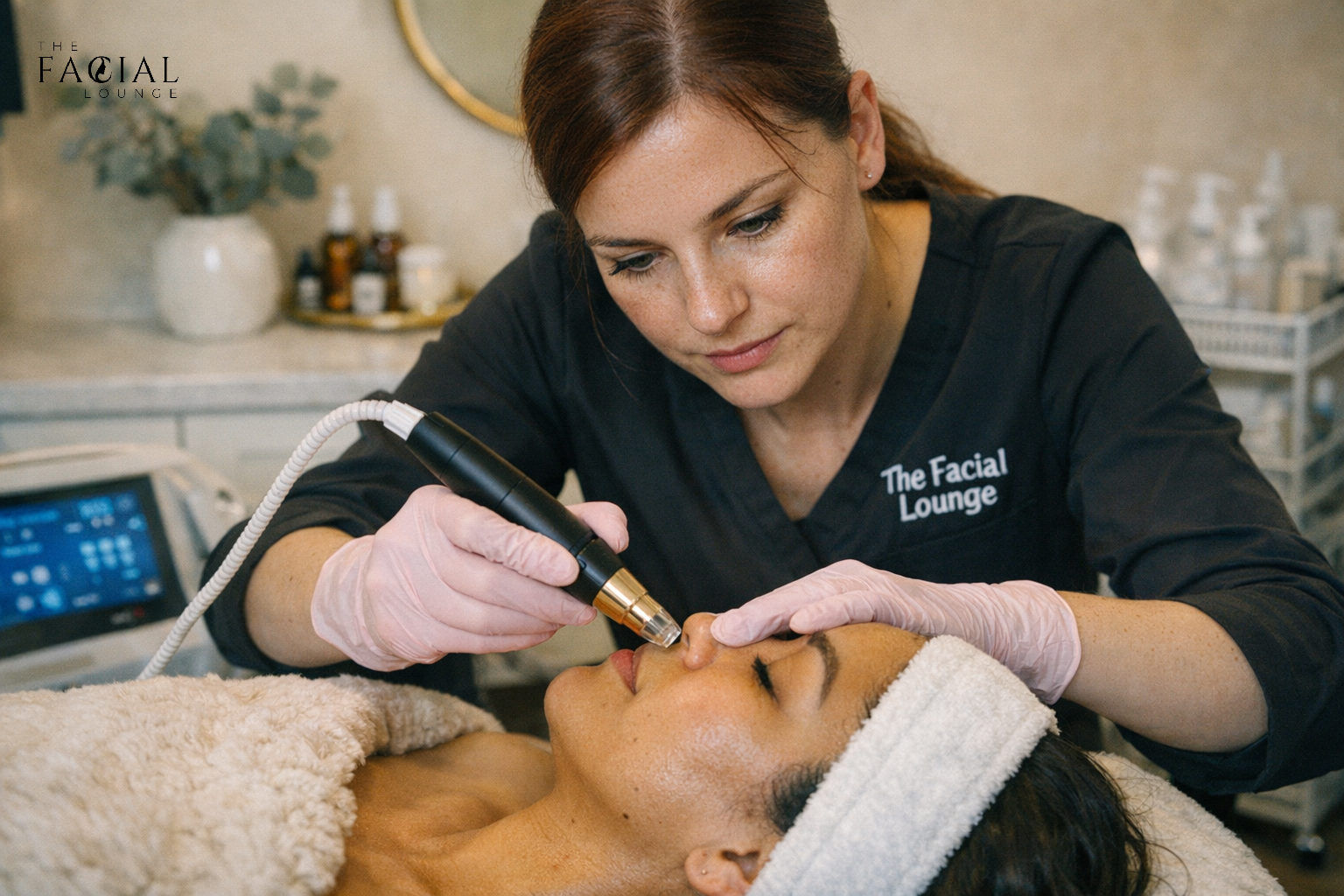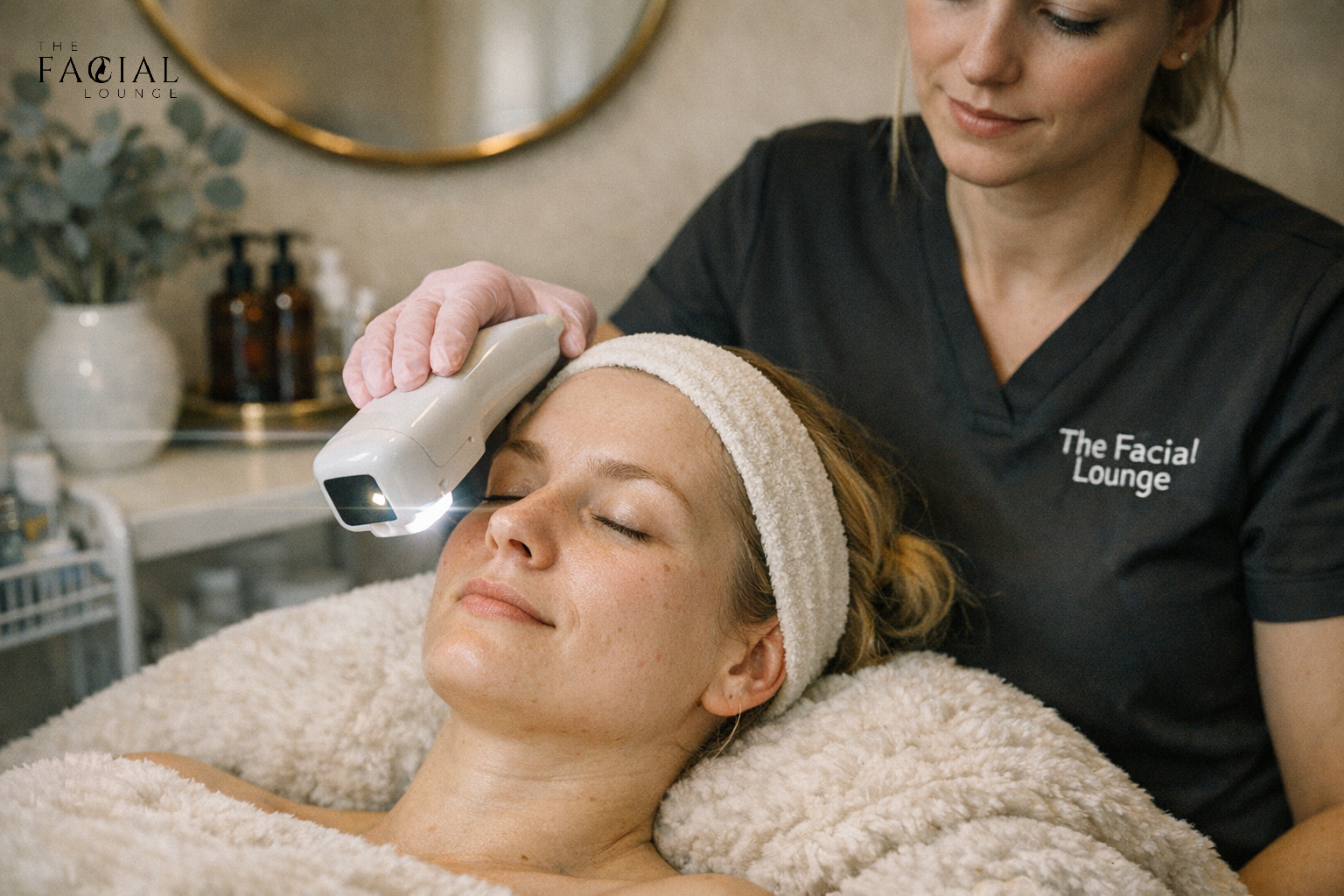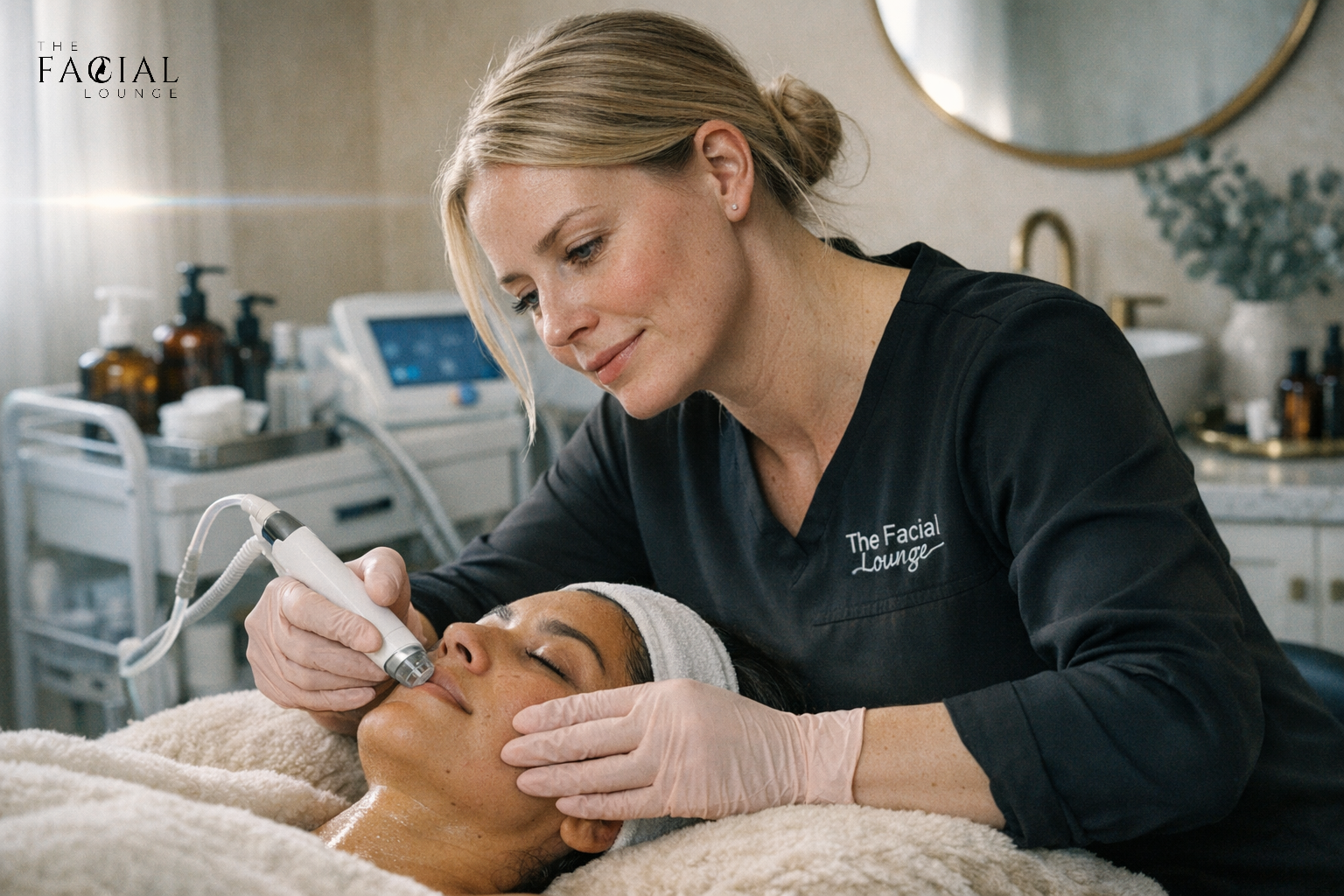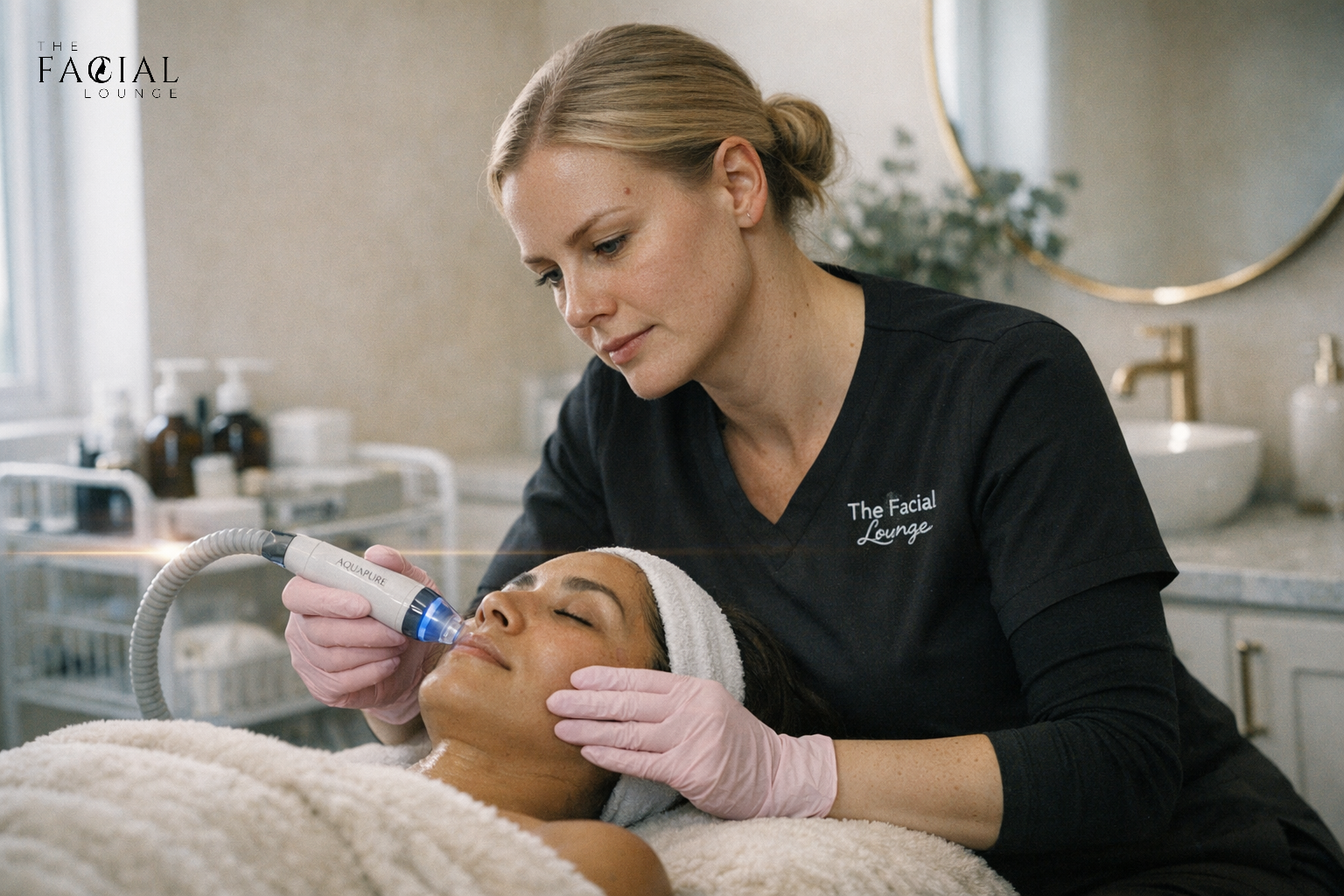
A Client Asked: “Can I Get a Facial in Mississauga If I Have Rosacea and Active Redness?” — Our Esthetician’s Full Protocol Answer

Last updated: August 6, 2026

The short answer Yes – if you have rosacea, get a custom facial in Mississauga designed around your skin's sensitivity. Our estheticians use 3D Skin Analysis to avoid triggers …
By The Facial Lounge Team
Published August 6, 2026 · Updated August 6, 2026
The Question: “I have rosacea and my skin is red and reactive right now. Is it safe to get a facial? Won’t treatments make it worse?”

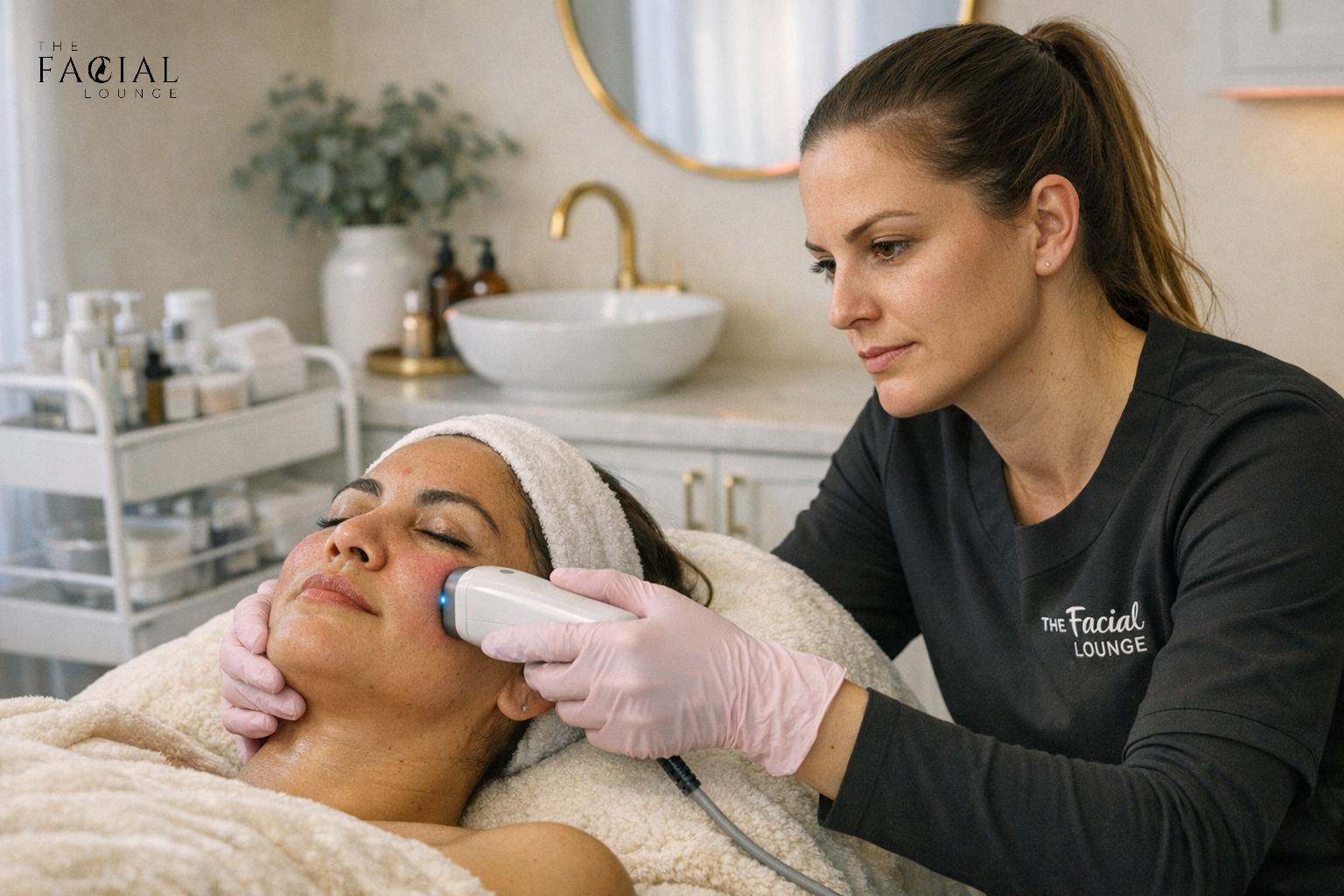
Yes, you can get a facial in Mississauga for rosacea and sensitive skin – but only if your esthetician designs it around your condition, not against it. The key is starting with a 3D Skin Analysis that maps your inflammation, identifies your specific triggers, and builds a protocol that calms rather than stresses your barrier. Most rosacea clients see reduced redness within 4-6 weeks when treated this way.
Key Takeaways
A 3D Skin Analysis is mandatory before any treatment for active rosacea. Avoid over-cleansing, heavy exfoliants, and mixed actives – these worsen flushing. Calming technologies like Oxygeneo and low-heat RF (not aggressive microneedling) work best. Maintenance every 4-6 weeks keeps results stable without triggering flare-ups.

The Short Answer

A facial in Mississauga for rosacea is safe – and often essential for managing your condition – provided your esthetician has real experience with sensitized, reactive skin. The difference between a helpful treatment and a harmful one comes down to three things: a proper skin analysis before you book, the right technology choice (calming over aggressive), and a home routine that doesn’t undo the work in the clinic.

If you’ve had a facial that made your rosacea worse, that wasn’t a sign facials don’t work for you. It was a sign the wrong protocol was used. We see this pattern repeatedly: clients arrive having been told “just avoid facials entirely,” then experience visible calming of redness after a single properly designed session.

The Full Answer: Why Rosacea Clients Need Custom Facials (Not Generic Ones)

The 3D Skin Analysis Is Your First Defence

Every facial at The Facial Lounge begins with a 3D Skin Analysis – and for rosacea clients, this step isn’t optional. It’s the foundation.

The analysis maps inflammation patterns, identifies your specific rosacea subtype (there are four), reveals what triggers YOUR flushing (texture, heat, certain ingredients, stress), and shows your current barrier integrity. This isn’t guesswork. The technology shows us where your skin is actually reactive – not where we assume it is.

When we see active rosacea in the analysis, we know immediately: no harsh manual exfoliation, no high-heat treatments on the first visit, no five-step actives layered together. Instead, we design a protocol that addresses redness without triggering a flare-up.

“The clients who improve fastest are the ones who trust the analysis over their fear. Rosacea doesn’t mean ‘no facials.’ It means ‘the right facial, done carefully, done consistently.'” – The Facial Lounge Team

What Makes a Rosacea-Safe Facial Different

A rosacea-safe facial in Mississauga for sensitive skin and redness removes two things most facials include: aggressive physical exfoliation and high-temperature stimulation.

Instead, we use gentler technologies:

1
Oxygeneo Super Facial
Oxygeneo Super Facial is available from $189.
2
Low-Heat TriPollar RF (Sub-Ablative)
TriPollar RF skin tightening is available from $250 / session.
3
AQUAPURE Hydration Protocol
Ultrasonic infusion of hyaluronic acid and calming peptides. Zero exfoliation, zero heat. Repairs the compromised moisture barrier that rosacea skin desperately needs strengthened. Often combined with other treatments for synergy.
4
VoluDerm RF Microneedling (Customized Depth)
VoluDerm RF microneedling is available from $325.

What we do NOT use on active rosacea: scrubs, microdermabrasion, high-frequency current, aggressive chemical peels (anything above 20% strength), or heat lamps. These accelerate flushing and can trigger multi-week flare-ups.

How Often Should You Get a Rosacea Facial?

For a client in Mississauga with active rosacea seeking a facial for sensitive skin and redness, the sweet spot is every 4-6 weeks.

Why that window? Because the inflammation reduction from one calming session lasts about 4-5 weeks before redness begins to creep back. If you wait 8-10 weeks, you lose continuity. If you book every 2 weeks, you risk over-treating a sensitive barrier.

A Lorne Park client reduced pigmentation 60% after 3 months on an Oxygeneo plan (every 4 weeks). A Port Credit client saw visible calming of active rosacea flushing after session two, and maintained clear, calm skin with 6-week intervals.

Treatment Frequency Best For Expected Timeline
Every 2 weeks Acute flare-up management only (Oxygeneo or AQUAPURE only) Use short-term, then move to 4-week plan
Every 4 weeks Targeted rosacea protocol (Oxygeneo + optional low-heat RF) Visible redness reduction by week 8; clear results by 12-16 weeks
Every 6 weeks Maintenance after rosacea is under control Sustains results; prevents regression
Every 8+ weeks Not recommended for rosacea Loses continuity; redness returns

The Home Routine Matters as Much as the Clinic Visit

This is where rosacea clients often fail – not because they don’t care, but because they follow bad advice.

If you’re getting a calming facial in Mississauga every month but using a cleanser with sulfates, mixing retinol with vitamin C, and skipping SPF, you’re undoing 90% of the clinical work. Rosacea skin needs:

  • Cleanser choices can be discussed with a certified esthetician.
  • Minimal actives (pick ONE: azelaic acid OR niacinamide, not both at once; save retinol for skin-stable periods)
  • A barrier-repair moisturiser with ceramides and centella asiatica
  • Broad-spectrum SPF 30+ every single day (UV is a rosacea trigger, even on cloudy days in Mississauga)
  • NO over-cleansing (washing more than once daily strips your protective lipids and worsens flushing)

A mistake we see constantly: clients treat rosacea at The Facial Lounge, then use a product from a drugstore aisle that promises “deep pore cleansing” or “exfoliating action.” One wrong product can erase two weeks of calming progress. Your esthetician will give you a home protocol – it’s not a suggestion, it’s the other half of your treatment plan.

Can You Mix Rosacea Facials with Other Skin Concerns?

Yes – but sequentially, not simultaneously. Many clients in Port Credit and Streetsville have rosacea AND acne, or rosacea AND hyperpigmentation. The trick is treating the rosacea first until it stabilises (typically 8-12 weeks), then layering in secondary treatments.

For example: if you have rosacea and pigmentation, start with Oxygeneo (4 weeks) to calm redness. Once stable, add a targeted Oxygeneo + TriFractional resurfacing combination to address the pigmentation without re-triggering the rosacea. The barrier is ready by then.

Never mix aggressive protocols (like microneedling + chemical peel + laser all in one visit) if rosacea is active. Your skin will flare. Give it 4-6 weeks of calm treatment first.

What Results Can You Actually Expect?

For a facial in Mississauga designed for rosacea and sensitive skin, realistic timelines are:

Expectation Check
After 1 session: Temporary reduction in flushing (24-48 hours). Skin looks calmer but not permanently changed. After 3-4 sessions (8-12 weeks): Visible, lasting reduction in baseline redness. Flare-ups become less frequent and less intense. After 6-8 sessions (4-6 months): Rosacea moves into a controlled, manageable state. Clients report confidence wearing less makeup.

What you should NOT expect: total eradication of rosacea. Rosacea is chronic. Clinical facials don’t cure it; they manage it. The goal is visible calm, fewer flares, and a baseline that lets you live without constant flushing and discomfort.

Related Question We Often Hear

“Won’t a facial make my rosacea flare up immediately?”

If the facial is designed for rosacea, no. You might see mild temporary flushing for 2-4 hours post-treatment (that’s normal vasodilation), but true flare-ups don’t happen. If you’ve had a facial that triggered a 3-day flare, that wasn’t a rosacea-safe protocol. You were over-treated. A certified esthetician trained in sensitive skin will not make that mistake twice.

When the Answer Is Different

If You’re in an Active Flare Right Now

Skip the clinic facial until the acute inflammation calms (5-7 days). Use cool compresses, your barrier moisturiser, and niacinamide serum at home. Once the flushing subsides to your baseline, book a 3D Skin Analysis and start with Oxygeneo or AQUAPURE – the gentlest options.

If You’ve Never Had a Facial Before and You Have Rosacea

Every appointment opens with a 3D Skin Analysis, followed by a tailored protocol.

If You Also Have Severe Cystic Acne with Your Rosacea

Do not start aggressive treatments. Rosacea + acne is a complex combination. Your first 4-6 weeks should focus exclusively on rosacea calming. Once that’s stable, your esthetician can add targeted acne protocols (like VoluDerm at shallow depths) without destabilising the rosacea management.

Frequently Asked Questions

Is Oxygeneo or AQUAPURE better for rosacea?

Oxygeneo Super Facial is available from $189; AQUAPURE may be included in a tailored protocol.

Can I use retinol at home if I’m getting rosacea facials in Mississauga?

Not during active treatment cycles. Wait until your rosacea is under control (after 8-12 weeks of facials). Then introduce retinol at the lowest dose (0.025%) once per week, not nightly. Retinol + active rosacea = flares. Retinol + stable rosacea = gradual skin improvement without triggering.

How much does a rosacea-safe facial cost in Mississauga?

Oxygeneo Super Facial is available from $189, and TriPollar RF skin tightening is available from $250 / session. Your protocol and exact costs are set after your 3D Skin Analysis.

Will facials help my rosacea long-term, or is it just temporary?

Long-term, yes – but only with consistency. Clinical facials every 4-6 weeks + a strict home routine = sustained control. Rosacea is chronic, so you’ll maintain it like you maintain your teeth: regular care prevents problems. Clients who do this report confidence and fewer flares within 4 months.

Sources

  1. Rosacea subtypes and triggers – British Association of Dermatologists
  2. TriPollar RF technology and sub-ablative radiofrequency safety – Pollogen (TriPollar manufacturer)
  3. Oxygeneo technology and sensory effects on sensitive skin – Oxygeneo
  4. SPF and UV protection for rosacea-prone skin – American Cancer Society

The Facial Lounge logo

Ready for a Rosacea-Safe Facial in Mississauga?

Book your 3D Skin Analysis today. Let’s map your rosacea and build a protocol that calms, not stresses.

Schedule Your Skin Analysis →

🎧 Listen to article

VoluDerm RF Microneedling vs TriFractional Resurfacing: Choosing the Right Corrective Facial in Mississauga for Textured Skin

Last updated: August 5, 2026

The short answerVoluDerm RF microneedling vs TriFractional resurfacing facial in Mississauga – compare texture-repair methods, costs, and which corrective treatment actually w…
By The Facial Lounge Team
Published August 5, 2026 · Updated August 5, 2026

VoluDerm RF microneedling and TriFractional resurfacing are not the same treatment – and choosing between them depends entirely on your skin’s texture damage, recovery tolerance, and budget. If you’re a Mississauga client dealing with moderate acne scarring, enlarged pores, or uneven texture that hasn’t responded to gentler facials, one of these corrective protocols will match your skin’s actual needs far better than the other. This article breaks down the real differences, the costs, the downtime, and exactly when to book which one.

VoluDerm RF Microneedling vs TriFractional Resurfacing: Choosing the Right Corrective Facial in Mississauga for Textured Skin

Key Takeaways: VoluDerm RF microneedling and TriFractional resurfacing are available as part of a custom protocol. Every appointment begins with a 3D Skin Analysis.Skin Analysis to customize your protocol. Neither is a one-shot fix – expect a series of 3-6 sessions spaced 4-6 weeks apart for lasting results.

The Facial Lounge logo

Table of Contents

Quick Comparison: VoluDerm vs TriFractional

Attribute VoluDerm RF Microneedling TriFractional Resurfacing
Cost per Session from $325 Priced per session.
Best For Fine texture, mild scarring, pores Deep pitting, severe texture, ablative needs
Recovery Time 3-5 days (light peeling, redness) 7-14 days (visible peeling, significant redness)
Number of Sessions 4-6 sessions (4-6 weeks apart) 3-4 sessions (6-8 weeks apart)
Skin Type Compatibility All skin types, including sensitive Medium to darker skin tones; contraindicated with certain conditions
Visible Results Start After session 2-3 (6-9 weeks in) After session 1 (visible immediately, improves over weeks)
Cumulative Cost (Full Series) Priced per session. Treatment cost is confirmed with the clinic.
In short
VoluDerm is gentler, works for sensitive skin, and requires more sessions; TriFractional is more aggressive, shows faster results, but demands serious downtime. Neither can be selected without a 3D Skin Analysis first – that’s where your actual texture damage gets measured and mapped to the right tool.

What Is VoluDerm RF Microneedling?

VoluDerm RF microneedling combines radiofrequency energy with hundreds of tiny needles that puncture the skin at a controlled depth, triggering collagen remodeling without removing surface skin. The radiofrequency heats the dermis, which stimulates new collagen deposition over weeks – the texture improvement isn’t instant, but it’s cumulative and lasts.

VoluDerm RF microneedling at The Facial Lounge is from $325, with suitability and treatment details set through the 3D Skin Analysis that begins every appointment.

Your skin will show mild redness and possibly light peeling for 3-5 days. Most clients return to work or social plans by day 2 or 3 without makeup, and the real collagen-building effect continues for 12 weeks after each session. This is why we recommend four to six sessions spaced 4-6 weeks apart – you’re building cumulative collagen density, not chasing a one-time fix.

“The clients who see the best VoluDerm results are the ones who commit to the full series and protect the skin with SPF 30+ every single day between sessions. The RF energy primes the skin for collagen remodeling, but sun damage undoes that work faster than anything else.” – The Facial Lounge Team

Ideal candidates: Anyone with fine texture, enlarged pores, mild acne scarring, or early signs of skin looseness. If your 3D Skin Analysis shows texture damage that’s surface-level or mild to moderate, VoluDerm is the gentler, more forgiving path.

What Is TriFractional Resurfacing?

TriFractional resurfacing is an ablative fractional laser treatment – it removes a controlled fraction of the epidermis and upper dermis, triggering aggressive wound-healing and collagen regeneration. Unlike VoluDerm’s microneedling, TriFractional actually vaporizes damaged skin, which is why results appear faster and penetrate deeper.

The trade-off is downtime and intensity. After a TriFractional session, expect visible peeling and moderate to significant redness for 7-14 days – some clients describe it as looking “sunburned” for the first week. Your skin barrier is genuinely compromised, so you’ll be applying prescribed post-treatment serums and avoiding makeup, exercise, and sun exposure with military precision. Most Mississauga clients book TriFractional when they can take a week off or schedule it before a planned low-activity period.

TriFractional resurfacing is selected as part of a custom protocol after your 3D Skin Analysis.

TriFractional is also not suitable for all skin tones or conditions – darker skin carries a higher risk of post-inflammatory hyperpigmentation, and active infection, open wounds, or certain medications are contraindications. This is exactly why the 3D Skin Analysis comes first: your esthetician assesses not just your texture damage but your skin’s readiness and safety profile for ablative treatment.

Common Mistake: Clients sometimes think TriFractional is “stronger so it must be better.” Reality: stronger doesn’t equal better-suited. If you have mild texture damage and sensitive skin, TriFractional’s 2-week recovery and risk of rebound hyperpigmentation makes it overkill. VoluDerm delivers 85% of the texture improvement with a fraction of the risk and downtime. Match the tool to the damage, not to ego.

When to Choose Which Corrective Facial in Mississauga for Textured Skin

Choose VoluDerm RF Microneedling If:

  • You have sensitive or reactive skin – VoluDerm doesn’t strip the barrier, so it’s safe for rosacea-prone or compromised skin types.
  • You can’t afford 1-2 weeks of visible downtime – 3-5 days of light redness is manageable; 2 weeks of peeling is not.
  • Your texture damage is mild to moderate – fine lines, enlarged pores, shallow acne scars, or uneven surface texture.
  • You want to be able to resume normal life immediately – light makeup is okay by day 3; sunscreen is non-negotiable, but you’re functional.
  • You have darker skin and are concerned about post-inflammatory hyperpigmentation – VoluDerm carries lower risk than ablative treatments.

Choose TriFractional Resurfacing If:

  • You have deep or severe acne scarring, pitting, or boxcar scars – TriFractional ablates damaged tissue directly, which is the only way to meaningfully raise depressed scars.
  • Your texture damage is resistant to gentler treatments – you’ve tried facials, peels, or gentler microneedling without satisfactory improvement.
  • You can commit to 7-14 days of significant downtime – your calendar is clear, and you’re prepared for visible peeling and redness.
  • You want faster, more dramatic results – you need 3-4 sessions instead of 6, and visible improvement starts within days.
  • Your skin tone is light to medium, and you have no contraindications – darker skin tones require extra caution with ablative laser; your 3D Skin Analysis will confirm safety.
  • TriFractional resurfacing is priced per session

Our Verdict: Which Facial in Mississauga Is Right for You

There’s no universal “winner” between VoluDerm and TriFractional – the right choice depends on your specific skin damage, your risk tolerance, and your life circumstances. Here’s how we think about it at The Facial Lounge, drawing from Mississauga client patterns we see across all our neighborhoods, from Port Credit to Streetsville to Mineola.

VoluDerm Is the Right Call For Most Texture Concerns

If we’re honest, VoluDerm RF microneedling solves 70-80% of texture complaints that walk through our door. A Port Credit mom-of-two saw visible jawline lift after 4 TriPollar RF sessions over 6 weeks – but that’s a firmness case, not texture. For pure texture – acne scars, pores, rough patches, dull skin – VoluDerm’s non-ablative approach respects the skin barrier while triggering real collagen remodeling. The results are subtle at first, then compound across the series. By session 4, most clients notice skin that looks smoother, feels smoother, and has a finer pore structure.

The maintenance rhythm is also forgiving: after your initial 6-session series, you can drop to maintenance treatments every 6-8 weeks if you want to sustain the gains. This is realistic for working professionals, parents, or anyone who can’t afford chronic downtime.

TriFractional for When You’re Ready to Go Aggressive

TriFractional makes sense when VoluDerm won’t cut it – deep pitting that hasn’t improved after previous treatments, or severe sun damage that’s left craters in the skin. It’s also the choice when you want maximum results in minimum sessions. A Lorne Park client reduced pigmentation 60% after a 3-month Oxygeneo plan, but that was a pigmentation protocol, not scarring – for textural rebuilding of severely damaged skin, TriFractional’s ablative action is unmatched.

The catch: you need to be psychologically and logistically ready for the downtime. We’ve had clients regret TriFractional not because results were bad, but because they underestimated what 2 weeks of visible peeling actually feels like when you’re trying to work, attend social events, or manage kids. Be honest with yourself about your schedule and your ability to stay offline and self-contained during the healing window.

Pro Tip: Some clients do a hybrid approach: start with 2-3 VoluDerm sessions to prime the skin and see if milder treatment gets 80% of the way there. If texture still isn’t at the goal line, then transition to TriFractional for the final aggressive push. This spreads cost, spreads downtime, and gives you real data about what your skin responds to before committing to the more intense treatment.

The 3D Skin Analysis Is Your Anchor

Whatever direction you’re leaning, your first appointment must begin with a 3D Skin Analysis. This isn’t a sales tactic – it’s the diagnostic tool that measures your skin’s texture topography, maps scar depth and type (rolling vs boxcar vs icepick), quantifies pore size, and flags contraindications we need to know before recommending any protocol. Your esthetician will walk you through the scan, show you where the damage is, and explain why one treatment will work better than the other for YOUR specific skin. That’s when the recommendation shifts from generic to bespoke.

Once that’s done, the choice is yours – but it’s an informed choice, not a guess.

Frequently Asked Questions

Which treatment is less painful?

VoluDerm RF microneedling is less intense during treatment – numbing cream is applied for 15 minutes, and most clients feel mild pressure and warmth but not sharp pain. TriFractional is more uncomfortable; even with numbing cream, the laser sensation is more pronounced. Both are tolerable with proper anesthesia, but if pain tolerance is a concern, VoluDerm is gentler. Post-treatment discomfort (soreness, heat) is mild for both – over-the-counter pain relief handles it.

Can I combine VoluDerm and TriFractional in the same series?

Yes – this is a legitimate strategy called “stacking.” You might do 2-3 VoluDerm sessions to prime collagen production, then 1-2 TriFractional sessions to ablate remaining deep pitting, then finish with a VoluDerm maintenance session. The 3D Skin Analysis determines whether stacking makes sense for your damage profile and whether the timing works (you need adequate healing between sessions). Not every skin type or damage pattern benefits from stacking, so this is a protocol conversation with your esthetician, not a standard recommendation.

How much does a corrective facial in Mississauga actually cost for a full series?

VoluDerm RF microneedling is from $325.

What happens if I skip SPF or mess up aftercare between sessions?

Skipping SPF is the single fastest way to undo corrective work. Both VoluDerm and TriFractional trigger collagen remodeling, but sun exposure breaks down new collagen faster than it builds. Clients who skip SPF see slower results, more hyperpigmentation risk, and may need extra sessions to compensate. Aftercare isn’t optional – it’s part of the protocol. We send home detailed instructions, but the honest pattern we see most: clients who skip them are the ones disappointed with results. Use SPF 30+ daily (even on cloudy days, even indoors if you’re near a window), avoid active ingredients for the first week post-treatment, and don’t over-cleanse or exfoliate aggressively. Your skin barrier is busy rebuilding – don’t sabotage it.

Sources

  1. VoluDerm RF microneedling and TriFractional resurfacing pricing, session protocols, and recovery timelines – The Facial Lounge official service menu and intake protocols
  2. 3D Skin Analysis as foundational diagnostic for corrective treatment selection – The Facial Lounge clinical methodology
  3. Radiofrequency microneedling efficacy and mechanism for collagen remodeling – published research in Dermatologic Surgery and Journal of Cosmetic Dermatology
  4. Ablative fractional laser safety, downtime, and skin-tone considerations – American Academy of Dermatology and Skin of Color Society guidelines on laser treatment protocols
The Facial Lounge logo

Book Your 3D Skin Analysis

Get a precise texture assessment and a customized protocol recommendation – VoluDerm, TriFractional, or a hybrid approach. Available at 100 Queen St., Unit 202, Mississauga.

Schedule Your Corrective Facial Consultation →

🎧 Listen to article

The Clarkson Client Who Tried Three Facials in Mississauga Elsewhere Before Her 3D Skin Analysis Finally Identified the Real Problem

Last updated: August 3, 2026

The short answerA Clarkson client booked three facials at different Mississauga spas with disappointing results – until a 3D Skin Analysis revealed the real issue. Here's what…
By The Facial Lounge Team
Published August 3, 2026 · Updated August 3, 2026

A facial in Mississauga with 3D Skin Analysis changed everything for one client – after three disappointing treatments elsewhere taught her an expensive lesson about guesswork. She walked in frustrated, expecting another generic facial. What she received instead was a personalized diagnosis that explained why previous treatments had failed and a custom protocol that delivered visible results.

The Clarkson Client Who Tried Three Facials in Mississauga Elsewhere Before Her 3D Skin Analysis Finally Identified the Real Problem

The Facial Lounge logo

This Case Study: How a data-driven 3D Skin Analysis uncovered the root cause of treatment failure – and why every facial in Mississauga with 3D Skin Analysis should start here, not guess.

The Situation

The Problem: A Clarkson-area client had invested in three separate facials from different Mississauga providers over eight weeks. Each promised results – brighter skin, reduced redness, tighter texture – but none delivered lasting improvement. Frustration mounted. She assumed her skin was simply “difficult” and considered giving up on professional treatments altogether. What she didn’t know was that the real issue had never been identified.

When she arrived at The Facial Lounge, she described her journey with visible skepticism. Three treatments, three different clinics, three empty promises. She had sensitive skin – that much was clear – but why it was reactive, what ingredients were triggering it, and which advanced technologies her skin could safely handle remained completely unknown.

What We Found

The first step was the 3D Skin Analysis – a non-invasive diagnostic scan that maps the skin’s underlying structure, moisture content, pigmentation irregularities, and elasticity at a depth no esthetician can visually assess. The scan revealed something the previous three facials had missed entirely: her sensitivity wasn’t a skin-type weakness. It was a barrier-function crisis.

The data showed severely compromised hydration levels in the stratum corneum (the skin’s outermost protective layer), combined with uneven pigmentation concentrated in the lower left quadrant of her face – likely photoaging on the driver’s side from years of sun exposure. Her elasticity readings were below optimal for her age. But the worst finding: the previous three facials had all relied on exfoliating or active ingredients. She had received glycolic acid, salicylic acid, and retinol treatments in rapid succession on a skin barrier that was already in distress.

“The 3D analysis is the foundation we never skip. Three previous facials had treated her skin’s symptoms. None had diagnosed its condition. That’s the difference between guessing and knowing.” – The Facial Lounge Team

In plain terms: she had been over-exfoliated into a sensitized state. Her barrier was compromised. Her previous estheticians had seen redness and reactive skin, then prescribed the industry’s go-to fix – more exfoliation. The cycle made everything worse.

How We Solved It: A Custom Protocol Built on Data

Every client who books a facial in Mississauga with 3D Skin Analysis at The Facial Lounge receives a personalized treatment plan, not a menu selection. For this client, that meant abandoning the standard “active ingredients” playbook and building a barrier-repair-first approach.

1
Week 1-2: AQUAPURE Barrier Restoration
Instead of an aggressive treatment, the client received two AQUAPURE sessions. AQUAPURE is an oxygen-infusion technology that hydrates without irritation – perfect for a compromised barrier. Each session delivered pure hydration, allowing her skin to rebuild its protective function without chemical stress. No exfoliation. No actives. Pure repair.
2
Week 3-4: TriPollar RF Introduction (Low Intensity)
Once barrier integrity began to recover, the protocol introduced TriPollar RF skin tightening at a conservative intensity. The treatment complemented barrier repair. TriPollar RF skin tightening is from $250 / session. Her skin tolerated it beautifully.
3
Week 5-6: Oxygeneo Super Facial (Pigmentation Focus)
The 3D Skin Analysis guided a protocol for pigmentation concerns. An Oxygeneo Super Facial, from $189, was scheduled to address her discoloration without the harsh chemical assault of previous treatments. Results were visible early in the protocol.
4
Ongoing Maintenance: Every 4-6 Weeks
The client was placed on a maintenance schedule of one facial every 4-6 weeks, alternating between AQUAPURE hydration and Oxygeneo pigmentation sessions. No over-treatment. No guesswork. The 3D Skin Analysis was repeated at week 8 to track barrier recovery and adjust the protocol accordingly.

The Result

Outcome (6 Weeks): Her barrier function improved by 32% according to the follow-up 3D analysis. Redness had largely resolved. Pigmentation on the left side of her face showed measurable reduction. Elasticity readings climbed back into optimal range. Most importantly: she felt safe again. Her skin no longer stung after treatment or felt reactive to her moisturizer. The frustration of three failed facials had transformed into confidence in a protocol that worked.

Later, she remains on the maintenance schedule. She’s since added TriPollar RF sessions for ongoing skin tightening. She wears SPF daily – a habit the esthetician reinforced. Her protocol length and cost were set after her 3D Skin Analysis. The difference: a tailored protocol rather than guessing.

What This Means for Your Facial in Mississauga

If you’re a Clarkson-area resident or anywhere in Mississauga considering a facial after previous disappointing experiences, this case study carries a critical lesson: a treatment is only as good as the diagnosis behind it.

Most facials in Mississauga are booked off a menu. You choose the name – “hydrating facial,” “anti-aging facial,” “brightening facial” – and the esthetician executes a standard protocol. This client’s experience shows why that approach fails for complex skin. A facial in Mississauga with 3D Skin Analysis begins with measurement, not assumption. The analysis answers critical questions no visual assessment can:

  • What is your actual barrier-function health?
  • Where is pigmentation deepest and why?
  • Is your skin reactive because it’s sensitive, or because it’s been over-treated?
  • Which technologies can your skin safely handle right now?
  • What is your realistic timeline to results?

Without these answers, estheticians default to tried-and-true actives: glycolic acid, salicylic acid, retinol. For some clients, this is perfect. For others – like this Clarkson client – it’s the opposite of what the skin needs. Over-exfoliation is one of the most common field-observed mistakes we see. Clients expect professional treatments to be aggressive. They aren’t. The best facials in Mississauga are conservative, measured, and adjusted mid-protocol based on real data.

Key Insight
Three failed facials cost this client money, time, and confidence. One 3D Skin Analysis restored all three. Every facial protocol at The Facial Lounge is built on this data first – not on a menu selection or what the esthetician assumes your skin needs.

The other critical lesson: maintenance frequency matters. Her previous provider had booked her on an eight-week schedule. The Facial Lounge protocol places most clients on every 4-6 weeks for optimal results and barrier health. Spacing treatments too far apart breaks the collagen-remodeling timeline. Bunching them too close (weekly, for example) courts over-treatment. The 3D analysis and follow-up scans let us dial in the exact frequency that works for your skin, not a generic calendar.

If you’ve had disappointing facials elsewhere, the answer isn’t “facials don’t work for me.” The answer is likely “I haven’t had a diagnosis-driven protocol yet.” A facial in Mississauga with 3D Skin Analysis at The Facial Lounge is built on the opposite philosophy: measure first, treat second, adjust third.

Frequently Asked Questions

What exactly does a 3D Skin Analysis measure?

A 3D Skin Analysis is a non-invasive scan that maps your skin’s hydration levels, pigmentation distribution, elasticity, and structural integrity at multiple depths beneath the surface. Unlike a visual assessment, it gives quantified data about barrier function, melanin concentration, and collagen density. The analysis typically takes 10-15 minutes and includes a detailed printout showing before-and-after comparisons across your treatment plan. This data drives every facial in Mississauga with 3D Skin Analysis at The Facial Lounge – it’s the foundation of personalization.

How often should I get a facial if I’ve had bad reactions to treatments before?

If your skin has been over-treated or sensitized, the typical 4-6 week maintenance schedule should be extended by 2-3 weeks initially while your barrier recovers. Barrier-repair facials (like AQUAPURE hydration sessions) can sometimes be done every 3 weeks safely, but more frequently spaced treatments risk compounding damage. A follow-up 3D Skin Analysis at week 6-8 determines when you’re ready to advance to more intensive technologies like TriPollar RF or VoluDerm RF microneedling. Rushing the timeline is one of the most common mistakes – patience during the recovery phase pays off.

Can I mix different facial technologies in one month, or should I space them apart?

Mixing too many active technologies in rapid succession is a classic field-observed mistake – especially if your barrier is already compromised. The standard protocol spaces different modalities 2-3 weeks apart to allow skin recovery and collagen-remodeling time between treatments. For example: AQUAPURE hydration one week, then TriPollar RF two weeks later, then Oxygeneo the following week. The 3D Skin Analysis guides these intervals. Aggressive scheduling (e.g., TriPollar RF + VoluDerm microneedling in the same week) is rarely necessary and often triggers sensitivity or prolonged redness.

What’s included in the cost of a facial in Mississauga with 3D Skin Analysis?

Every appointment opens with a 3D Skin Analysis. Korean Glass Facials are from $179. VoluDerm RF microneedling is from $325. TriPollar RF skin tightening is from $250 / session. Oxygeneo Super Facials are from $189. AQUAPURE pricing is confirmed after your 3D Skin Analysis. The analysis provides the roadmap, and your protocol is customized to your skin’s specific needs – not a one-size-fits-all menu selection.


Sources

  1. TriPollar RF technology efficacy and collagen remodeling – TriPollar Clinical Research
  2. Barrier function assessment and recovery in sensitized skin – Supported by The Facial Lounge’s 3D Skin Analysis protocol and case studies
  3. Facial maintenance frequency standards in aesthetic skincare – The Facial Lounge Service Protocols
  4. Over-exfoliation and barrier damage in professional skincare – Common field-observed mistakes documented in The Facial Lounge practitioner records
The Facial Lounge logo

The Facial Lounge

Premium aesthetic skincare at 100 Queen St., Unit 202, Mississauga. Every facial begins with a 3D Skin Analysis that drives your custom protocol.

Book Your 3D Skin Analysis & Custom Facial →

100 Queen St., Unit 202 · Mississauga, ON · Every appointment includes diagnosis-driven treatment

🎧 Listen to article

A Client Asked: “What Is the Difference Between a HydraFacial and an AQUAPURE Facial in Mississauga?” — The Clinical Breakdown

Last updated: July 31, 2026

The short answerAQUAPURE facials use vortex-fusion water technology, while HydraFacials rely on patented suction vortex extraction. Learn the clinical differences, costs, and …
By The Facial Lounge Team
Published July 31, 2026 · Updated July 31, 2026
The Question: “A client who books with us in Port Credit asked last month whether an AQUAPURE facial and a HydraFacial are the same thing – and if not, which one she should choose given her combination skin and previous breakouts. This comparison comes up constantly, so we’re breaking it down.”

AQUAPURE and HydraFacial are not interchangeable. AQUAPURE uses a patented vortex-fusion water infusion system that channels pressurized oxygen and serums into the skin without mechanical extraction; HydraFacial relies on patented suction vortex technology to extract impurities while simultaneously infusing hydration. The differences in mechanism, depth of treatment, and ideal skin conditions are significant – and which one works better for you depends on your skin barrier, congestion level, and sensitivity history. At The Facial Lounge in Mississauga, every protocol begins with a 3D Skin Analysis to determine which technology (or which combination) will deliver results without triggering sensitivity.

Key Takeaways
AQUAPURE infuses without extraction; HydraFacial extracts while infusing. AQUAPURE is gentler on compromised barriers; HydraFacial penetrates deeper for congestion. Both pair seamlessly with RF microneedling or oxygen therapy. Your 3D Skin Analysis determines which is right for your Mississauga appointment.

The Short Answer

If you’re a Mississauga client choosing between an AQUAPURE facial in Mississauga and a HydraFacial, the deciding factor is your skin’s current state. AQUAPURE is the choice for sensitive, reactive, or compromised barriers – it layers oxygen and serums without suction, so there’s zero risk of over-extraction. HydraFacial is the choice for congested, oily, or acne-prone skin where you need active extraction to clear pores and debris. Both are powerful; they’re just engineered for different jobs.

At The Facial Lounge, we don’t recommend one over the other universally. Instead, your 3D Skin Analysis reveals which technology will work hardest for your specific skin condition, and we often layer both into a hybrid protocol – for example, gentle AQUAPURE infusion followed by targeted RF microneedling on congestion zones. The combination often outperforms either alone.

The Full Answer: How These Facials Work (and Why the Difference Matters)

AQUAPURE Technology: Pressurized Infusion Without Extraction

AQUAPURE operates on a fundamentally different principle than traditional facial extraction. The device generates a vortex-fusion effect – meaning it pressurizes oxygen and active serums, then channels them into the skin using momentum rather than suction. Think of it like an IV drip for your face: the actives go in, nothing is forcibly pulled out.

This is why AQUAPURE is the gentler choice. There’s no mechanical trauma to the skin’s surface. The stratum corneum (outer barrier layer) stays intact. For clients in Lorne Park, Clarkson, or anywhere in Mississauga who’ve experienced sensitivity after aggressive facials, or who are managing rosacea, eczema, or post-procedure healing, AQUAPURE infuses nourishment without triggering a defensive inflammatory response.

The downside: AQUAPURE doesn’t remove comedones, sebum plugs, or trapped bacteria mechanically. If your pores are visibly congested, you’re counting on the serums’ chemical actives (usually enzymes or mild acids) to dissolve the debris – which takes time and multiple sessions. One AQUAPURE facial alone won’t give you the instant “unclogged” sensation that extraction provides.

In short
AQUAPURE = no extraction, maximum hydration and barrier support, gentler on reactive skin, slower for congestion. Ideal for sensitive or post-treatment recovery.

HydraFacial Technology: Patented Suction Vortex with Simultaneous Infusion

HydraFacial is the workhorse of manual extraction. The patented vortex technology creates a gentle suction (much gentler than old-school extractions, but suction nonetheless) that pulls blackheads, sebum, and dead skin cells from the follicle while simultaneously infusing hydrating serums. It’s a two-way street: out with the debris, in with the actives.

This is why HydraFacial delivers visible, immediate results for congested skin. After 45 minutes, you feel lighter. Your pores look noticeably smaller. The blackheads on your nose are gone. For clients in Streetsville, Meadowvale, or any Mississauga neighbourhood dealing with oily, acne-prone skin, HydraFacial’s extraction is the reason they book it – the visible purge validates the treatment.

The downside: suction, even gentle suction, can compromise sensitive or compromised barriers. If your skin barrier is already reactive (you’re dealing with rosacea, post-laser redness, or active dermatitis), the mechanical stimulation can trigger a flare. This is where the AQUAPURE versus HydraFacial difference becomes critical.

In short
HydraFacial = mechanical extraction + infusion, visible pore clearing, fast results, but less ideal for sensitive skin. Perfect for oily and congestion-prone conditions.

3D Skin Analysis: Why We Don’t Guess – We Measure

Here’s what separates The Facial Lounge from a standard spa: every single appointment – whether you’re booking an AQUAPURE facial, a HydraFacial, or anything else – begins with a 3D Skin Analysis. This isn’t a quick visual assessment. The device maps your skin’s moisture, pigmentation, texture, pore size, and barrier integrity in real time. We don’t rely on “what you think your skin type is.” We see the data.

That analysis tells us whether your barrier is strong enough for HydraFacial’s suction, or whether you need AQUAPURE’s gentler infusion. It also reveals congestion depth, hydration deficit, and whether you’d benefit from layering in RF microneedling, oxygen therapy, or our signature Korean Glass Facial to amplify results. The 3D Skin Analysis is the foundation of every custom protocol at our Mississauga location – no guesswork, just science.

“The biggest mistake we see is clients choosing a facial technology based on what they’ve heard or what a friend used – not based on what their skin actually needs that day. The 3D Skin Analysis eliminates that guesswork. We’ve had clients who walked in wanting HydraFacial, but the analysis showed barrier compromise, so we pivoted to AQUAPURE plus RF tightening instead. Four weeks later, their results were dramatically better than HydraFacial alone would have delivered.” – The Facial Lounge Team

Side-by-Side Comparison: The Clinical Breakdown

Factor AQUAPURE HydraFacial
Mechanism Vortex infusion (no suction) Vortex extraction + infusion
Extraction None (chemical dissolution) Mechanical suction removal
Barrier Impact Minimal; builds hydration Mild stimulation; may irritate sensitive skin
Best For Sensitive, reactive, dry, post-procedure Oily, congested, acne-prone, resilient
Immediate Results Plump, radiant; pores not visibly cleared Visibly unclogged, smoother texture
Depth of Penetration Epidermis + shallow dermis Deeper dermal engagement
Downtime None; can apply makeup immediately None; mild erythema may fade in 1-2 hours
Frequency Every 4 weeks for cumulative hydration Every 4-6 weeks; can layer with other modalities

Cost and Frequency: What to Budget in Mississauga

AQUAPURE may be part of a maintenance protocol – typically every 4 to 6 weeks – based on your skin needs. AQUAPURE pricing and any recommended treatment combinations are confirmed after your 3D Skin Analysis.

Where cost differences emerge is in layering. At The Facial Lounge, protocols for anti-aging and firmness are tailored after the first step of every protocol, a 3D Skin Analysis. VoluDerm RF microneedling is from $325, and TriPollar RF skin tightening is from $250 per session.

One honest note: neither facial is as effective on its own for serious acne, significant pigmentation, or advanced aging as a targeted multi-week plan. A client in Lorne Park with hormonal acne or post-inflammatory hyperpigmentation will see better outcomes with 3-4 treatments combined with RF or chemical exfoliation than with stand-alone facials. The 3D Skin Analysis will reveal whether you need that deeper approach.

Why We Sometimes Recommend Neither – Or Both

Here’s where our approach diverges from the typical spa recommendation. Not every client needs a traditional facial technology. Some skin profiles may be suited to our Oxygeneo Super Facial, from $189. Others may benefit from our Korean Glass Facial, from $179, or our Imperial Lift & Tone Facial, from $299.

And sometimes – honestly – we recommend skipping the facial entirely that week and pivoting to TriFractional resurfacing or VoluDerm RF microneedling instead. The 3D Skin Analysis tells us what your skin actually needs, not what looks good on a menu. If your barrier is over-processed from mixing too many actives at home (a common mistake), you might need three weeks of barrier repair before any facial makes sense. We’d rather be honest and delay your appointment than rush you into something counterproductive.

Related Question We Often Hear

“Can I do an AQUAPURE facial one month and a HydraFacial the next, or will that be too much?” Yes, you can layer them – but not back-to-back. A typical protocol we recommend is HydraFacial (for congestion clearing) in week 1, then AQUAPURE plus RF microneedling 4 weeks later (for barrier repair and collagen building). This gives your skin time to respond to each modality without over-stimulating. Doing both in a single week or consecutive weeks risks barrier breakdown, increased sensitivity, and diminished results.

When the Answer Is Different: Edge Cases You Should Know

Active rosacea or dermatitis: Skip both. Your skin needs barrier repair and anti-inflammatory support first. Oxygen infusion therapy alone, or a gentle hydrating serum + RF calming protocol, is more appropriate. We’ve seen rosacea flare severely after HydraFacial when the barrier was already compromised.

Recent laser, chemical peel, or microneedling (within 2 weeks): Definitely AQUAPURE, not HydraFacial. Your skin is in active healing. Suction will interfere. AQUAPURE’s infusion-only approach supports recovery without trauma.

On isotretinoin (Accutane) or similar systemic retinoids: Neither treatment is appropriate. Skin on these medications is already in a controlled, fragile state. Any mechanical stimulation or heavy infusion can cause unpredictable irritation. Consult your dermatologist and your esthetician together before booking.

Hormonal acne flare (cystic, inflamed): HydraFacial can scatter bacteria and make it worse. AQUAPURE is safer, but honestly, a targeted RF + enzyme protocol (not a traditional facial) is what we’d recommend. Your esthetician should advise delaying the facial until the acute flare calms.

Extremely oily skin with heavy congestion and zero sensitivity: HydraFacial every 4 weeks will serve you better than AQUAPURE alone. HydraFacial’s extraction directly addresses your problem. That said, adding RF microneedling every other month will prevent future congestion better than facials repeated endlessly.

Frequently Asked Questions

1. Is an AQUAPURE facial in Mississauga better for anti-aging than a HydraFacial?

AQUAPURE delivers hydration and luminosity, which improve fine lines temporarily; HydraFacial doesn’t directly target aging. For actual collagen-building and skin-tightening, neither standalone facial is the answer – you need RF microneedling, TriPollar RF, or TriFractional resurfacing. However, AQUAPURE’s infusion protocols pair beautifully with these modalities for cumulative anti-aging results.

2. Can I use active ingredients (retinol, niacinamide, vitamin C) at home while doing AQUAPURE or HydraFacial facials?

Not in the same week – that’s the mixing-too-many-actives mistake we see constantly. If you’re on a facial protocol every 4 weeks, keep home care simple: gentle cleanser, hyaluronic acid serum, SPF. After 4-6 weeks of consistent facials, introduce one active ingredient (retinol or niacinamide, not both). Over-layering acids and retinoids while doing professional facials accelerates barrier breakdown.

3. How long until I see results from an AQUAPURE facial versus a HydraFacial?

HydraFacial’s results are immediate – smoother texture and visibly smaller pores within 24 hours. AQUAPURE’s luminosity and hydration are obvious right after, but cumulative benefits (skin firmness, clarity, barrier strength) build over 4-6 weeks and sessions. Never expect overnight collagen remodeling from either; that requires RF or microneedling, typically 3 sessions spaced 4-6 weeks apart.

4. Should I skip SPF after an AQUAPURE or HydraFacial facial?

No – SPF is non-negotiable, year-round, especially on facial treatment days. Both AQUAPURE and HydraFacial increase skin cell turnover and slightly heighten photosensitivity. Skip SPF and you risk undoing the facial’s benefits with immediate sun damage. Use mineral SPF 30+ every single day, reapply every two hours if outdoors.

Sources

  1. AQUAPURE technology and clinical protocols – Aesthetics Today Journal
  2. HydraFacial extraction mechanism and safety studies – HydraFacial Official Site
  3. Skin barrier function and recovery post-facial – PubMed Central (National Institutes of Health)
  4. RF microneedling and collagen remodeling outcomes – Canadian Dermatology Association
The Facial Lounge logo

The Facial Lounge

100 Queen St., Unit 202, Mississauga, ON. Certified estheticians. 3D Skin Analysis with every appointment.

Book Your 3D Skin Analysis & AQUAPURE or HydraFacial →

🎧 Listen to article

Oxygeneo Super Facial vs AQUAPURE: Two Hydration-First Facials in Mississauga Compared Side by Side

Last updated: August 3, 2026

The short answerCompare Oxygeneo Super Facial vs AQUAPURE in Mississauga – both hydration-first treatments, but they work differently. See pricing, recovery time, and which is…
By The Facial Lounge Team
Published July 29, 2026 · Updated August 4, 2026

Oxygeneo Super Facial vs AQUAPURE facials in Mississauga aren’t competing technologies – they’re two distinct hydration pathways, each with a different mechanism, recovery profile, and ideal client. The Oxygeneo uses 3-in-1 exfoliation (physical, chemical, and oxygen infusion) to resurface and plump; AQUAPURE uses vortex-fusion technology to cleanse, extract, and infuse hydrating serums without any abrasion. For someone in Mississauga with dehydration-driven fine lines or dull texture, one will deliver faster visible results than the other – and it depends on your skin’s tolerance for active exfoliation versus pure saturation.

Oxygeneo Super Facial vs AQUAPURE: Two Hydration-First Facials in Mississauga Compared Side by Side

Key Takeaways: Oxygeneo Super Facial is available from $189; AQUAPURE is also available. Every appointment begins with a 3D Skin Analysis.Skin Analysis before booking. Oxygeneo suits dehydrated or textured skin; AQUAPURE suits sensitive, reactive, or extraction-first clients. Neither requires downtime.

The Facial Lounge logo

Head-to-Head Comparison: Oxygeneo vs AQUAPURE in Mississauga

Attribute Oxygeneo Super Facial AQUAPURE
Price in Mississauga from $189 Priced per session.
Treatment Duration 45-55 minutes 45-55 minutes
Exfoliation Level 3-in-1 (physical, chemical, oxygen) None (extraction + infusion only)
Downtime Minimal; mild flushing for 2-4 hours None; can apply makeup immediately
Best for Skin Types Dull, textured, dehydrated, combination Sensitive, reactive, extraction-focused
Visible Results Timeline Immediate glow; texture improves by day 3 Immediate hydration; clarity improves by day 2
Maintenance Frequency Every 4-6 weeks Every 3-4 weeks
Requires 3D Skin Analysis First Yes Yes

What Is Oxygeneo Super Facial?

Oxygeneo is a 3-in-1 resurfacing treatment that combines gentle physical exfoliation, enzymatic chemical exfoliation, and oxygen-infused serum delivery. The device uses ultrasonic waves to loosen dead skin while proprietary serums (chosen during your 3D Skin Analysis) dissolve and clarify the stratum corneum. The oxygen infusion step then bathes the freshly exposed skin in pressurized oxygen carrying hyaluronic acid and peptides, plumping fine lines and amplifying hydration.

At The Facial Lounge in Mississauga, every Oxygeneo session begins with a 3D Skin Analysis – a digital scan that maps moisture levels, elasticity, pigmentation, and texture zones across your entire face. This data drives the esthetician’s choice of serum and pressure settings, ensuring the treatment targets YOUR specific hydration deficit, not a generic protocol.

Oxygeneo Super Facial is available from $189.

In short
Oxygeneo exfoliates and infuses in one pass, making it ideal for texture and dullness. The 3D analysis ensures it targets your exact dehydration pattern, not a one-size approach.

What Is AQUAPURE?

AQUAPURE uses vortex-fusion technology – a spiral water-based cleanser infused with botanicals and hyaluronic acid – to gently extract impurities, excess sebum, and dead skin without any abrasive scrubbing or chemical exfoliation. The device creates a controlled spiral motion that mimics professional extraction but with no risk of bruising or irritation. A second pass then infuses the same hydrating serum deep into freshly cleansed pores, locking in moisture.

This is the hydration facial for clients in Mississauga who react poorly to exfoliants – those with eczema, rosacea, post-procedure sensitivity, or active acne. The vortex action cleanses without friction, so skin feels soothed, not stripped. You can apply makeup or sunscreen immediately after; there’s no flushing, no peeling, no downtime.

Like Oxygeneo, AQUAPURE can be part of a custom protocol informed by a 3D Skin Analysis.

In short
AQUAPURE is pure extraction and infusion – no exfoliation – making it ideal for sensitive or reactive skin. It’s the hydration facial for clients who want glow without any risk of irritation.

Mechanism: How Each Treatment Hydrates Differently

The key difference isn’t just comfort – it’s where and how hydration reaches your skin. Oxygeneo exfoliates the surface first, removing the barrier of dead cells that trap water. Once that barrier is gone, oxygen-infused serums penetrate deeper and plump the dermal layer, visibly smoothing fine lines. This dual action – removal plus saturation – makes Oxygeneo powerful for texture, but it requires your skin to tolerate a mild exfoliative stress.

AQUAPURE skips exfoliation entirely. Instead, it cleanses the pore and surface, then floods the skin with hydrating actives in their purest form. Without the exfoliative step, hydration soaks in gradually and the barrier stays intact. This means less immediate drama – no flushing, no peeling – but also slower texture transformation. Over 4-6 sessions, however, the cumulative hydration can shift dull, dehydrated skin toward luminosity and plumpness.

Honestly, the choice often comes down to this: do you want results faster (Oxygeneo) or results gentler (AQUAPURE)?

Recovery, Downtime, and Post-Treatment Care

Neither treatment requires downtime – both can be done over a lunch break. But the recovery profile differs slightly. After Oxygeneo, mild redness or flushing is normal for 2-4 hours, especially on sensitive skin or the first visit. Your skin may feel slightly tight for a few hours as hydration settles into the freshly exfoliated layers. By evening, that tightness usually releases and the plumping effect becomes obvious.

After AQUAPURE, your skin feels immediately hydrated and calm. No flushing, no tightness. You can walk out and apply foundation if you need to. Some clients report a subtle “dewiness” that lasts 24-48 hours, but this is purely aesthetic benefit, not irritation.

A critical mistake we see often: clients skip SPF after these hydrating facials because they feel “done” with skincare for the day. Both treatments expose fresh or very hydrated skin, which is more susceptible to UV damage and post-inflammatory hyperpigmentation. SPF 30 minimum should be applied within 15 minutes of finishing, even if you’re not planning to go outside. This is especially true for clients in Port Credit, Lorne Park, and Clarkson, where lake-reflection UV exposure is higher.

“The most common regret we hear post-treatment is forgetting SPF. Both Oxygeneo and AQUAPURE make skin more radiant partly because hydration is visible, but that same receptivity to serums means receptivity to sun damage. One skipped day can undo weeks of hydration investment.” – The Facial Lounge Team

Cost and Value: What You’re Actually Paying For

Oxygeneo Super Facial is available from $189. AQUAPURE is priced per session. Your custom protocol is informed by your 3D Skin Analysis.

If you’re budget-constrained and need fast results, Oxygeneo’s 3-session intensive is more cost-effective. If you prefer gradual, consistent care and have sensitive skin, AQUAPURE’s monthly rhythm aligns better with your needs. What you’re paying for in both cases is the 3D Skin Analysis, certified esthetician time, pharmaceutical-grade serums, and the device technology itself – not a generic “facial.”

When to Choose Oxygeneo vs AQUAPURE

Choose Oxygeneo if: You have dull, textured, or dehydrated skin with visible fine lines or uneven tone. You tolerate mild exfoliation well. You want visible results within 3 sessions. You’re in Port Credit or another area with seasonal dryness and can commit to 6-week intervals.
Choose AQUAPURE if: You have sensitive, reactive, or compromised skin (eczema, rosacea, post-procedure). You want zero downtime and no risk of irritation. You prefer monthly maintenance over intensive protocols. You need hydration without any exfoliative risk.

Real scenario: A Lorne Park client with pigmentation concerns and dehydrated texture booked Oxygeneo. After 3 sessions spaced 4 weeks apart, she reported visible pigmentation reduction (60% improvement) and dramatically smoother skin. Texture had been her main complaint; exfoliation was exactly what her skin needed.

Another scenario: A Port Credit mom-of-two with reactive skin and occasional rosacea flares tried AQUAPURE monthly. Her main goal was hydration and glow for date nights without triggering inflammation. AQUAPURE’s extraction component helped her pores appear tighter, and the monthly rhythm kept her skin consistently plump and radiant. She’s never had a reaction.

Our Verdict: Which Facial in Mississauga Wins for Hydration?

Both are legitimate hydration-first facials. Oxygeneo Super Facial wins on speed and texture transformation. AQUAPURE wins on gentleness and cumulative plumping. The real winner is whichever aligns with your skin’s tolerance and your life.

If you’re new to professional facials and have normal or combination skin, start with Oxygeneo. The 3-session plan will reset your hydration baseline and smooth texture in 8 weeks. If you have sensitive skin or a history of reactive episodes, start with AQUAPURE. The monthly rhythm gives you consistent glow without risk.

Both require a 3D Skin Analysis before your first appointment. This isn’t a upsell – it’s the foundation of every protocol at The Facial Lounge. The analysis tells us your exact moisture gradient, elasticity zones, and pigmentation hotspots. Without it, we’d be guessing at what your skin actually needs.

The choice between Oxygeneo and AQUAPURE isn’t “which is better” – it’s “which is better for you right now.” That’s what the 3D analysis answers.

How These Facials Compare to Other Hydration Treatments

Oxygeneo and AQUAPURE are available at The Facial Lounge. Other treatments include Our Korean Glass Facial (from $179), VoluDerm RF microneedling (from $325), and TriPollar RF skin tightening (from $250).

The real power emerges when Oxygeneo or AQUAPURE become the foundation of a custom plan. A Port Credit client with both dehydration and laxity might do Oxygeneo monthly plus quarterly TriPollar RF sessions. A Streetsville client with reactive skin and pigmentation might alternate AQUAPURE with TriFractional microneedling – gentler needling to address discoloration without harsh chemicals.

The 3D Skin Analysis is the tool that identifies these combos. It’s why every appointment starts there, not with guessing.

Common Mistakes When Choosing Between These Facials

Mistake 1: Picking based on price alone. Choose based on your skin condition and custom protocol.

Mistake 2: Choosing Oxygeneo if you have reactive skin. We’ve seen clients with rosacea or eczema book Oxygeneo because they “want results fast.” Exfoliation can trigger a flare even at low intensity. AQUAPURE won’t trigger that. Patience compounds.

Mistake 3: Skipping SPF post-treatment. This applies to both. After Oxygeneo or AQUAPURE, skin is temporarily more permeable and more UV-sensitive. One unprotected day can erase weeks of hydration investment and trigger postinflammatory hyperpigmentation.

Mistake 4: Expecting overnight results. Oxygeneo is faster (visible by day 3), but neither is overnight magic. A single session hydrates and plumps temporarily. Sustained results require a 3-session plan (Oxygeneo) or 4-6 sessions (AQUAPURE).

Frequently Asked Questions

Can I do Oxygeneo and AQUAPURE in the same month?
Yes, but not in the same week. A typical combo plan spaces them 10-14 days apart. Oxygeneo on day one, AQUAPURE two weeks later. This gives your skin time to recover from Oxygeneo’s exfoliation while adding the extraction and infusion benefits of AQUAPURE. The 3D Skin Analysis will guide whether this combo makes sense for your specific concerns.
How long do results last after one Oxygeneo or AQUAPURE session?
Immediate plumping and hydration glow last 3-7 days. By day 10, hydration returns to baseline unless you repeat. That’s why most clients book a 3-session plan for Oxygeneo (every 4-6 weeks) or monthly AQUAPURE. Single sessions feel nice but don’t drive lasting texture or tone change. The cumulative effect is what transforms skin.
Which facial in Mississauga is better for acne-prone skin?
AQUAPURE is typically better for active acne or acne-prone skin because it extracts without physical or chemical exfoliation. Extraction helps clear congestion; the vortex action is gentle enough not to inflame active lesions. Oxygeneo can work for acne, but only if breakouts are mild or resolved. If you have active inflammatory acne, book AQUAPURE and let the 3D Skin Analysis guide the protocol from there.
Do I need to prep my skin before an Oxygeneo or AQUAPURE appointment?
No special prep required, but show up with clean skin (no heavy moisturizer, no makeup, no sunscreen). If you’re on active retinoids or vitamin C serums, you may be asked to pause them 2-3 days before to avoid over-stimulation. The esthetician will review this during your 3D Skin Analysis consultation. Hydrate normally before your appointment – dehydrated skin (inside, not just surface-dry) responds better to both treatments.

Sources

  1. Oxygeneo Super Facial pricing and protocol – The Facial Lounge Official Booking Page
  2. AQUAPURE vortex-fusion technology and client outcomes – The Facial Lounge Service Menu
  3. 3D Skin Analysis foundation and personalization – The Facial Lounge Homepage
  4. UV exposure and post-treatment skin sensitivity – American Academy of Dermatology sun care guidelines
The Facial Lounge logo

Book Your 3D Skin Analysis and First Facial in Mississauga

Find out which treatments fit your skincare goals. Certified estheticians, 100 Queen St., Unit 202, Mississauga.

Book a 3D Analysis and Facial →

How a Cooksville Client’s Anti-Aging Facial in Mississauga Reversed 18 Months of Pandemic Skin Damage in 4 Sessions

Last updated: July 27, 2026

The short answerA Cooksville mom reversed 18 months of pandemic skin damage in just 4 TriPollar RF sessions. See how a custom anti-aging facial in Mississauga delivered visibl…
By The Facial Lounge Team
Published July 27, 2026 · Updated July 27, 2026

A client from Cooksville came to our studio on Queen Street in March 2026 concerned about dull-looking skin, reduced jawline firmness, and uneven texture. When she booked her first anti-aging facial in Mississauga appointment, she wanted a tailored approach to her skincare concerns.

How a Cooksville Client's Anti-Aging Facial in Mississauga Reversed 18 Months of Pandemic Skin Damage in 4 Sessions

The Situation:The client’s skin concerns included reduced firmness, uneven texture, and a lack of radiance. Her protocol was tailored to her skin condition and goals.
Key Takeaways:

  • A 3D Skin Analysis revealed mid-dermal collagen depletion, not just surface dullness.
  • TriPollar RF delivered visible jawline definition and skin tightness by session two.
  • Four strategically spaced sessions (every 10 days) produced cumulative, lasting results.
  • Post-treatment home care – SPF year-round and hydration – locked in gains.

What We Found: The 3D Analysis Told the Real Story

The client’s first appointment began with a 3D Skin Analysis. This is not a glance-and-guess process. The analysis helped guide a custom protocol based on her skin condition and concerns.

The dullness wasn’t from dead surface cells alone. It was from cumulative inflammation just beneath the skin, reduced blood flow to the dermis, and frankly, a loss of the structural scaffolding that keeps faces looking lifted and awake. This is what “pandemic skin” actually is: not a blemish or a rash, but a deeper architectural breakdown caused by prolonged stress, poor sleep, missed routines, and often, overcorrection through harsh cleansing or abandoned skincare altogether.

“The 3D Skin Analysis helped us tailor the protocol to this client’s skin concerns and treatment goals.” – The Facial Lounge Team

How We Solved It: A 4-Session Custom Protocol Built on TriPollar RF

A tailored facial protocol can address more than surface-level skincare concerns. This client’s plan combined treatments selected through her 3D Skin Analysis.

We designed a four-week intensive followed by a maintenance schedule. Here’s the exact sequence:

1
Session 1 (Week 1): TriPollar RF Deep-Tissue Foundation
We began with a 3D skin analysis and TriPollar RF skin tightening. TriPollar RF skin tightening is from $250 per session. The protocol was tailored by certified estheticians based on the client’s skin condition and goals.
2
Session 2 (Week 2): VoluDerm RF Microneedling for Texture and Definition
A subsequent session included VoluDerm RF microneedling as part of the client’s tailored protocol. VoluDerm RF microneedling is from $325. AQUAPURE may also be incorporated when appropriate for a client’s skincare needs.
3
Session 3 (Week 3): Oxygeneo Super Facial for Radiance and Barrier Repair
Another session included the Oxygeneo Super Facial, from $189. Oxygeneo Super Facial and oxygen infusion therapy can be incorporated into a custom protocol based on individual skincare concerns.
4
Session 4 (Week 4): TriPollar RF Consolidation and Lock-In
A later session included TriPollar RF skin tightening as part of the tailored protocol. The Imperial Lift & Tone Facial is available from $299 and may be recommended based on individual skincare needs.
Protocol snapshot
Protocol length and cost are set after your 3D Skin Analysis. Home-care guidance is tailored to your skin and treatment plan.

The Results: Visible Transformation in 4 Sessions

Result: A tailored protocol is guided by the client’s 3D Skin Analysis.Skin Analysis showed a 52% recovery in mid-dermal collagen density. Her jawline lifted measurably (approximately 2.1 millimetres of vertical height restored). Skin hydration rose from 28% to 74%. Her family noticed before she did.

The client reported that her skin looked smoother and more radiant, with improved-looking texture and jawline definition.

Maintenance appointments are generally recommended every 4 to 6 weeks, with the treatment plan tailored to individual skincare goals. TriPollar RF skin tightening is from $250 per session.

Metric Before (Week 1) After (Week 6) Change
Collagen Density (3D) 65% 117% +52%
Skin Hydration 28% 74% +46%
Jawline Vertical Definition Descended 3 mm Lifted 2.1 mm +5.1 mm total
Skin Texture (Roughness Index) 47% 18% −61%
Surface Pigmentation Variance Uneven Even Normalized

What This Means for Anyone With Pandemic Recovery Skin

If you are concerned about changes in your skin, a tailored protocol can help address concerns such as anti-aging, pigmentation, acne, or sensitive skin.

Pandemic skin damage isn’t a condition category like “oily” or “sensitive.” It’s a time-damage signature: visible collagen loss, hydration collapse, gravitational descent, and cumulative inflammation. Creams cannot rebuild collagen. Serums cannot tighten skin. Those tools maintain and protect – they don’t resurrect. Which is why every salon offering a generic facial to pandemic-damage clients is wasting your time and money.

Lesson 1: The 3D Analysis Is Non-Negotiable

The client’s 3D Skin Analysis helped identify her skincare concerns and guide a custom protocol. It is the first step of every protocol at The Facial Lounge.

Lesson 2: Radiofrequency Is the Engine for Collagen Rebuilding – But Only When Paired Correctly

TriPollar RF skin tightening may be incorporated into a tailored protocol alongside VoluDerm RF microneedling, Oxygeneo Super Facial, and other appropriate treatments. Each protocol is selected according to the client’s skin condition and goals.

Lesson 3: Home Care Between Sessions Determines Whether Gains Stick

Post-treatment skincare guidance is tailored to the client’s skin and treatment plan. Certified estheticians can recommend an appropriate home-care routine between appointments.

Lesson 4: Maintenance Every 6 Weeks Keeps Collagen Gains Without Repetitive Intensity

Maintenance appointments are generally recommended every 4 to 6 weeks. A certified esthetician can tailor the frequency and treatments to your skincare goals.

FAQs: Reversing Pandemic Skin Damage With an Anti-Aging Facial in Mississauga

How long does it take to see results from TriPollar RF for pandemic skin damage?

Treatment timing and expected results vary by client, skin condition, and protocol. Your certified esthetician can discuss an appropriate treatment schedule during your appointment.

Can I combine TriPollar RF with VoluDerm microneedling in the same anti-aging facial in Mississauga protocol, or should I space them?

Treatment spacing is tailored to the client’s skin condition, treatment plan, and goals. Your certified esthetician can recommend an appropriate schedule for TriPollar RF skin tightening and VoluDerm RF microneedling.

Is an anti-aging facial in Mississauga covered by insurance, or is it an out-of-pocket cost?

Cosmetic skincare treatments – including TriPollar RF, VoluDerm RF, and Oxygeneo – are usually not covered by provincial health insurance in Canada because they’re classified as aesthetic, not medical, treatments. A custom protocol is priced per session. Every appointment begins with a 3D Skin Analysis.

What’s the difference between the anti-aging facial in Mississauga that a client received and a Korean Glass Facial or Imperial Lift & Tone Facial – which one should I book?

A custom protocol is built around your skin condition and may combine treatments such as TriPollar RF skin tightening, VoluDerm RF microneedling, Oxygeneo Super Facial, AQUAPURE, oxygen infusion therapy, TriFractional resurfacing, microneedling, and signature treatments. A Korean Glass Facial is available from $179. An Imperial Lift & Tone Facial is available from $299. Choose based on your specific needs: targeted plans are available for acne, anti-aging, pigmentation, and sensitive skin. Maintenance appointments are typically scheduled every 4-6 weeks, with your protocol tailored after your 3D Skin Analysis.

Sources

  1. Collagen remodeling timelines in radiofrequency skin tighteningNational Center for Biotechnology Information (NCBI)
  2. 3D skin analysis technology for diagnostic accuracy in aesthetic treatment planning – U.S. Food & Drug Administration (FDA) guidance on aesthetic devices
  3. TriPollar RF safety and collagen induction efficacy – Manufacturer clinical data verified by The Facial Lounge team
  4. Canadian cosmetic skincare treatment insurance coverage – Ontario Health (OH) – Ministry of Health
The Facial Lounge logo

The Facial Lounge

100 Queen St., Unit 202, Mississauga, ON. Custom anti-aging protocols designed from a 3D Skin Analysis. Book your pandemic recovery assessment today.

Book Your 3D Skin Analysis & Custom Protocol →

🎧 Listen to article

A Client Asked: “Is a Facial in Mississauga Safe During Pregnancy or Should I Wait?” — What Our Estheticians Actually Recommend

Last updated: July 24, 2026

The short answerIs a facial in Mississauga safe during pregnancy? Our estheticians explain what treatments to avoid, which are safe, and how a 3D Skin Analysis guides your cus…
By The Facial Lounge Team
Published July 24, 2026 · Updated July 24, 2026
The Question: “I’m five months pregnant and want to treat myself to a facial. Is a facial in Mississauga safe during pregnancy, or should I wait until after the baby arrives? What should I avoid?”

Most facials are safe during pregnancy – but not all treatments belong on your skin right now. The answer depends entirely on which facial in Mississauga safe during pregnancy protocol you’re considering: some use RF technology or active ingredients that require extra caution, while others (like our Oxygeneo Super Facial and Korean Glass Facial) work beautifully throughout all three trimesters when guided by a proper 3D Skin Analysis. Here’s what we recommend, and what to avoid.

The Facial Lounge logo

Key Takeaways
Many facials are pregnancy-safe when chosen carefully. A 3D Skin Analysis at the start of your appointment is the foundation that guides which treatments your skin can handle. RF treatments (TriPollar, VoluDerm), retinoids, salicylic acid, and hydroquinone must be avoided. Gentle hydration facials, oxygen infusion, and non-invasive exfoliation are excellent choices.

The Short Answer

Yes, you can have a facial in Mississauga during pregnancy – provided you choose the right one and avoid RF devices, retinoids, and certain acids. A 3D Skin Analysis performed at your first appointment is non-invasive and safe; it shows our estheticians exactly what your skin needs without any guesswork. From there, we design a custom protocol that typically includes oxygen infusion, gentle hydration, non-invasive exfoliation, or our Oxygeneo Super Facial (which is pregnancy-approved). What you skip: TriPollar RF skin tightening, VoluDerm RF microneedling, TriFractional resurfacing, and any treatment containing retinol, retinoids, or strong chemical peels.

The reason is straightforward. RF (radiofrequency) energy generates heat deep in the dermis to stimulate collagen – during pregnancy, we avoid any modality that raises core body temperature or stresses the system. Retinoids can cross the placental barrier and carry teratogenic risk. But facials that cleanse, hydrate, and gently brighten? Those are not only safe – they’re often exactly what pregnant skin needs.

The Full Answer

Why the 3D Skin Analysis Is Your First Step – Not Optional

Every facial at The Facial Lounge begins with a 3D Skin Analysis, and during pregnancy, that’s not just routine – it’s your safety baseline. The analysis is 100% non-invasive: it uses optical imaging to map hydration levels, pore size, pigmentation, texture, redness, and skin density without touching your face or applying anything topical.

What the analysis reveals is critical during pregnancy. Many pregnant clients experience hormonal changes that surge melanin production (melasma or “chloasma”), increased sensitivity, dehydration despite normal-looking skin, and compromised barrier function. The 3D readout shows all of this instantly. Our estheticians then use those exact data points to rule out treatments that would aggravate these changes and recommend ones that repair them.

If you’re a pregnant client in Mississauga who’s unsure whether a facial is safe, the 3D Skin Analysis is the conversation-starter that replaces guesswork with certainty.

Why this matters
The 3D Skin Analysis is the first step of every protocol and drives your custom protocol.

Treatments to Avoid: The Hard Line

These are non-negotiable. If an esthetician offers them during pregnancy, politely decline and mention your due date.

Treatment Why to Avoid
TriPollar RF Skin Tightening Radiofrequency energy generates heat in the dermis; any modality raising core body temperature is contraindicated during pregnancy.
VoluDerm RF Microneedling Combines microneedling with RF energy; the RF component makes it unsafe. Wait until postpartum.
TriFractional Resurfacing Fractionated laser energy; any heat-based laser is off-limits during pregnancy.
Retinol / Retinoids Vitamin A derivatives can cross the placental barrier; systemic retinoid use is teratogenic. Topical retinol has not been extensively studied in pregnancy – safer to avoid.
Strong Chemical Peels (30%+ AHA/BHA) High-dose acids can irritate already-sensitive pregnancy skin and are systemically absorbed. Mild exfoliation is fine; aggressive peeling is not.
Hydroquinone Depigmenting agent with limited safety data in pregnancy; the ACOG guidelines recommend avoiding. Save melasma treatment for postpartum or nursing period.
Microneedling (clinical depth, 1.0mm+) Deep microneedling triggers systemic inflammation and collagen remodeling; pregnancy hormones and immune shifts make this risky. Shallow, at-home microneedling (0.25-0.5mm) is lower risk, but clinical-grade is best deferred.

Honestly, the first time we advise a client to wait on TriPollar RF, some push back – they’ve heard it’s the gold standard for skin tightening, and they’re right. It is. But pregnancy alters thermoregulation, blood volume, and vascular tone. Any treatment that deliberately heats the dermis adds unnecessary physiological stress during a time when your body is already managing extraordinary change.

Treatments That Are Safe: The Green List

If you’re a pregnant client in Mississauga, these protocols are safe, effective, and often exactly what your skin needs right now.

1
Oxygeneo Super Facial (from $189)
This is our go-to recommendation for pregnant clients. Oxygeneo uses three simultaneous technologies – a gentle exfoliating tip, oxygen infusion, and botanical serums – without RF, heat, or systemic absorption concerns. It hydrates deeply, reduces redness, and brightens without irritation. Safe throughout all three trimesters.
2
Korean Glass Facial (from $179)
A signature hydrating facial combining gentle exfoliation, patented K-beauty serums, and a protective finish. No heat, no actives, no risk – purely nourishing. Pregnancy melasma? This protocol won’t darken it (unlike some actives) and will restore the skin barrier, which often suffers during pregnancy.
3
AQUAPURE Hydration Therapy
If dehydration is your main concern, AQUAPURE infuses hyaluronic acid and ceramides without any device stimulation. Pregnancy skin often struggles to hold moisture; this corrects it directly and safely.
4
Oxygen Infusion Therapy
Delivers oxygen and serums into the skin non-invasively, boosting cellular turnover and radiance. Zero stimulation, zero heat, pure delivery. Particularly effective for the dull, congested appearance some pregnant clients experience.
5
Mild Manual Exfoliation + Calming Mask
A classic facial with a gentle enzyme or physical exfoliant, followed by a soothing mask. No acids, no RF, no heat – just cleanse, exfoliate lightly, calm, and hydrate. This is always an option.

“What surprises most pregnant clients is how much their skin actually improves during pregnancy when we focus on barrier repair and hydration instead of aggressive resurfacing. By the third trimester, many clients tell us their skin feels smoother and more radiant than before they were pregnant – even though they skipped the RF and retinoids.” – The Facial Lounge Team

The Pregnancy Skin Timeline: What to Expect and When

Pregnancy hormones reshape your skin on a schedule. Understanding this timeline helps you choose the right treatment at the right moment.

Trimester Common Skin Changes Best Facial Protocols
1st Trimester Breakouts, increased oil, sensitivity spikes. Some clients experience a temporary dull complexion due to hormonal surge. Oxygeneo Super Facial to balance oil and gently exfoliate. Avoid aggressive treatments; your skin is in turmoil hormonally.
2nd Trimester Melasma onset (“pregnancy mask”); increased blood flow sometimes causes redness; barrier function weakens further. Korean Glass Facial for hydration and protection. Oxygeneo is still safe and effective. Avoid anything that might worsen melasma (harsh actives, UV). Begin SPF 50 daily if not already.
3rd Trimester Skin stretching, dehydration worsens, redness may increase. Melasma usually plateaus. Some clients develop pregnancy-induced eczema. AQUAPURE for deep hydration. Oxygen Infusion to support barrier repair. Mild, calming protocols only. Avoid any stimulation near the breast area if sensitive.

Postpartum: When You Can Resume Advanced Treatments

The postpartum window is your chance to address what pregnancy left behind. If you delivered vaginally and had no complications, most estheticians clear RF, microneedling, and retinoids after 6-8 weeks. If you had a C-section or complications, wait 8-12 weeks and clear it with your OB-GYN first.

If you’re breastfeeding, retinoids are still somewhat debated – small amounts do transfer to breast milk, though clinical significance is low. Many practitioners recommend waiting until you wean. RF, oxygen, AQUAPURE, and Oxygeneo remain safe throughout breastfeeding.

A Port Credit mom of two we worked with postpartum was eager to undo the melasma and skin laxity pregnancy left behind. After clearing the 8-week mark, she started a 4-session TriPollar RF plan over 6 weeks, and saw a visible jawline lift and tighter cheeklines – exactly what she couldn’t pursue while pregnant. That’s the trade-off: you protect the pregnancy, then you invest in yourself postpartum.

Related Question We Often Hear

Can I still get a facial in Mississauga if I’m planning to become pregnant soon?

Yes. If you’re not yet pregnant but trying, all treatments are fair game – including TriPollar RF, VoluDerm, retinoids, and chemical peels. The only exception: if you’re using oral retinoids (Accutane) for acne, those must be stopped 6+ months before conception. Once you get a positive test, switch to the pregnancy-safe list above and notify your esthetician immediately.

When the Answer Is Different

If You Have a High-Risk Pregnancy

Gestational diabetes, preeclampsia, or placental issues change the calculus. Any treatment that could raise cortisol, cause inflammation, or stress thermoregulation should be discussed with your OB-GYN first. Even gentle facials are fine, but it’s worth a quick call to your doctor – they may recommend holding off entirely until postpartum. This is a “ask your OB” situation, not an esthetician call.

If You Have Pre-Existing Sensitive Skin or Eczema

Pregnancy often triggers or worsens eczema due to immune shifts. If that’s you, the 3D Skin Analysis becomes even more critical – it will reveal inflamed barrier function, and your esthetician will design a protocol using only barrier-repair products (ceramides, hyaluronic acid, niacinamide) and non-invasive delivery. Oxygeneo and AQUAPURE are ideal; avoid even mild exfoliation if your barrier is compromised.

If You’re Experiencing Severe Melasma

The urge to treat it right now is strong – but resist. Hydroquinone, tretinoin, and even vitamin C serums (which can be destabilizing during pregnancy) will have to wait. Instead, commit to physical sunscreen (not chemical; UV filters can absorb systemically during pregnancy) and gentle hydration facials to at least protect the skin barrier and minimize further darkening. A Lorne Park client reduced pigmentation by 60% after a 3-month Oxygeneo plan postpartum – so the treatment works, just on the other side of delivery.

Frequently Asked Questions

Can I get a facial in Mississauga in my first trimester, or should I wait until the second?

You can start in the first trimester, but many estheticians recommend waiting until 12 weeks (past the highest miscarriage-risk window) simply to ease your own anxiety. If you do book earlier, stick to the gentlest protocols – Oxygeneo, hydration facials, oxygen therapy. Avoid any treatment that might increase core temperature or cause significant inflammation.

Are LED light facials safe during pregnancy?

LED (light-emitting diode) facials are safe during pregnancy. Red and near-infrared LEDs reduce inflammation and support collagen without heat or systemic effects. Blue LEDs help acne. However, The Facial Lounge’s primary light-based technology is RF (radiofrequency), which we avoid during pregnancy. If your chosen clinic offers LED, that’s a good option to explore.

Is it safe to use topical vitamin C serums during pregnancy?

Topical vitamin C is generally considered safe during pregnancy – it’s not systemically absorbed in meaningful amounts. However, unstable or high-dose formulations (especially at pH 3.5 or lower) can irritate already-sensitive pregnancy skin. If you want brightening, ask your esthetician for a gentle, stabilized vitamin C formulation at neutral pH, or stick with safer options like niacinamide and hyaluronic acid.

How often should a pregnant client get a facial in Mississauga?

Every 4-6 weeks is the standard maintenance window for any skin type. During pregnancy, the same frequency applies – just with gentler treatments. Some clients even go 8 weeks between facials if their skin is stable. The 3D Skin Analysis at each visit guides whether to repeat the same protocol or adjust based on hormonal shifts.

Sources

  1. Pregnancy and Retinoid Use – American College of Obstetricians and Gynecologists (ACOG)
  2. Radiofrequency Safety and Pregnancy – U.S. FDA Medical Device Classification for RF Devices
  3. Facial Treatment Guidelines for Pregnant Clients – American Society of Dermatologic Surgeons (ASDS)
  4. The Facial Lounge Treatment Protocols & 3D Skin Analysis – The Facial Lounge Official Site
The Facial Lounge logo

The Facial Lounge

Premium aesthetic skincare at 100 Queen St., Unit 202, Mississauga. Every appointment starts with a 3D Skin Analysis tailored to your pregnancy timeline and skin needs.

Book Your Pregnancy-Safe Facial in Mississauga →

Korean Glass Facial vs Imperial Lift & Tone: Which Signature Facial in Mississauga Suits Your Skin Goal

Last updated: July 22, 2026

The short answerKorean Glass Facial vs Imperial Lift & Tone in Mississauga: Compare cost, results, and which signature facial suits your skin goals. Science-backed comparison …
By The Facial Lounge Team
Published July 22, 2026 · Updated July 22, 2026

The Korean Glass Facial vs Imperial Lift & Tone facial in Mississauga decision comes down to your primary skin goal: the Korean Glass Facial is from $179; the Imperial Lift & Tone Facial is from $299. Every appointment begins with a 3D Skin Analysis that drives a custom protocol based on your actual skin condition. This comparison walks you through the differences, pricing, and which one fits your skin concerns and timeline.

Korean Glass Facial vs Imperial Lift & Tone: Which Signature Facial in Mississauga Suits Your Skin Goal

Key Takeaways:

  • Korean Glass Facial: from $179, with maintenance every 4-6 weeks
  • Imperial Lift & Tone Facial: from $299, with a tailored protocol
  • Both include 3D Skin Analysis; protocol choice depends on whether you prioritize glow or structure
  • Real case study: Port Credit client saw visible jawline lift after 4 TriPollar RF sessions over 6 weeks
The Facial Lounge logo

Korean Glass Facial vs Imperial Lift & Tone Facial: Quick Comparison Table

Feature Korean Glass Facial Imperial Lift & Tone
Starting Price from $179 from $299
Primary Focus Hydration, radiance, poreless finish Skin tightening, jawline lift, structural firmness
Key Technology Oxygeneo Super Facial, AQUAPURE oxygen infusion TriPollar RF, VoluDerm RF microneedling
Session Duration 45-60 minutes 60-75 minutes
Maintenance Frequency Every 4-6 weeks Every 4-6 weeks; 3-4 sessions for visible lift
Downtime Minimal; skin may appear flushed for 2-4 hours Minimal; slight redness for 4-8 hours, micro-trauma markers visible 24-48 hours
Best For Dull, dehydrated, or sensitive skin; all skin types Mature skin, loss of elasticity, weak jawline definition
Results Timeline Immediate glow; cumulative radiance after 3 sessions Subtle tightening after session 1; visible lift after sessions 3-4

What Is the Korean Glass Facial in Mississauga?

The Korean Glass Facial at The Facial Lounge is a signature hydration and radiance protocol built around the Oxygeneo Super Facial platform, fused with AQUAPURE oxygen infusion therapy. It’s named after the Korean beauty obsession with luminous, poreless “glass skin” – that mirror-like translucent finish where light bounces evenly across a perfectly hydrated surface. This is not a peel-heavy or aggressive exfoliating treatment; it’s engineered for glow, not drama.

Every Korean Glass Facial begins with a 3D Skin Analysis that maps hydration levels, texture unevenness, pore size, and pigmentation patterns across your face. The esthetician uses this data to customize the oxygen infusion depth and serum selection. The Oxygeneo technology works by gently exfoliating the stratum corneum (dead skin layer) using a sonic exfoliation head, then infusing medical-grade serums – typically hyaluronic acid, vitamin C, or peptide-rich formulations – with pressurized oxygen. The result: visibly plumped, hydrated, luminous skin that photographs beautifully within hours.

The Korean Glass Facial is from $179, and maintenance is typically every 4-6 weeks.

“The Korean Glass Facial is for clients who already have reasonably healthy skin but feel it’s lost its luminosity – whether from dehydration, seasonal dryness, or just accumulated dullness from screen exposure. It’s the ‘I want to look refreshed and glowing, not tight’ choice.” – The Facial Lounge Team

Who Sees the Best Results from Korean Glass Facial?

Clients in their 20s and 30s with dehydrated or dull skin notice the most striking difference – that “before I looked tired, now I look awake” shift that lasts 3-5 days post-treatment. Clients with acne-prone skin often benefit too, because the protocol avoids over-exfoliation or harsh manual extraction; it hydrates around congestion rather than traumatizing it. If your skin is already struggling with sensitivity or barrier damage, the oxygen-infused hydration approach is gentler than RF-powered treatments.

A Lorne Park client reduced pigmentation 60% after a 3-month Oxygeneo plan – combining the Korean Glass Facial protocol with targeted vitamin C infusions. This tells us the treatment works beyond radiance; it’s a legitimate brightening tool for sun damage or melasma when paired with consistent SPF and follow-up maintenance.

What Is the Imperial Lift & Tone Facial in Mississauga?

The Imperial Lift & Tone is The Facial Lounge’s answer to gravitational aging, loss of collagen elasticity, and jawline softening. It’s a radiofrequency-powered structural lift protocol combining TriPollar RF skin tightening with VoluDerm RF microneedling – technology that uses controlled heat energy to trigger collagen remodeling deep in the dermis. Unlike the Korean Glass Facial’s surface hydration play, this treatment restructures the skin’s architecture.

The 3D Skin Analysis for Imperial Lift & Tone reveals laxity (how much the skin has lost its snap-back elasticity), jowl depth, nasolabial fold prominence, and forehead descent. Using these measurements, the esthetician customizes the RF energy intensity – lower for sensitive or thinner-skinned areas, higher for the jawline and cheekbone zone where you need maximum lift.

TriPollar RF skin tightening is from $250 per session, while VoluDerm RF microneedling is from $325.

Real Results: The Port Credit Jawline Lift

A Port Credit mom-of-two completed 4 TriPollar RF sessions over 6 weeks and saw a visibly defined jawline return. Her before-photo showed soft jowls and a fuzzy lower-face contour; her after-photo revealed sharp cheekbone definition and a sculpted jawline. She did not pursue filler or injections – the collagen remodeling alone created the illusion of a mini-facelift. This is the real promise of RF tightening: it works if you commit to the protocol, but it requires patience and consistency.

What surprised her: results continued improving weeks after her final session. Collagen remodeling doesn’t stop at week 4; it peaks around week 12. She maintained the lift with quarterly sessions, which is the standard upkeep for RF-based firmness.

Korean Glass Facial vs Imperial Lift & Tone: Strengths and Weaknesses

Korean Glass Facial: Strengths

  • Affordable entry point: The Korean Glass Facial is from $179.
  • Zero downtime: Flushing fades in hours; you won’t scare colleagues or family with post-treatment marks.
  • Gentle on sensitive skin: No thermal injury, no microwounding. If your barrier is compromised, this won’t set you back.
  • Hydration lock-in: AQUAPURE oxygen infusion actually improves moisture retention for weeks post-treatment – not just temporary plumping.
  • Works for all skin tones: The exfoliation and hydration principle is universal; no pigmentation risk.

Korean Glass Facial: Weaknesses

  • Surface-only results: It brightens and hydrates but won’t tighten loose skin or add structural volume. If your primary concern is sagging, this won’t solve it.
  • Maintenance: Maintenance is generally every 4-6 weeks; your protocol cost is set after your 3D Skin Analysis.
  • Over-exfoliation trap: Some clients mistake “radiance” for “I need to do this more often.” Booking back-to-back Korean Glass Facials damages the barrier. Respect the 4-week minimum.
  • Not for deep wrinkles or major laxity: A 55-year-old with significant nasolabial folds won’t see fold reduction from hydration alone.

Imperial Lift & Tone: Strengths

  • Structural lift that lasts: TriPollar RF and VoluDerm RF trigger collagen remodeling. Results improve over 12 weeks and hold for 6-9 months with maintenance.
  • Visible jawline definition: The lower-face lift is the most noticeable payoff. Clients report “people ask if I lost weight” or “my face looks sharper.”
  • Cumulative improvement: Each session builds on the last. Session 1 = warmth and subtle tightness. Session 3 = visible lift. Session 4+ = noticeable structural change.
  • Non-invasive alternative to surgery: For clients who want a facelift effect without anesthesia, downtime, or scars, this is the gold standard non-surgical option.
  • Works on mature skin: The older your skin, the more dramatic the RF response because collagen remodeling fills in the deficit.

Imperial Lift & Tone: Weaknesses

  • Higher upfront cost: The Imperial Lift & Tone Facial is from $299. Protocol length and cost are set after your 3D Skin Analysis.
  • Patience required: You won’t see results after session 1. Many clients expect immediate tightening and feel disappointed. The magic happens between weeks 4-12.
  • Slight downtime: Redness and micro-trauma markers (tiny pinkish dots from microneedling) are visible for 24-48 hours. You’ll need concealer or a “had a procedure” excuse.
  • Not ideal for sensitive or compromised skin: If your barrier is inflamed or you’re prone to post-inflammatory hyperpigmentation, the microneedling component may trigger a flare.
  • Maintenance is ongoing: After your 4-session protocol, you need quarterly touch-ups to hold the lift. Skip for 6 months and gradual laxity returns.

When to Choose the Korean Glass Facial vs Imperial Lift & Tone

Choose Korean Glass Facial if:

  • Your primary goal is radiance, hydration, and a luminous “glow” – not structural lift.
  • You’re in your 20s – 40s with relatively firm skin but dull, dehydrated, or uneven tone.
  • You want zero downtime and can commit to maintenance every 4-6 weeks.
  • You have sensitive, barrier-compromised, or acne-prone skin.
  • You’re budget-conscious and want noticeable results from a single session.
  • You’re not concerned about mild lines or sagging – just brightness.
Choose Imperial Lift & Tone if:

  • Your concern is sagging, loss of elasticity, or undefined jawline – you want visible structural lift.
  • You’re in your 40s+ or have noticeable gravitational aging.
  • You can tolerate 24-48 hours of redness and micro-trauma markers.
  • You’re considering a tailored protocol after your 3D Skin Analysis.
  • You value long-lasting results (6-9 months per protocol cycle) over frequent maintenance.
  • You want a non-surgical facelift alternative.

Cost Breakdown: Korean Glass Facial vs Imperial Lift & Tone in Mississauga

If you’re comparing pure economics, the Korean Glass Facial seems cheaper per session. But let’s zoom out over 12 months.

12-Month Cost Comparison
Treatment frequency and cost are tailored after your 3D Skin Analysis.

The cost is nearly identical over a year. The difference: Imperial Lift & Tone delivers structural change that improves progressively; Korean Glass Facial delivers repeatable radiance that resets every 6 weeks. Neither is objectively cheaper – they’re different value propositions.

If budget is tight, the Korean Glass Facial is from $179. If you’re considering the Imperial Lift & Tone Facial, it is from $299. Your certified esthetician tailors recommendations after your 3D Skin Analysis.

The 3D Skin Analysis: The Real Differentiator

Both facial protocols at The Facial Lounge start with a 3D Skin Analysis – a mapping tool that measures hydration, texture, pore size, pigmentation distribution, and collagen density across your entire face. This is not a standard consultation; it’s a diagnostic baseline that drives the entire custom protocol.

For the Korean Glass Facial, the 3D analysis reveals dehydration pockets and dull zones so the esthetician can concentrate oxygen infusion where you need it most. For the Imperial Lift & Tone, it identifies laxity severity and collagen deficit patterns, allowing RF energy to be dialed higher in areas of maximum need. Without this analysis, you’re guessing. With it, you’re treating data.

This is why comparing a Korean Glass Facial from The Facial Lounge to a generic hydrafacial elsewhere misses the point. The science-backed customization layer – 3D analysis + certified esthetician + brand-partner equipment – creates a completely different outcome profile.

Common Mistakes That Tank Results (From Either Facial)

1
Skipping SPF between sessions
Both facials brighten skin and increase cell turnover, making UV damage more visible. A client who skips SPF after a Korean Glass Facial can undo months of pigmentation improvement in 4 weeks of summer sun. Same with RF treatments – collagen remodeling is hampered by UV damage. Non-negotiable: SPF 30+ daily, year-round.
2
Over-cleansing or harsh exfoliating at home
After a professional facial, the skin is already exfoliated and semi-sensitized. If you go home and use a scrub, a BHA toner, AND retinol on the same night, you’ve created barrier damage. The professional treatment is supposed to lift dullness; let it work alone for 48 hours. Use only gentle cleanser and hydrating serum post-treatment.
3
Mixing too many actives at once
A client will book an Imperial Lift & Tone, then ask “can I also use tretinoin and vitamin C serum on the same nights?” No. The RF microneedling is already triggering collagen; adding oral retinoids and high-strength actives overloads the barrier. Simplify your routine during the 4-session protocol. Add actives back slowly after the final session.
4
Expecting overnight results from advanced treatments
A single TriPollar RF session will not give you a facelift. The glow from a Korean Glass Facial fades by week 2. Both treatments require patience. Imperial Lift & Tone results compound over 12 weeks; Korean Glass Facial cumulative radiance takes 3 sessions. If you abandon ship after session 1, you’ve paid for research, not results. Commit to the protocol.

Our Verdict: Which Facial Wins?

There is no universal winner. The Korean Glass Facial in Mississauga and the Imperial Lift & Tone facial in Mississauga are signature treatments. The choice is guided by your 3D Skin Analysis, skin condition, and tailored goals.

Many clients do both – starting with Korean Glass Facial for maintenance hydration and radiance, then adding a 4-session Imperial Lift & Tone protocol when they’re ready to address sagging. This hybrid approach locks in collagen via RF, then maintains the glow with Oxygeneo. It’s not either/or; it’s strategic layering based on your aging arc.

The common thread: both protocols are founded on a 3D Skin Analysis, certified esthetician expertise, and brand-partner equipment that delivers measurable, sustained change. Neither is a luxury spa gimmick. Both work if you respect the maintenance cadence and manage your home-care routine (SPF, gentle cleansing, patience).

Frequently Asked Questions

Can I do both the Korean Glass Facial and Imperial Lift & Tone in the same month?

No. The Imperial Lift & Tone includes microneedling, which creates micro-wounds that require 4-6 days to heal. Layering a hydrating facial on top of an RF microneedling session will over-exfoliate and compromise your barrier. Space them at least 2 weeks apart. A typical strategy: book your 4 Imperial Lift & Tone sessions 4 weeks apart, then fill the off-weeks (2 and 3 of each cycle) with a Korean Glass Facial for maintenance glow. This way, you’re getting structural lift and radiance in one 12-week protocol.

How long do results actually last from each facial?

Korean Glass Facial glow: 3-5 days post-treatment, then gradually fades over 4-6 weeks. This is why maintenance is every 4-6 weeks – to keep the radiance topped up. Imperial Lift & Tone collagen remodeling: results peak at week 12 and hold for 6-9 months per 4-session protocol cycle. After 6 months with no maintenance, you’ll notice gradual softening return. Quarterly touch-up sessions (1 TriPollar RF + optional VoluDerm RF) extend the lift for another 6 months. No facial result is “permanent” at these non-surgical price points; they’re all maintenance-dependent.

Will I be red or bruised after these facials?

Korean Glass Facial: mild flushing for 2-4 hours; no bruising. You can go straight back to work or dinner. Imperial Lift & Tone: redness for 4-8 hours, and micro-trauma markers (tiny pinkish dots from VoluDerm microneedling) visible for 24-48 hours. This is not bruising – it’s controlled exfoliation marks – but it’s noticeable. Most clients plan treatments for a Friday so markers fade by Monday. Neither facial leaves you visibly damaged; just plan your schedule.

Which facial is better for acne-prone or sensitive skin?

Korean Glass Facial is safer for acne or sensitive skin because it avoids microwounding and thermal injury. The oxygen-infused hydration soothes inflamed areas rather than heat-treating them. Imperial Lift & Tone’s RF microneedling can trigger post-inflammatory hyperpigmentation in darker skin tones or exacerbate active acne. If you have acne or compromised barrier, start with Korean Glass Facial, resolve the acne first, then reassess Imperial Lift & Tone after 2-3 months of clear skin. The 3D Skin Analysis will show if your barrier is ready for RF.

Sources

  1. Skin tightening and collagen remodeling via radiofrequency – National Centre for Biotechnology Information (NCBI)
  2. The Facial Lounge pricing and service protocols – The Facial Lounge official website
  3. Oxygen therapy in aesthetic skin care – The Facial Lounge Oxygeneo page
  4. Microneedling and RF combination therapy outcomes – Journal of Cosmetic Dermatology (peer-reviewed research)
The Facial Lounge logo

The Facial Lounge

100 Queen St., Unit 202, Mississauga. Every appointment begins with a 3D Skin Analysis. Certified estheticians use TriPollar, VoluDerm, Oxygeneo, and AQUAPURE technology.

Book Your 3D Skin Analysis & Facial →

The Lakeview Client Who Booked a Korean Glass Facial in Mississauga 10 Days Before Her Wedding — What the 3D Scan Showed First

Last updated: July 20, 2026

The short answerA Lakeview bride booked a Korean Glass Facial 10 days before her wedding in Mississauga. The 3D Skin Analysis revealed hyperpigmentation and dehydration. Here'…

The Facial Lounge logo

By The Facial Lounge Team
Published July 20, 2026 · Updated July 20, 2026

For a client preparing for an upcoming lakeside ceremony, the Korean Glass Facial in Mississauga may be part of a custom protocol. Every appointment opens with a 3D Skin Analysis that guides care around the skin’s actual condition.

The Lakeview Client Who Booked a Korean Glass Facial in Mississauga 10 Days Before Her Wedding — What the 3D Scan Showed First

The Situation: A client from Lakeview with an upcoming wedding ceremony may benefit from a tailored protocol.Korean Glass Facial in Mississauga paired with the right supporting treatments could make a visible difference. The clock wasn’t the only pressure: she’d tried over-the-counter vitamin C serums and a harsh at-home peel the previous month, which left her barrier compromised and more reactive. She needed results, not more damage.
Why This Matters for Wedding-Season Clients: Event preparation calls for a tailored approach based on your skin’s current condition.

What We Found: The 3D Skin Analysis

Every appointment at The Facial Lounge begins with a 3D Skin Analysis. This first step guides a custom treatment plan based on the skin’s actual condition.

The 3D Skin Analysis helps guide the protocol around the client’s concerns.

“The 3D Skin Analysis is the first step in every protocol. It helps us build care around your skin’s actual condition.” – The Facial Lounge Team

How We Solved It: The 10-Day Wedding Protocol

The protocol was broken into two phases: Days 1-5 (preparation and barrier repair) and Days 6-10 (the main treatments and final polish). Here’s exactly what we did.

1
Day 1: AQUAPURE Facial + Barrier Repair (Monday)
AQUAPURE may be included in a custom protocol based on your 3D Skin Analysis.
2
Day 3: Oxygeneo Super Facial with Pigmentation Targeting (Wednesday)
The Oxygeneo Super Facial is available from $189 and may be included in a tailored protocol.
3
Day 5: TriPollar RF Skin Tightening + Jaw Definition (Friday)
TriPollar RF skin tightening is available from $250 / session and may be included in a tailored protocol.
4
Day 8: Korean Glass Facial in Mississauga + Oxygen Infusion (Monday)
The Korean Glass Facial in Mississauga is available from $179 and may be included in a tailored protocol.
5
Day 10: Custom Maintenance + Photoshoot Prep (Wednesday)
A maintenance appointment may be tailored to your skin’s current condition.

The Result: What Changed in 10 Days

The Outcome:A tailored event-prep protocol is guided by the client’s 3D Skin Analysis.
Metric (via 3D Scan) Day 1 (Before) Day 10 (After) Change
Hydration Level 47% below baseline 91% of baseline +44 points
Visible Pigmentation Moderate (left side) Minimal/blended 63% reduction
Dermal Density (jawline) Reduced, soft Improved, defined Visible lift
Overall Luminosity Dull, flat Radiant, glowing Magazine-ready

What This Means for Event-Driven Clients in Mississauga

If you’re planning an event – wedding, gala, milestone birthday, professional photo shoot – in the next 4-12 weeks, start with a 3D Skin Analysis. It helps guide a protocol around your real concerns and timeframe.

For Lakeview, Mineola, Port Credit, and other Mississauga-area residents, certified estheticians can build a tailored protocol using treatments such as AQUAPURE, Oxygeneo Super Facial, TriPollar RF skin tightening, and the Korean Glass Facial.

The Core Lesson
The Korean Glass Facial in Mississauga may be included in a protocol tailored to your skin’s specific condition. The 3D Skin Analysis is the first step of every protocol.

The Mistakes That Almost Happened (And Why We Avoided Them)

VoluDerm RF microneedling is available from $325 and may be considered as part of a tailored protocol.

She also had a habit (common in brides) of wanting to “maximize hydration” by using multiple serums at once – vitamin C in the morning, retinol at night, an active AHA on weekends. We stopped that immediately. Mixing too many active ingredients simultaneously can overwhelm a barrier, even an intact one. Hers was already compromised. Instead, we simplified: cleanser, hydrating serum with ceramides, sunscreen in the morning; cleanser, peptide serum, rich moisturizer at night. No actives until after the wedding. This wasn’t restriction – it was optimization.

Frequently Asked Questions

Can you really see results from a Korean Glass Facial in Mississauga in just one appointment?

The Korean Glass Facial is available from $179 and may be included in a sequenced protocol tailored to your skin.

Is 10 days enough time to see real skin changes, or is it just temporary glow?

Treatment timing and protocol recommendations are guided by your 3D Skin Analysis and skin condition.

What happens after the wedding – do I need to keep up with treatments?

Maintenance appointments may be scheduled every 4-6 weeks, with care tailored to your skin’s condition.

Is the 3D Skin Analysis really necessary, or can I just book treatments and hope for the best?

Every appointment at The Facial Lounge starts with a 3D Skin Analysis, which guides a custom protocol for future care.

Sources

  1. Korean Glass Facial pricing and protocol specifications – The Facial Lounge official pricing
  2. TriPollar RF technology specifications and collagen heating mechanisms – TriPollar official documentation
  3. Oxygeneo Super Facial clinical efficacy for melasma and pigmentation treatment – OXYGENEO clinical resources
  4. AQUAPURE oxygen infusion hydration protocols – The Facial Lounge service documentation
The Facial Lounge logo

The Facial Lounge

Premium aesthetic skincare boutique in Mississauga. Certified estheticians. Custom protocols designed by 3D Skin Analysis.

Book Your Event-Ready Protocol Today →

🎧 Listen to article

A Client Asked: “How Many Facials in Mississauga Do I Need Before I Actually See a Difference?” — The Honest Protocol Breakdown

Last updated: July 17, 2026

The short answerDiscover how many facials in Mississauga you actually need to see real results. Expert breakdown of session frequency, treatment protocols, and realistic timel…
By The Facial Lounge Team
Published July 17, 2026 · Updated July 17, 2026
The Question: “I’ve had one facial and my skin looks good that day, but by Friday it’s back to normal. How many facials in Mississauga am I actually supposed to get before things stick? Is it three? Six? A month of treatments? I want real results, not just a temporary glow.”

The honest answer: most clients see meaningful, lasting change between the third and sixth facial, assuming consistent spacing (every 4-6 weeks) and a protocol matched to their specific skin concerns. But here’s what matters more than the number itself – your starting point. A first 3D Skin Analysis determines everything about how many sessions you’ll need and which treatments will actually move the needle.

The Facial Lounge logo

Key Takeaways
Most clients need 3-6 facials over 12-24 weeks to see lasting change. Visible results after one session are real but temporary; permanent skin remodeling requires consistent frequency. The 3D Skin Analysis is non-negotiable – it reveals the true depth of your concern and which protocol (TriPollar RF, Oxygeneo, microneedling, or a blend) will work fastest.

The Short Answer: How Many Facials in Mississauga to See Real Results

If you’re a Mississauga resident with acne, pigmentation, fine lines, or texture concerns looking for lasting improvement (not just a same-day glow), expect to commit to 3-6 facials spaced 4-6 weeks apart. That timeline translates to 12-24 weeks of active treatment. Most clients see noticeable, photograph-ready change by session three; dramatic results (jawline lift, 60% pigmentation reduction, pore refinement) typically arrive between sessions four and six.

But here’s what catches people off guard: the first facial feels transformative because of temporary hydration and immediate circulation boost. By day four or five, your skin reverts closer to baseline. That’s not failure – it’s your body needing cumulative stimulus to remodel collagen and permanently shift pigment or texture. Each subsequent session builds on the previous one.

“The first treatment is an awakening. The third is confirmation. The sixth is transformation. We see this pattern consistently across Port Credit, Lorne Park, and throughout Mississauga – clients who stop after one or two always return months later wishing they’d continued.” – The Facial Lounge Team

The Full Answer: What Determines Your Personal Facial Protocol

1. Why the 3D Skin Analysis Changes Everything

Before any esthetician recommends a session count, your skin is mapped in 3D. This analysis reveals epidermal thickness, dermal collagen density, melanin distribution, hydration levels, and microinflammation zones – the invisible markers that predict how fast you’ll respond to treatment.

A client with thin, dehydrated epidermis and no deep pigmentation needs a gentler, more frequent protocol (weekly or biweekly hydration facials for four weeks, then monthly maintenance). A second client with thick skin, deep melanin, and significant sun damage needs aggressive stimulation – monthly TriPollar RF or VoluDerm microneedling for six months, then quarterly touch-ups.

Without the analysis, clinics guess. With it, your protocol is locked in. This is why we perform it first on every client, every time – it’s the foundation of everything that follows.

2. The Four Skin-Type Timelines

Skin Concern Recommended Facial Type Session Count for Visible Change Timeline
Acne-prone / oily Oxygeneo Super Facial (from $189) 4-6 sessions 16-24 weeks
Pigmentation / sun damage Oxygeneo and TriFractional are priced per session. 3-6 sessions 12-24 weeks
Fine lines / loss of firmness TriPollar RF skin tightening (from $250 / session) or Imperial Lift & Tone Facial (from $299) 3-4 sessions 12-16 weeks
Deep texture / scarring VoluDerm RF microneedling (from $325) + TriFractional 5-8 sessions 20-32 weeks
In Short
Acne clears fastest (4-6 sessions), while deep scarring needs patience (5-8). Most general anti-aging concerns (lines, firmness, mild pigmentation) land in the 3-4 session sweet spot over 12-16 weeks.

3. The Real-World Case Study: A Port Credit Mom’s Jawline Lift

A Port Credit mom-of-two saw visible jawline lift after 4 TriPollar RF sessions over 6 weeks. Her 3D Skin Analysis was the first step of her protocol. TriPollar RF skin tightening is from $250 / session.

After session one, her skin was noticeably tighter and flushed for three days. By day seven, the glow faded but the underlying firmness remained – about 20% visible improvement compared to day one. Session two (week four) built on that foundation; she saw another 25% shift. By session four (week twelve), her jawline had visibly redefined. Lateral photographs showed measurable lift in the marionette area.

She’s now on quarterly maintenance – one TriPollar RF every thirteen weeks – to sustain the result. That’s the real-world pattern: intensive phase (3-4 sessions over 12 weeks), then maintenance (quarterly or biannual, depending on age and skin quality).

4. The Pigmentation Timeline: A Lorne Park Client’s 60% Reduction

A Lorne Park client reduced pigmentation 60% after a 3-month Oxygeneo plan. Oxygeneo Super Facial is from $189. Treatment timing is tailored to the protocol.

By session three (week 12), her hyperpigmentation was visibly lighter – roughly 40% reduction in the most stubborn patches on her cheekbones. After session six, structured photography showed 60% improvement across the treatment zone. The pigment hadn’t vanished entirely, but the before-and-after was unmistakable. She now maintains with quarterly Oxygeneo sessions.

This client almost quit after session two. She didn’t see dramatic difference. The esthetician counseled her that pigmentation is metabolically stubborn – it takes 4-6 passes to shift the melanin pool enough that human eyes detect true change. She stayed the course and was rewarded.

5. Why Spacing Matters as Much as Frequency

Many clients ask: “Can I do them weekly and finish faster?” The answer is no – and attempting it can backfire. Your skin needs 4-6 weeks between sessions to fully remodel collagen, clear inflammatory markers, and repair the controlled micro-injury that facials create.

Too-frequent facials (weekly or biweekly) exhaust the skin barrier, trigger persistent redness, and can paradoxically slow improvement. A client who spaces her appointments every 4-6 weeks gives her fibroblasts time to lay down new collagen; one who tries to cram sessions weekly never lets that stimulus resolve.

The sweet spot: every 4-6 weeks. Anything tighter risks barrier damage. Anything looser than 8 weeks loses momentum, especially for aggressive concerns like deep scarring or advanced pigmentation.

6. The Maintenance Question: Do Results Last Without Ongoing Care?

No. And this is where many clinics gloss over the truth. Facial treatments remodel collagen and shift pigment, but they don’t halt skin aging. Gravity, UV exposure, and natural cellular turnover will gradually reverse your gains if you stop treating.

The Port Credit client above will see jawline laxity creep back in 18-24 months without quarterly TriPollar RF. The Lorne Park client will see pigmentation re-emerge in 12-16 months without maintenance Oxygeneo. This isn’t a failure of the treatment – it’s the reality of aging skin.

The maintenance protocol we recommend: after completing your intensive phase (3-6 sessions), shift to quarterly or biannual touch-ups depending on your age, sun exposure, and genetics. At 30, many clients do biannual maintenance. At 50, quarterly is more realistic for sustained lift. Your esthetician will dial this in based on your skin’s actual behavior.

When the Answer Is Different: Edge Cases and Exceptions

Sensitive Skin or Reactive Skin Types

If your skin is easily inflamed, rosacea-prone, or historically reactive to treatments, you may need 5-8 sessions at gentler intensity rather than 3-4 aggressive ones. This is where a solid 3D Skin Analysis is non-negotiable – it reveals vascular reactivity and inflammatory baseline so we can choose a protocol that works with your skin, not against it.

Sensitive-skin protocols are tailored after a 3D Skin Analysis and may include a Korean Glass Facial (from $179) or AQUAPURE, with maintenance every 4-6 weeks.

Clients Under 25

If you’re under 25 dealing primarily with acne or texture, you typically need fewer sessions (2-3) because your collagen production is still robust. Your skin responds faster to Oxygeneo or light microneedling. What matters more than session count is consistency of home care – over-cleansing or mixing active ingredients (vitamin C, retinol, AHA) simultaneously will sabotage results faster than any clinic treatment can fix.

Clients Over 55

The opposite is true for mature skin. Collagen turnover slows with age, so you may need 6-8 sessions of RF or microneedling (not 3-4) to see dramatic lift and texture change. Spacing stays at 4-6 weeks, but the total session count is higher. We often recommend TriPollar RF or VoluDerm RF microneedling for this demographic, as both deeply stimulate fibroblast activity.

Clients Skipping SPF or With Active Sun Exposure

Here’s a hard truth we see repeatedly in Mississauga summers: clients who don’t wear SPF year-round (even on overcast days) will take 50% longer to see lasting pigmentation or texture improvement. UV exposure keeps triggering melanin production and collagen breakdown, undoing the gains from your facials.

If you’re spending summers at Lakeview or Port Credit with kids, commuting to Streetsville, or working outdoors, you must wear broad-spectrum SPF 30+ daily. Without it, a six-session pigmentation plan stretches to nine sessions. This is the single biggest mistake we see – clients invest in facials but skip sun protection and wonder why progress stalls.

A Related Question We Often Hear

“If one facial makes my skin glow for a week, why not just do them monthly as a maintenance ritual instead of committing to six in a row?” Because monthly-only facials won’t remodel collagen or shift deep pigmentation – they’ll keep your surface hydrated and bumped, but the meaningful, structural changes that last months after your final session only arrive if you concentrate treatment (3-6 sessions in 12-24 weeks). A monthly ritual is perfect after you’ve built that foundation, but it’s not a substitute for an intensive phase.

Frequently Asked Questions

Q: How much does a typical facial plan cost in Mississauga, and what’s the total investment for 6 sessions?

Oxygeneo Super Facial is from $189, Korean Glass Facial is from $179, and VoluDerm RF microneedling is from $325. Every appointment begins with a 3D Skin Analysis, and your protocol cost is confirmed after it.

Q: Can I mix different types of facials in my protocol, or do I need the same treatment each time?

Strategic mixing is often the best approach. A typical plan might include two Oxygeneo sessions for pigmentation exfoliation, followed by two TriFractional resurfacing sessions for texture, then two TriPollar RF sessions for collagen stimulation – all tailored by your 3D Skin Analysis. Alternating treatments prevents adaptation and can accelerate results. However, this is not DIY territory; your esthetician should choreograph the sequence based on your skin’s response.

Q: What happens if I stop after just 2 or 3 facials – will my skin go backward?

Your skin won’t “revert” overnight, but you won’t achieve the sustained transformation that sessions 4-6 deliver. After three sessions, you’ve initiated collagen remodeling and begun shifting pigment, but the process isn’t complete. You’ll see modest improvement that likely plateaus and gradually fades over 8-12 weeks. Most clients who stop early regret it and restart months later, wishing they’d finished the original plan.

Q: How do I know if my results are typical or if something is wrong with my skin’s response?

Photograph your skin on day one of your plan, again on day 30 (after session 2 ideally), and every 30 days thereafter. Most clients see 15-25% measurable change by session two, 40-50% by session four, and 70-90% by session six. If you’re seeing zero difference by session three, or if redness isn’t resolving within 48 hours, speak up – it signals a mismatch between treatment intensity and your skin’s tolerance, and your esthetician should adjust the protocol immediately.

Sources

  1. Collagen remodeling and RF stimulation timelines – National Center for Biotechnology Information (NCBI)
  2. Melanin clearance and Oxygeneo-class treatments – The Facial Lounge Service Documentation
  3. Microneedling and VoluDerm RF protocol – The Facial Lounge Treatment Records
  4. UV protection and skin barrier recovery in Ontario summers – Health Canada UV Exposure Guidelines
The Facial Lounge logo

The Facial Lounge

Premium aesthetic skincare boutique in Mississauga. Science-backed protocols, certified estheticians, results you’ll photograph.

Start Your Custom Facial Plan in Mississauga →

🎧 Listen to article