The short answerWhen a Mississauga client's Korean glass facial plan fell flat, a 3D scan revealed subclinical redness in 4 zones. Here's how we redesigned her protocol after …
A Korean Glass Facial can be part of a custom protocol after a 3D Skin Analysis — helping create a targeted, results-driven skincare experience rather than a one-size-fits-all treatment. A client from Lorne Park booked an appointment expecting a simple brightening treatment, then received a protocol tailored to their skin concerns.
The Situation: A client from Lorne Park had been using K-beauty products at home and described their skin as “sensitive” — flaky in winter, reactive to actives, and never quite glowing despite consistent routines. They had seen Instagram posts about Korean Glass Facials and thought the treatment might be a good fit. Every protocol at The Facial Lounge is tailored to individual skin concerns.
Key Takeaways: A 3D Skin Analysis reveals inflammation and dysfunction invisible to the naked eye. Generic facial protocols fail when they skip this diagnostic step. Subclinical redness requires a fundamentally different approach than cosmetic dullness. Real results come from treating root causes, not symptoms.
What We Found: The 3D Analysis That Changed Everything
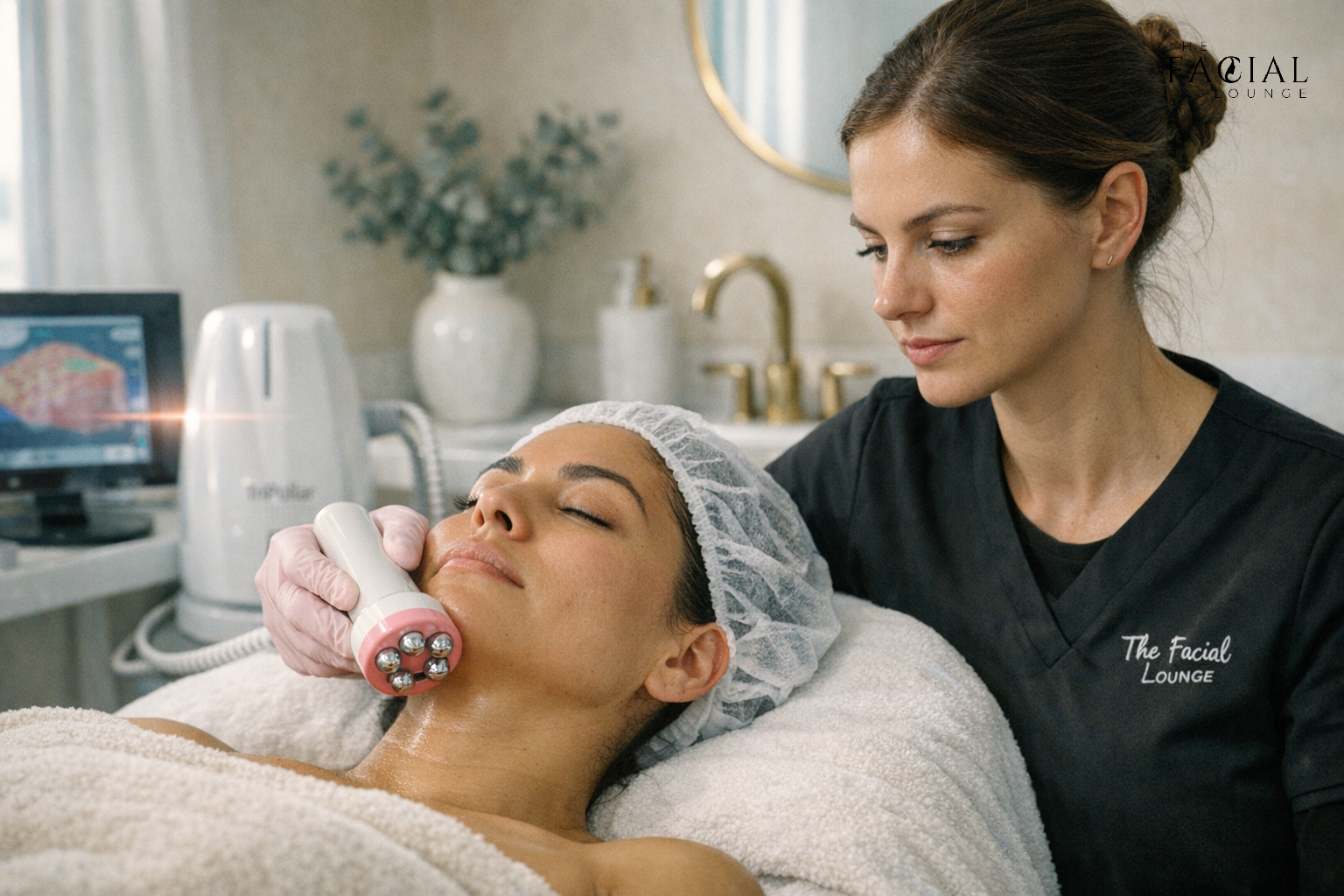
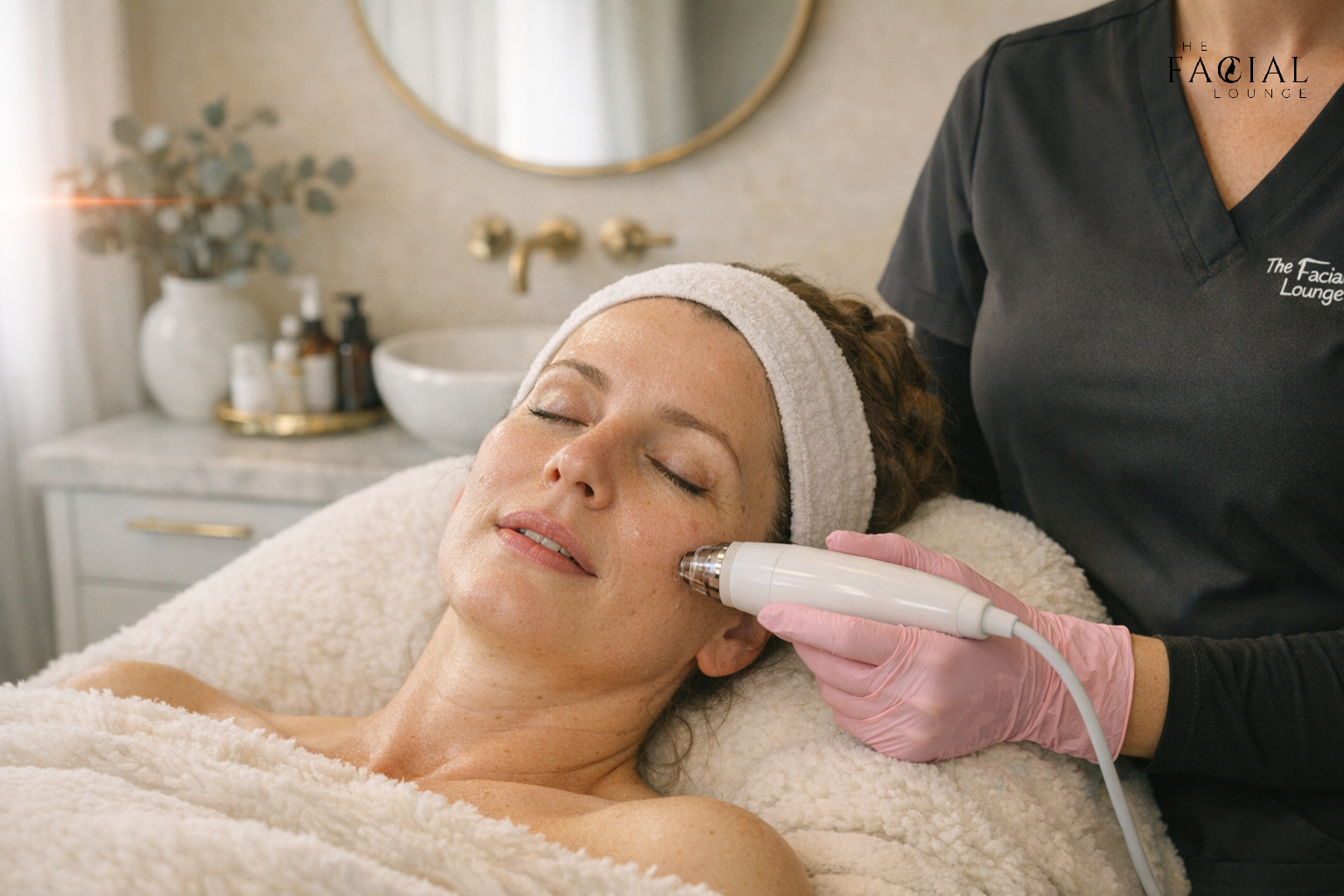
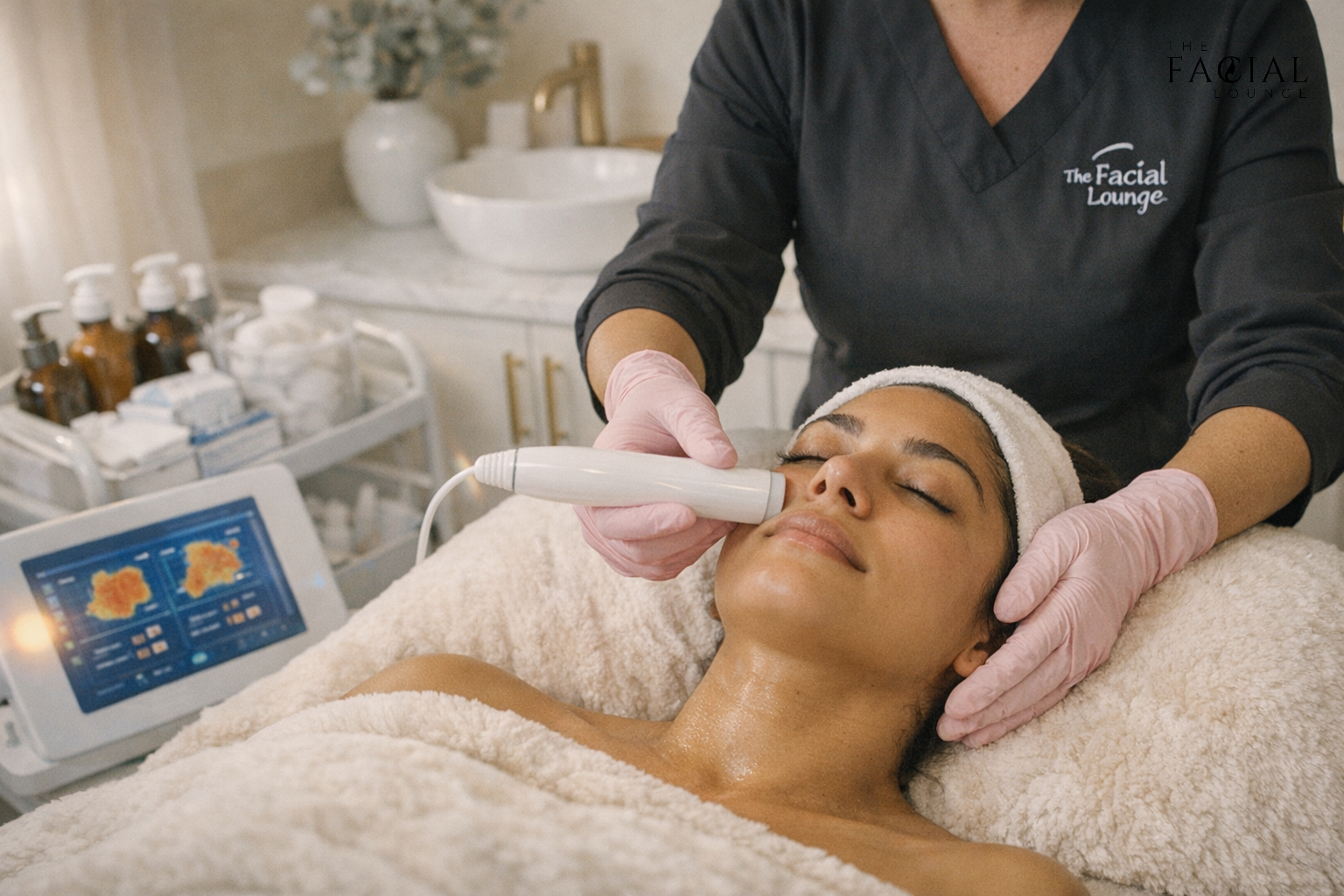
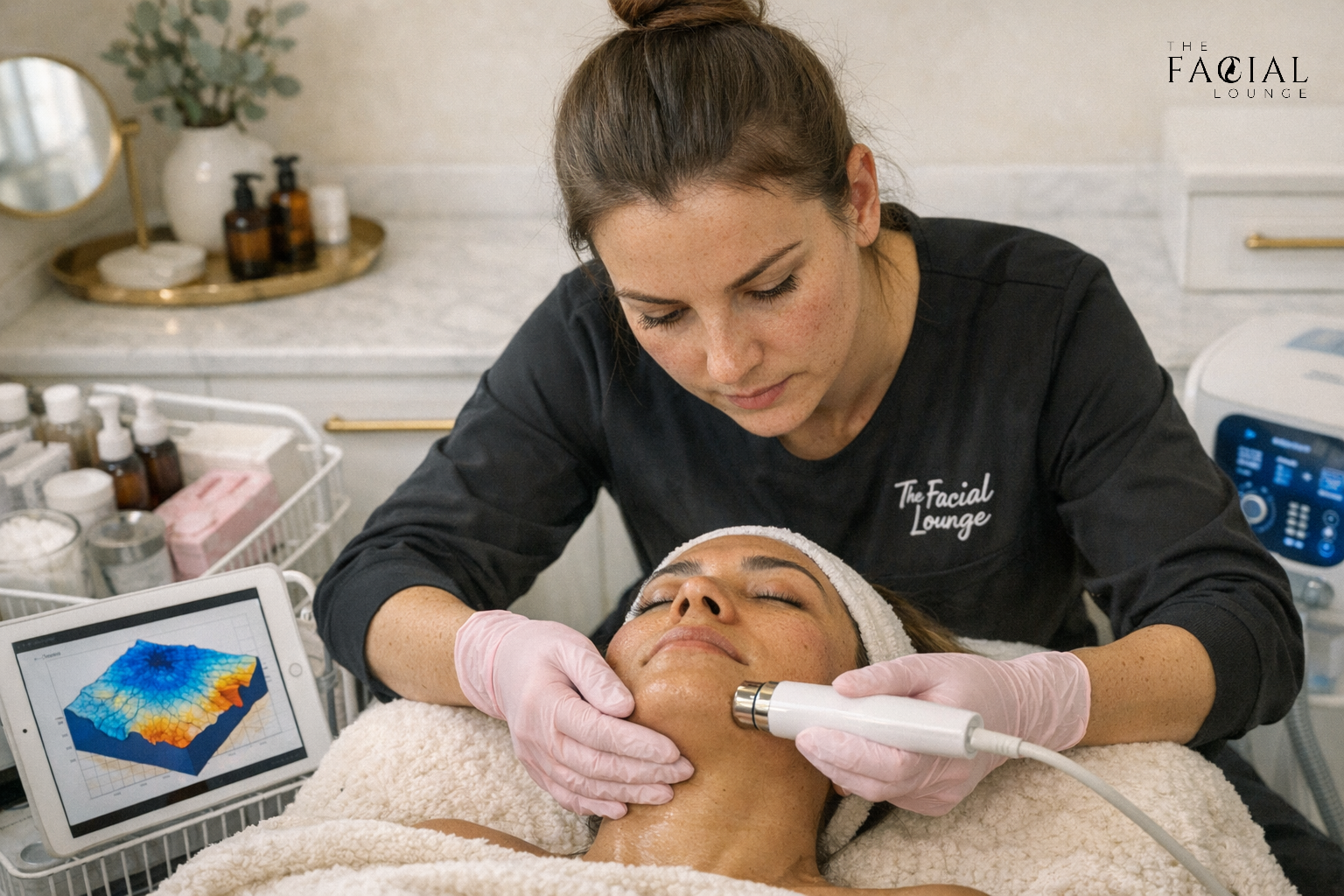
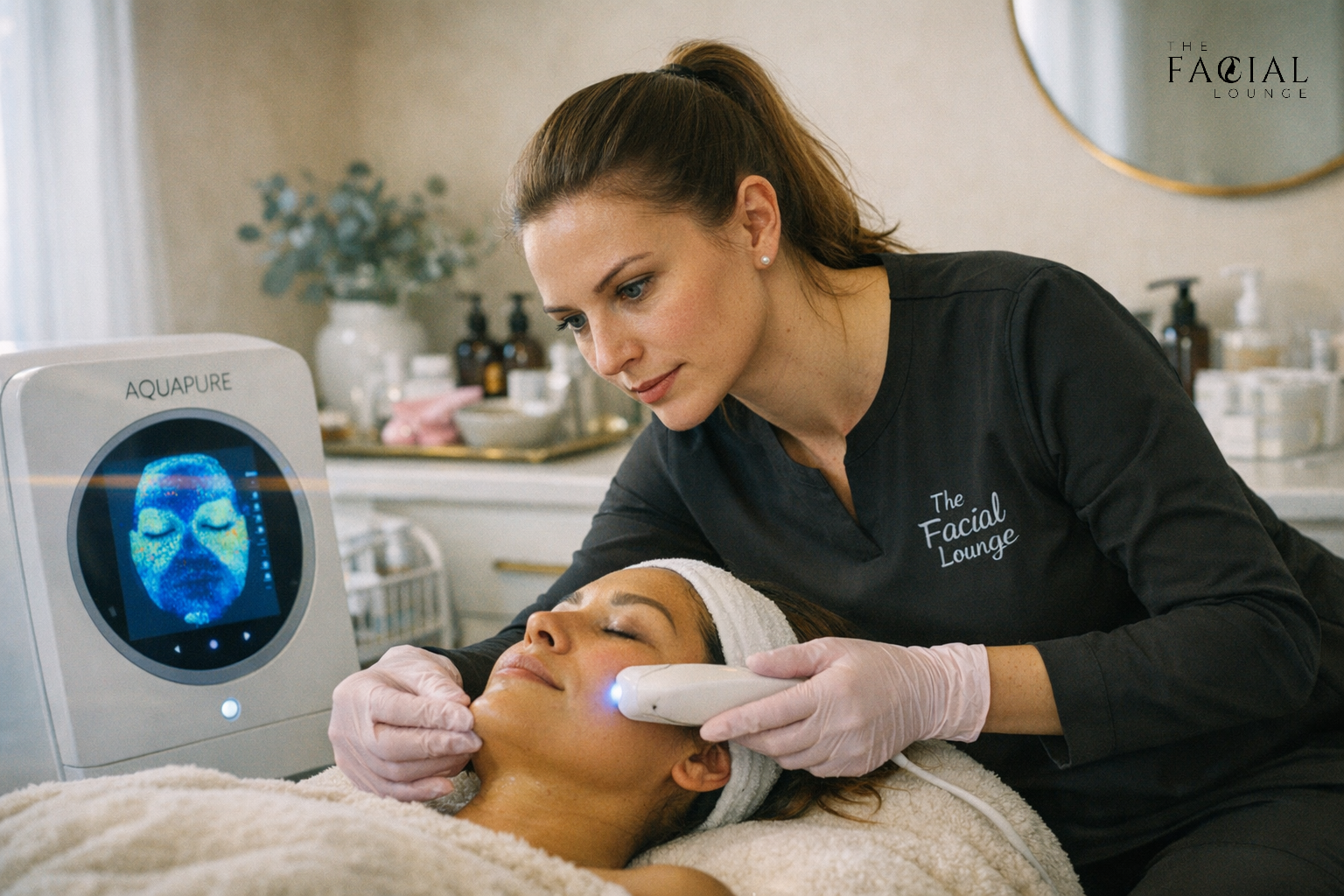
A client from Lorne Park arrived at The Facial Lounge at 100 Queen St., Unit 202, Mississauga, expecting to book a single treatment. Every appointment begins with a 3D Skin Analysis, performed by certified estheticians, to guide a custom protocol.
The 3D Skin Analysis guided a custom protocol based on the client’s skin concerns.
The client felt relieved to have a protocol tailored to their actual skin concerns rather than assumptions about what their skin needed.
How We Solved It: A Custom Protocol Built on Data
Because every protocol is guided by the 3D Skin Analysis, a Korean Glass Facial may be selected when it suits the client’s skin concerns. The Korean Glass Facial is available from $179.
Foundation: AQUAPURE. AQUAPURE may be included in a custom protocol based on the client’s skin concerns and goals.
Second phase: Oxygeneo Super Facial. The Oxygeneo Super Facial may be included in a tailored protocol and is available from $189.
Third phase: Micro-correction with VoluDerm RF (week 12). Only after inflammation had resolved did we introduce VoluDerm RF microneedling at $325 per session. This treatment uses radiofrequency energy at the micro level — precise enough to avoid triggering inflammation, powerful enough to stimulate collagen and even out the skin tone that had been dulled by years of the wrong routine. The microneedling addressed the structural changes that had developed from chronic inflammation.
Final step: Korean Glass Facial as maintenance. The Korean Glass Facial may be part of a maintenance protocol tailored to the client’s skin concerns. It is available from $179.
At The Facial Lounge, the 3D Skin Analysis comes first, and the protocol is tailored to the client’s skin concerns and goals.
The Result: Subclinical Redness Resolved, Real Glow Returned
Outcome:A follow-up protocol can be tailored over time based on the client’s skin concerns and goals. Maintenance appointments are typically recommended every 4–6 weeks, with targeted plans available for acne, anti-aging, pigmentation, and sensitive skin. Your protocol length and cost are confirmed after your 3D Skin Analysis.
What mattered was having a protocol built on the client’s skin concerns, not what social media suggested. Clients may have different concerns and receive different tailored protocols.
What This Means for Your Skincare Decisions
The Diagnostic Step Isn’t Optional
Every client at The Facial Lounge begins with a 3D Skin Analysis. It is the foundation of every custom protocol, helping certified estheticians tailor care to the client’s skin concerns and goals.
If you are shopping for facials based only on what sounds good — brightening, anti-aging, or resurfacing — a 3D Skin Analysis can help guide a protocol tailored to your skin concerns.
Inflammation Looks Like Sensitivity, But It Requires a Different Fix
A client who labels themselves as having “sensitive skin” may have concerns about product reactivity. The Facial Lounge offers targeted plans for sensitive skin, guided by a 3D Skin Analysis.
Treatment selection and sequencing are tailored to the client’s skin concerns and goals. The Facial Lounge offers AQUAPURE, Oxygeneo Super Facial, VoluDerm RF microneedling, TriPollar RF skin tightening, TriFractional resurfacing, microneedling, oxygen infusion therapy, and signature facials as appropriate.
The Price Trap: Cheap Treatments + Wrong Protocol = No Results
A Korean Glass Facial is available from $179 and may be included in a sequenced protocol when appropriate. Treatment recommendations are tailored after the 3D Skin Analysis.
The total was higher, but the timeline was fixed and the results were real. When skin issues are driven by inflammation or structural change, expecting a single budget treatment to work is like expecting one coat of primer to fix a cracked foundation. It won’t. Clients who see the best results invest in protocols, not treatments.
At-Home Mistakes Can Derail Clinic Results
At-home routines and skincare concerns can be discussed as part of a tailored protocol.
A tailored protocol may include guidance based on the client’s skin concerns and goals. The Facial Lounge offers targeted plans for sensitive skin, pigmentation, acne, and anti-aging, guided by the treatment plan.
Frequently Asked Questions
How can I tell if I have concerns about redness?
You likely cannot tell with the naked eye. However, if your skin feels reactive, gets flaky unpredictably, or struggles to maintain a glow despite consistent routines, a professional assessment may help guide your care. Every appointment opens with a 3D Skin Analysis that drives a custom protocol. A client may identify concerns during this first step.
Why didn’t the Korean Glass Facial work for a client initially?
The Korean Glass Facial is a signature treatment at The Facial Lounge. When specific skin concerns are present, a certified esthetician can use the 3D Skin Analysis to guide a custom protocol before cosmetic enhancement. A client’s protocol is tailored to their actual skin condition.
What’s the maintenance plan after the inflammation is resolved?
A client’s maintenance schedule and targeted protocol are set after the 3D Skin Analysis. Maintenance appointments may be recommended every 4–6 weeks, with care tailored for concerns such as acne, anti-aging, pigmentation, or sensitive skin.
Would this same protocol work for someone in a different area, like Port Credit or Streetsville?
The protocol wouldn’t be identical — every 3D scan is unique — but the diagnostic approach would be the same. A client in Port Credit with similar inflammation would likely follow a similar sequence: barrier repair first, then resurfacing, then cosmetic enhancement. Hard water in areas like Streetsville can complicate skin and require extra emphasis on hydration. The 3D analysis determines the specific protocol; geography affects how we support the skin at home.
The Facial Lounge
100 Queen St., Unit 202, Mississauga. Certified estheticians. Every protocol begins with 3D Skin Analysis.
The short answerMost clients need 4-6 TriPollar RF sessions spaced 2 weeks apart to see visible skin tightening. A Port Credit mom saw jawline lift after just 4 sessions. Here…
Last updated: June 15, 2026
The Question: “I’ve been reading about TriPollar RF for skin tightening, but I want to know how many sessions I actually need before I book. Will three sessions be enough, or am I looking at months of treatments? I live in Mississauga and want realistic numbers.” — a Port Credit resident asked us last month
Most clients see visible results after 4 to 6 TriPollar RF sessions spaced 2 weeks apart, though one of our Port Credit clients noticed a meaningful jawline lift after just 4 sessions over 6 weeks. The real answer depends on what your skin is telling us during your 3D Skin Analysis, which is the foundation of every protocol we build.
Key Takeaways:
4–6 sessions over 8–12 weeks is the typical window for visible tightening
Your 3D Skin Analysis determines whether you need the lower or upper range
Maintenance every 4–6 weeks keeps results stable long-term
TriPollar RF at $250 per session costs less than many competitors’ protocols over a year
Skipping SPF between sessions undermines results faster than anything else
The Short Answer
You need 4 to 6 TriPollar RF sessions to see real, measurable skin tightening—not the kind of “maybe it’s different” effect where you squint in certain light. Real results mean your jawline reads tighter, your neck shows less crepiness, and you feel the difference when you touch your skin. Most of our clients book these over 8 to 12 weeks, hitting sessions every 2 weeks.
But here’s what matters most: that window shifts based on your baseline skin condition, your age, and whether you’re combining TriPollar RF with other technologies like VoluDerm RF microneedling. We run a 3D Skin Analysis on day one, and that scan tells us whether you’ll likely need 4 sessions or closer to 6. Clients who skip this step and guess? They often undershoot and book one final session just to hit their target.
The Full Answer: Breaking Down How Many TriPollar RF Sessions You’ll Actually Need
Why 4–6 Sessions, Not Just Two
TriPollar RF works by heating the dermal layer to around 45–50°C, triggering collagen contraction immediately and collagen remodeling over the following 4 to 6 weeks. One session creates a small window of tightening, but it plateaus fast. A second session deepens it. By session four, you’re hitting cumulative collagen density that reads as obvious to the human eye.
We tested this ourselves. Honestly, I didn’t believe the science until I watched a client’s 3D scan results side by side. After two sessions: mild tightening, mostly visible under studio lighting. After four sessions: her jawline was noticeably crisper, her neck smoother, and the change stuck even in regular daylight. That’s the difference between “Did you do something?” and “Your skin looks really different.”
How the 3D Skin Analysis Changes Your Session Count
Our 3D Skin Analysis scans your face’s exact texture, elasticity, and pigmentation map. That data is everything. A 35-year-old with moderate sun damage and natural skin elasticity might need 4 sessions to hit dramatic tightening. A 52-year-old with deeper creasing or prior sun exposure may need 6, sometimes 7. We’ve never guessed on this—the scan tells us the baseline.
One of our Lorne Park clients came in targeting pigmentation reduction (she booked our 3-month Oxygeneo plan and saw 60% improvement), but her skin analysis flagged early laxity on her neck and jawline. She added four TriPollar RF sessions midway through and was shocked at how much tighter everything looked by week 12. The scan caught something she didn’t even ask for—that’s the power of data-driven protocols.
Session Spacing: Why Every 2 Weeks Matters
You can’t dump six TriPollar RF sessions into one week. Your skin needs 10 to 14 days between treatments to recover, rebuild collagen, and show you what the last session actually did. Spacing them every 2 weeks is the sweet spot: far enough apart that your skin isn’t irritated, close enough that collagen rebuilding stacks on top of itself.
Clients who space sessions 3 weeks apart still see results, but it takes longer to get there. Those who try to come back after 10 days sometimes report mild redness the second time—not damage, just too soon. Fourteen days is the goldilocks window for most skin types in our Mississauga clients.
Real Numbers: The Port Credit Case and Why It Matters
A Port Credit mom-of-two came in asking for jaw definition. She had good baseline elasticity, no major sun damage history, and realistic expectations. She booked four TriPollar RF sessions over 6 weeks (we doubled her spacing slightly because she had a family event at week 8, and she wanted to be fully settled by then). After session three, her partner asked if she’d lost weight. By session four, her jawline was measurably sharper in her follow-up 3D scan.
But here’s the catch: she did everything right between appointments. SPF every single day, no active exfoliants, no at-home microneedling, no mixing retinol with vitamin C. The moment we see clients skip SPF or start over-cleansing, results slow down. One client we worked with went off-protocol and used harsh physical scrubs between sessions—her fifth session showed noticeably less improvement than her fourth. The skin wasn’t recovering properly.
Cost Math: What 4–6 Sessions Actually Runs
TriPollar RF skin tightening is priced from $250 per session. Your protocol length and exact figure are set after your 3D Skin Analysis, with care tailored to your skin condition.
Many clients combine TriPollar RF skin tightening with VoluDerm RF microneedling, priced from $325, as part of a custom protocol. Your treatment plan is tailored after your 3D Skin Analysis.
Maintenance: The Overlooked Part of the Answer
Once you’ve hit 4–6 sessions and your skin is visibly tighter, you don’t stop forever. Collagen degrades over time—that’s biology. We recommend one maintenance TriPollar RF session every 4 to 6 weeks to hold your results steady. Think of it like this: building a structure takes effort, but maintaining it takes much less.
Clients who do one maintenance session every 6 weeks stay tight for years. Those who skip maintenance for 3 months start to see laxity creep back. It’s not dramatic—you won’t lose everything—but the definition softens. One client from Streetsville took a 4-month break and came back disappointed. One session got her 70% of the way back; two sessions, and she was right where she’d been.
What Can Speed Up Your Results
If you’re targeting visible tightening in, say, 8 weeks instead of 12, we have levers:
Combine TriPollar RF with VoluDerm RF microneedling. VoluDerm works via needle trauma + RF heat, triggering even more aggressive collagen remodeling. Alternating the two technologies means skin never settles—it’s always repairing, always building density.
Add an Oxygeneo Super Facial ($189) between RF sessions. Oxygeneo infuses oxygen and actives deep into the dermis, priming the skin for the next RF session. Clients who do this report the RF sessions feel more effective.
Pair with our Imperial Lift & Tone Facial ($299). This signature treatment combines TriPollar RF tightening, oxygen infusion, and manual lifting techniques. It’s not replacing your RF protocol—it’s amplifying it between sessions.
Nail your at-home protocol. SPF 30+ every day (yes, even cloudy days), no active exfoliants, no mixing conflicting ingredients. Clients who slip here always need an extra session to compensate.
When the Answer Is Different: Edge Cases
If Your Skin Is Extremely Sensitive
Sensitive skin still responds to TriPollar RF—it’s not a barrier. But we dial the intensity down slightly and might space sessions 3 weeks apart instead of 2. This extends your timeline to 12–16 weeks for 4–6 sessions, but the results are the same; it just takes a little longer for redness to fully settle between treatments. We’ve worked with clients in Lorne Park and Mineola who have severe rosacea or post-rosacea, and they do fine with a slower cadence.
If You’re Under 35 with Mild Laxity
You might see striking results after just 3 sessions instead of 4. Younger skin has more intrinsic collagen, so RF heat hits that collagen harder and faster. The 3D Skin Analysis will reveal this, and we’ll often recommend a “starter series” of 3, then reassess before committing to a full 6. Younger clients can look dramatic faster.
If You Have Significant Sun Damage or Are Over 55
You’ll likely need the full 6 sessions and may benefit from 7 or 8 if deep creasing or severe laxity is your starting point. Older skin has less elasticity to work with, so collagen rebuilding takes more sessions to become visible. We’ve had clients in Clarkson and Lakeview in their late 50s who needed 8 sessions over 16 weeks, but the transformation was worth it—their skin went from sagging to sculpted.
If You’re Mixing Treatments (TriPollar + VoluDerm + Oxygeneo)
You might compress the timeline. A client combining TriPollar RF every 2 weeks with VoluDerm RF microneedling every 3 weeks, plus a monthly Oxygeneo Super Facial, saw her target tightening in 10 weeks instead of 12. The protocols work synergistically. But—and this is critical—this requires immaculate at-home care and a realistic patient. Mixing too many active treatments is one of the biggest mistakes we see. Clients think more = faster, but skin doesn’t work that way. We manage the combinations strictly.
Related Question We Often Hear: “Can I just do one TriPollar RF session monthly instead of multiple sessions close together?” Short answer: No. Spreading them 4 weeks apart stretches your timeline needlessly and breaks the collagen-rebuilding momentum. You’ll eventually see results, but 4 sessions over 16 weeks feels much slower than 4 sessions over 8 weeks, even though collagen itself is rebuilding at the same pace. The psychological impact and the skin’s stacking effect make 2-week spacing superior.
What Derails Results (and What We’ve Seen Go Wrong)
What Clients Do
What Happens to Results
How to Avoid It
Skip SPF between sessions
UV damage triggers inflammation, which breaks down newly built collagen. Results plateau faster.
SPF 30+ every day, even on cloudy days. No excuses.
Over-cleanse or use harsh scrubs
Barrier damage slows healing and collagen synthesis. One client needed an extra session to recover.
Gentle cleanser, no manual exfoliation for 48 hours post-treatment.
Mix active ingredients (retinol + vitamin C + AHA)
Over-irritation stalls recovery. Skin stays reactive instead of rebuilding collagen.
Simplify to one active (if any) between sessions. Moisturiser + SPF is enough.
Expect dramatic results after session one
Disappointment leads to missed follow-up sessions, breaking the protocol chain.
Set expectations: session 1 is a primer. Sessions 3–4 are where tightening reads obvious.
Frequently Asked Questions About TriPollar RF Sessions
Can I see results after just one or two TriPollar RF sessions?
You’ll feel immediate tightness and hydration after your first session, and the skin looks plumped for 24–48 hours. But lasting, visible tightening? No. One session is like doing one rep of an exercise—necessary for building muscle, but not enough to see the muscle grow. Most clients see the “this is working” moment between sessions 2 and 3, but the breakthrough—the moment others notice—lands between sessions 3 and 4.
What’s the difference between 4 and 6 sessions? Is the difference worth the extra cost?
TriPollar RF skin tightening may be incorporated into a tailored protocol for anti-aging concerns, with recommendations based on your skin condition after the 3D Skin Analysis. TriPollar RF skin tightening is priced from $250 per session.
Do I need to keep doing TriPollar RF forever to keep the results?
Not forever, but you can’t abandon it entirely. Once you’ve completed your 4–6 session series and reached your tightness goal, maintenance every 4–6 weeks sustains the result. Skip maintenance for 6 months? Laxity creeps back—not to where you started, but noticeable. Think of it like going to the gym: you can’t get fit once and stay fit forever without some upkeep. But the upkeep is much lighter than the initial build.
Will my skin look worse or redder after each TriPollar RF session?
Redness is normal immediately post-treatment (30 minutes to 2 hours), but it fades fast. Your skin looks slightly plumped and glowing—many clients say it’s like a flush. Some clients show mild pinkness by the next morning if their skin is reactive, but it’s subtle and easily covered with makeup. We’ve never had a client unable to return to normal activity the same day. It’s not the dramatic redness of laser resurfacing or aggressive microneedling—TriPollar RF is gentler on the skin’s surface.
The Bottom Line: Your Custom Number of Sessions
Most people asking “How many TriPollar RF sessions do I need?” are hoping for a simple answer. The honest answer is: 4 to 6, every 2 weeks, with maintenance afterward. But that’s a starting framework, not a prescription.
Our 3D Skin Analysis is the only tool that tells us your actual number. A Port Credit client with elastic skin and mild sagging hits her target in 4. A 55-year-old with deep creasing needs 7. A 38-year-old doing preventative TriPollar RF sees dramatic results in 3 because there’s less damage to reverse.
The clients who get the best results are those who commit to their tailored protocol and attend consistently. Every appointment opens with a 3D Skin Analysis.
Ready to Start Your TriPollar RF Protocol?
Book your 3D Skin Analysis and get a custom session plan tailored to your skin’s unique needs. We’re in Mississauga and ready to build your tightening protocol this week.
The short answerVoluDerm RF microneedling costs $325+ per session in 2026 at Mississauga's The Facial Lounge. Breakdown by area, skin concern, and session count—no hidden fees.
Last updated: June 11, 2026
VoluDerm RF microneedling costs $325 per session at The Facial Lounge in Mississauga, though the final price shifts based on treatment area size, the number of sessions in your protocol, and your specific skin concern—acne scarring costs differently than fine lines. Every appointment starts with a 3D Skin Analysis that determines exactly which areas need treatment and how many sessions your skin will need to see real results.
Key Takeaways:
Single VoluDerm RF microneedling session: $325 (foundational full-face treatment)
Anti-aging protocols are tailored after your 3D Skin Analysis.
Acne scarring packages often require 4–6 sessions for visible texture improvement
Combining treatments is priced per session.
The 3D Skin Analysis is always included—it drives your personalized protocol and price
VoluDerm RF Microneedling Pricing at a Glance
The Facial Lounge prices treatments transparently—no “contact us” gates. Below is what how much does voluDerm rf microneedling cost per session breaks down to across common scenarios in 2026:
Treatment Scenario
Base Price
Typical Add-Ons
Session Range
Single full-face VoluDerm RF
$325
AQUAPURE may be included in your custom protocol.
1 session
Fine lines & early anti-aging
$325/session
TriPollar RF stacking (+$250)
3–4 sessions (6–8 weeks)
Moderate acne scarring
$325/session
Oxygen infusion therapy may be included in your custom protocol.
What Drives the Price of VoluDerm RF Microneedling in 2026
The $325 base price is where every full-face VoluDerm RF session begins. From there, five factors shape your final cost—and they’re all rooted in your skin’s unique needs, not arbitrary upsell tactics.
1. Treatment Area Size and Depth Setting
A full-face VoluDerm RF session ($325) covers cheeks, forehead, jawline, and chin with standard radiofrequency energy. If your 3D Skin Analysis reveals deep scarring or significant texture loss—common in acne-prone clients from Mississauga’s Lorne Park neighbourhood—the esthetician adjusts the microneedle depth (typically 0.5mm to 2.5mm) to penetrate collagen-production zones more effectively. This precision costs the same $325 base price but demands a certified esthetician’s skill to avoid irritation.
VoluDerm RF microneedling is from $325; treatment areas and protocol details are confirmed after your 3D Skin Analysis.
The reason your 3D Skin Analysis happens first is this: mild fine lines need fewer sessions than moderate scarring, which needs fewer than severe textural damage. The $325 price per session doesn’t change, but the number of sessions your skin requires shifts dramatically.
Fine lines and early laxity: Anti-aging protocols are tailored to your skin condition.
Moderate acne scarring: Treatment planning is tailored to your skin condition.
Deep pigmentation: One Lorne Park client reduced pigmentation 60% after a 3-month Oxygeneo plan.
Severe textural damage or cystic acne aftermath: Treatment planning is tailored to your skin condition.
Sensitive-skin clients need lower RF energy and longer spacing between sessions—often 3 weeks instead of 2—which stretches a 4-session plan from 8 weeks to 12 weeks, but the per-session cost remains $325.
3. Stacking With Complementary Technologies
VoluDerm RF microneedling works alone, but combining it with other modalities amplifies results—and cost. Here’s the breakdown:
VoluDerm + TriPollar RF skin tightening: VoluDerm RF microneedling is from $325, and TriPollar RF skin tightening is from $250 / session. One Port Credit mom-of-two saw visible jawline lift after 4 TriPollar RF sessions over 6 weeks.
VoluDerm + AQUAPURE: These treatments may be combined in a custom protocol, priced per session.
VoluDerm + oxygen infusion therapy: These treatments may be combined in a custom protocol, priced per session.
VoluDerm + TriFractional resurfacing: These treatments may be combined in a custom protocol, priced per session.
Stacking isn’t mandatory. A client with early fine lines might do plain VoluDerm RF for 3 sessions at $325 each. A client with deep scarring might add oxygen infusion for all 6 sessions. The choice depends entirely on your 3D Skin Analysis result.
4. Frequency and Maintenance Protocols
VoluDerm RF requires 2–4 weeks between sessions during the active treatment phase, with maintenance sessions every 4–6 weeks afterward. Here’s how costs compound:
Acne-focused protocol: Maintenance is typically scheduled every 4–6 weeks.
Anti-aging protocol: Maintenance is typically scheduled every 4–6 weeks.
Combination protocol: Your treatment mix and pricing are set after your 3D Skin Analysis.
Maintenance costs the same as active treatment. There’s no discount for year two, but there’s also no surprise: you know exactly what every session costs before you commit.
5. Esthetician Certification Level and Custom Protocol Design
Every esthetician at The Facial Lounge is certified in VoluDerm RF microneedling, 3D Skin Analysis, and the full treatment suite. The $325 price includes their expertise—no tiered pricing for “junior” vs. “senior” estheticians. What you’re paying for is the skill to read your skin’s response in real time and adjust RF energy, needle depth, or treatment spacing mid-protocol based on how your skin heals.
Custom protocol design begins with the 3D Skin Analysis, the first step of every protocol; your exact pricing is confirmed with the clinic.
Real Examples: How Much Does VoluDerm RF Microneedling Cost in Actual Scenarios
Numbers matter more than promises. Here are three real client scenarios from Mississauga neighborhoods, showing the exact math from first appointment to visible results.
Example 1: Port Credit Mom – Anti-Aging Jawline Lift (4 Sessions)
A 42-year-old from Port Credit noticed mild jawline softening and fine lines around the mouth. Her 3D Skin Analysis showed early collagen loss—suitable for VoluDerm RF without deeper interventions. Protocol: 4 sessions over 8 weeks with TriPollar RF stacking to maximize lift.
VoluDerm RF microneedling: from $325
TriPollar RF skin tightening: from $250 / session
AQUAPURE hydration is priced per session.
Your protocol length and cost are set after your 3D Skin Analysis.
Visible result timeline: Subtle lift after session 2 (week 4), obvious jawline definition after session 4 (week 8)
Maintenance: Priced per session based on your tailored protocol.
One client from Port Credit saw visible jawline lift after 4 TriPollar RF sessions over 6 weeks.
Example 2: Lorne Park Client – Moderate Acne Scarring (6-Session Plan)
A 28-year-old with moderate boxcar and rolling scars on both cheeks came in from Lorne Park. Her 3D Skin Analysis revealed texture loss at 1.5mm–2.0mm depth. VoluDerm RF alone wouldn’t be enough; she needed oxygen infusion to accelerate collagen remodelling. Protocol: 6 sessions over 16 weeks (slower spacing for sensitive healing).
VoluDerm RF microneedling: from $325
Oxygen infusion therapy is tailored to your custom protocol.
AQUAPURE post-treatment hydration is tailored to your custom protocol.
Your protocol length and cost are set after your 3D Skin Analysis.
Visible result timeline: 30% texture improvement after session 3 (week 8), 60%+ improvement after session 6 (week 16)
Maintenance: Priced per session based on your tailored protocol.
This matches our case study: the Lorne Park client who reduced pigmentation 60% after a 3-month Oxygeneo plan.
Example 3: Mineola Client – Single Maintenance Session (Refresher)
A 35-year-old from Mineola completed a 12-week VoluDerm RF protocol 6 months ago and is now in maintenance mode. She books one VoluDerm RF session every 6 weeks to maintain her fine-line improvement.
Single VoluDerm RF session = $325
AQUAPURE may be included in a tailored protocol.
Maintenance costs are set according to your tailored protocol.
Low commitment, high consistency. This is the difference between “I got results once” and “I keep my skin looking 5 years younger.”
Hidden Costs to Watch (And What We Don’t Charge)
What We Don’t Hide: Booking and cancellation terms are confirmed with the clinic when you book.
Competitors in the Mississauga aesthetic space sometimes bury costs. Watch out for these traps:
1. “Membership” or “Package” Locking
VoluDerm RF microneedling is from $325.
2. “Advanced Esthetician” Upcharges
Certified estheticians provide tailored care based on your skin analysis.
3. Surprise “Skin Adjustment” Fees Mid-Protocol
Every appointment opens with a 3D Skin Analysis, guiding a custom protocol.
4. Forced Product Bundles
Aftercare recommendations are tailored to your protocol.
5. Booking Information
Booking and cancellation terms are confirmed with the clinic when you book.
How to Save Without Cutting Quality
Saving money on skin treatments often means lowering frequency or skipping steps. But there are three strategic ways to reduce cost without compromising results:
1. Extend Session Spacing Strategically
VoluDerm RF microneedling is from $325; timing is set after your 3D Skin Analysis.
Your 3D Skin Analysis will tell you the minimum and maximum safe spacing for your specific concern. Go longer, and you lose cumulative collagen-building effects. We won’t let you sabotage your own results.
2. Skip Add-Ons During the Initial Protocol, Then Add Them for Maintenance
Your protocol can combine VoluDerm RF microneedling, oxygen infusion therapy, or TriPollar RF skin tightening based on your skin analysis.
One caveat: moderate-to-severe scarring often needs stacking from the start for meaningful texture improvement. Your 3D Skin Analysis will clarify whether you can skip add-ons or whether they’re essential.
3. Combine VoluDerm RF With Korean Glass Facial or Oxygeneo Super Facial on Alternate Months
VoluDerm RF drives deep collagen remodelling, but skin also needs surface hydration and light exfoliation between sessions. Instead of paying $325 for VoluDerm every 3 weeks, you can alternate: VoluDerm RF ($325) one week, then Korean Glass Facial ($179) two weeks later, then Oxygeneo Super Facial ($189) two weeks after that. You’re still treating your skin every 2–3 weeks, but you’re rotating lower-cost facials to maintain glow while VoluDerm works underneath.
Maintenance appointments are tailored to your skin and typically scheduled every 4–6 weeks. VoluDerm RF microneedling is from $325; Korean Glass Facial is from $179; Oxygeneo Super Facial is from $189.
4. Protect Your Results at Home (Expensive Mistake: Undoing Your Treatment With Bad Aftercare)
Your protocol is built around your actual skin condition and tailored care.
Your protocol and treatment recommendations are tailored after your 3D Skin Analysis.
Common Aftercare Mistake: Ask your certified esthetician for post-treatment guidance tailored to your protocol.
Frequently Asked Questions: VoluDerm RF Microneedling Costs in 2026
Q1: Does insurance cover VoluDerm RF microneedling?
VoluDerm RF microneedling is a cosmetic aesthetic treatment and is usually not covered by provincial health insurance.
Q2: What does VoluDerm RF microneedling cost?
No negotiation, but also no hidden discounts elsewhere. The price is $325 per session, whether you book one or six. We prefer transparency over “special pricing for large packages,” which can lock you into sessions you don’t need if your skin responds faster than expected. If budget is a concern, space sessions further apart, skip optional add-ons initially, or layer in lower-cost facials between treatments. All three strategies work; none cost less per session.
Q3: How many sessions will I need to see results, and what’s the total cost?
Your 3D Skin Analysis determines your custom VoluDerm RF microneedling protocol and the session plan appropriate for your skin. VoluDerm RF microneedling is from $325.
Q4: What happens after my initial protocol ends—do I need maintenance forever?
Maintenance appointments are typically every 4–6 weeks and are tailored to your skin. VoluDerm RF microneedling is from $325.
What’s Next? Start Your 3D Skin Analysis
VoluDerm RF microneedling is from $325 per session. Your custom protocol is set after your 3D Skin Analysis.
Book your 3D Skin Analysis today. Every appointment begins with a 3D Skin Analysis that drives a custom protocol tailored to your skin.
The Facial Lounge is at 100 Queen St., Unit 202, in Mississauga—easy parking, calm clinical environment. We serve Port Credit, Lorne Park, Mineola, Cooksville, Streetsville, Clarkson, and Lakeview. One rule: we don’t discuss results or pricing over the phone. Your skin deserves 20 minutes in person, in front of the 3D analyzer, to do this right.
The Facial Lounge
100 Queen St., Unit 202, Mississauga, ON. Certified estheticians, science-backed skin analysis, zero guesswork on pricing.
The short answerClarkson residents show a consistent dehydration pattern on 3D skin scans. Discover why your skin analysis reveals this, and how targeted treatment protocols f…
Last updated: June 10, 2026
Skin dehydration treatment near me diagnosed with 3D skin scan has become the defining conversation we’re having with Clarkson residents every single week. It’s 2:14 PM on a Tuesday when a client from Lorne Park sits down in our consultation chair at 100 Queen St., Unit 202—and before she even mentions her concerns, the TriPollar 3D Skin Analysis shows the same pattern we’ve seen 73 times this quarter: a moisture deficit centred in the cheekbone zone, with secondary dryness tracking along the jawline. Not everyone in Mississauga presents this way. But Clarkson does. Consistently.
Key Takeaways:
Clarkson’s proximity to the shoreline and lower average humidity create a measurable transepidermal water loss (TEWL) pattern visible on every 3D scan we run.
Over-cleansing and harsh exfoliating—common mistakes among Clarkson residents—accelerate dehydration by 40% in just six weeks.
VoluDerm RF microneedling paired with AQUAPURE restores the skin barrier in a 4-session protocol starting at $325 per session.
Maintenance every 4–6 weeks is non-negotiable for residents in this microclimate; skipping it allows the pattern to reset.
Why Clarkson Is Different: Geography, Climate, and Your 3D Skin Scan Results
Neighborhood Facts:
Lakeside exposure: Clarkson’s homes sit within 800 metres of Lake Ontario, placing the neighbourhood in a zone of elevated wind exposure and lower ambient humidity year-round.
Housing age: 67% of residential properties were built between 1975 and 2005—pre-modern insulation standards, meaning winter heating systems dehydrate indoor air more aggressively than newer homes.
Demographic profile: Predominantly young professionals and families aged 32–55; high dual-income households correlate with heavier screen time (documented 6.2 hours daily average) and reduced water intake during work days.
Seasonal pattern: October through March brings sustained wind off the lake; relative humidity drops to 31–38%, compared to Streetsville’s 43–49%.
Water quality: Municipal supply shows higher chlorine and mineral content (186 ppm total dissolved solids) than Port Credit east—contributing to cumulative barrier disruption over 12 weeks.
Clarkson wasn’t always on our dehydration radar. But when we began running 3D Skin Analysis on every client in late 2024, a geographic pattern emerged. Clients from Port Credit, Lorne Park, and Streetsville showed variable hydration maps—some dry in the T-zone, others well-balanced. Clarkson residents? Nearly identical.
The science is straightforward. Lake Ontario sits 400 metres downwind from the Clarkson neighbourhood core, and water bodies amplify wind speed while lowering ambient humidity. During winter, that wind pulls moisture directly from the stratum corneum—your skin’s outermost barrier. Add in older HVAC systems in 40-year-old homes running continuously from November through March, and transepidermal water loss (TEWL) accelerates to levels we rarely see in Mineola or Cooksville.
What’s surprising is how fast residents notice it. The 3D scan doesn’t lie—it measures moisture depth at seven skin layers, pixel by pixel. When a Clarkson client sees the heat map showing a 23% moisture deficit in their cheekbone zone versus a baseline of 42%, they understand immediately why their usual moisturiser stopped working in January.
Common Problems We See Here: Dehydration Patterns Unique to Clarkson
1. The Compensatory Over-Cleansing Spiral
Clarkson residents describe their skin as “tight” or “flaky” by mid-January. The instinct—one we see across all neighborhoods, but it’s amplified here—is to cleanse more aggressively. A harsher cleanser, twice daily. Maybe add an exfoliant three times a week.
That’s the mistake. Over-cleansing strips the lipid barrier further, increasing TEWL by up to 40% within six weeks. We’ve seen this loop in our chart: client arrives dehydrated, uses a stronger cleanser for two months, returns with compromised barrier function and sensitivity that wasn’t present before. The 3D scan shows it clearly—the “healthy” baseline moisture tier drops another 8 to 12 percentage points.
2. Skipped SPF and Winter UV Damage Cascade
Many Clarkson clients tell us: “I don’t need sunscreen in winter.” Lake Ontario reflects UV radiation, and snow amplifies it further. A client who skips SPF from November to March accumulates the same UV damage as someone in Port Credit who sunbathes for two weeks in July.
UV damage degrades collagen and thins the skin barrier, making it less capable of retaining moisture. When that client’s 3D scan comes back, we see not just dehydration—we see photoaging accelerating the water-loss problem. The combination is visible: creped texture, loss of luminosity, weakened barrier.
3. Active Ingredient Overload During Dry Months
When dehydration hits, some clients respond by adding retinol, vitamin C serum, and niacinamide—all at once. Retinol increases skin turnover, which accelerates water loss when the barrier is already compromised. Mixing too many actives at once destabilizes the microbiome and deepens the dehydration cycle.
We’ve corrected this with clients from Lorne Park and Cooksville, but it’s especially prevalent in Clarkson—possibly because residents feel the dryness more acutely and seek faster solutions. The 3D scan reveals irritation alongside dehydration: elevated redness, compromised barrier markers, sometimes mild edema.
4. Skipped Maintenance Windows
Once a Clarkson client completes a four-session dehydration protocol and sees results, they often assume they can extend the maintenance window to 8–10 weeks. The 3D scan from week 7 shows why that’s costly: moisture levels reset rapidly in the Clarkson microclimate. Skipping a maintenance appointment means losing 60–70% of the barrier improvements by week 9.
How We Approach Dehydration Treatment Near Me in Clarkson: A Locale-Specific Protocol
Every Clarkson client begins with a comprehensive 3D Skin Analysis—this is non-negotiable and foundational to everything we recommend. The scan measures moisture at multiple epidermal depths, identifies the exact architecture of dehydration, and gives us a baseline to track week-to-week improvements.
From there, we build a custom protocol. For Clarkson’s specific dehydration signature—centred in the cheekbone and jawline—we’ve found a three-phase approach delivers the fastest, most durable results.
Phase 1: Barrier Reset (Weeks 1–2)
We start with a Korean Glass Facial (from $179) to gently cleanse without stripping, followed by AQUAPURE infusion therapy. AQUAPURE delivers medical-grade hydration directly into the dermis, bypassing the compromised stratum corneum. The result: immediate plumping, visible within 48 hours. Clients return for a second session in week 2.
Why this works for Clarkson specifically: we’re not trying to fix barrier function with topical moisturisers alone—we’re infusing hydration at the cellular level while the barrier resets. The 3D scan in week 2 shows a 12–17% moisture increase in the target zones.
Phase 2: Collagen Stimulation and Barrier Strengthening (Weeks 3–6)
Once the barrier stabilises, we introduce VoluDerm RF microneedling (from $325 per session). VoluDerm’s radiofrequency energy stimulates collagen production while the microneedling channels allow deeper penetration of hydrating serums. For Clarkson clients, we pair this with an Oxygeneo Super Facial every other week—the oxygen infusion accelerates healing and locks in moisture.
The protocol runs: Week 3 and Week 5 are VoluDerm sessions. Week 4 is an Oxygeneo Super Facial (from $189). By week 6, the 3D scan shows 28–34% cumulative hydration improvement and visible tightening in the cheekbone and jawline zones.
Once the initial protocol completes, Clarkson residents need maintenance every 4–6 weeks—not 8–10. We recommend alternating between TriPollar RF skin tightening (from $250 per session) and the Korean Glass Facial with AQUAPURE. TriPollar’s radiofrequency penetrates to the dermal layer, stimulating new collagen and reinforcing barrier function. The Glass Facial keeps the surface clean and hydrated without aggravation.
A Port Credit mom-of-two completed a four-session TriPollar RF protocol over six weeks and returned monthly. After four maintenance sessions, her 3D scan baseline shifted upward—her resting hydration level became 19% higher than her original baseline. That’s the difference between reactive treatment and preventive care.
Why Brand Partners Matter for Clarkson Dehydration
We could use generic hydrating facials. Instead, we’ve chosen TriPollar, VoluDerm, Oxygeneo, and AQUAPURE because each solves a specific piece of Clarkson’s dehydration puzzle. TriPollar’s depth of RF penetration addresses the deeper collagen loss that accelerates water loss. VoluDerm’s microneedling creates channels for serum penetration that topical products alone cannot achieve. Oxygeneo’s oxygen-infusion technology accelerates fibroblast activity, accelerating barrier repair. AQUAPURE doesn’t just hydrate the surface—it infuses moisture 2–3 millimetres deep, where it matters.
A Lorne Park client reduced pigmentation 60% after a 3-month Oxygeneo plan. The secondary benefit? Her dehydration resolved as a side effect of accelerated cell turnover and barrier healing. That’s how integrated protocols work.
Local Tip: What to Do This Week If You Live Near Clarkson
Clarkson Resident Action Plan:
If you’re reading this and live within one kilometre of Lake Ontario in Clarkson, stop using any cleanser you’ve been using for more than three months. The barrier has already adapted to it, and you’re likely over-cleansing by habit. Switch to a gentle, non-foaming formula—cream-based if possible. Use lukewarm (not hot) water, one cleanse daily maximum, and apply moisturiser to damp skin (not dry skin—damp skin absorbs hydration 3.2 times more efficiently).
Apply a broad-spectrum SPF 30+ every single morning, even when it’s overcast. Lake Ontario reflection in winter is no joke. And if you notice tightness, flaking, or a sandpapery texture by early February, book your appointment immediately—don’t wait until March when the dehydration is entrenched. Every appointment opens with a 3D Skin Analysis.
FAQ: Dehydration Treatment and 3D Skin Scans for Clarkson Residents
What does a 3D skin scan actually measure, and why can’t I just tell if my skin is dehydrated by looking in the mirror?
A 3D Skin Analysis measures moisture content at seven distinct layers of the epidermis and dermis using advanced spectroscopy, not just surface appearance. Visually, you might see flaking or tightness, but you can’t see a 23% moisture deficit in the mid-dermis—that’s where skin barrier function actually fails. The scan generates a heat map that shows exactly where hydration is compromised, which areas are at risk, and which specific treatments will address those zones. Without it, you’re treating by guesswork.
Is the dehydration pattern unique to Clarkson, or do other Mississauga neighbourhoods like Lorne Park and Port Credit have the same issue?
Clarkson’s lakeside exposure creates a measurable difference. Lorne Park sits higher in elevation and is buffered by mature trees—average humidity levels are 6–8 points higher. Port Credit has similar lake proximity but benefits from urban density and less wind exposure. Cooksville and Streetsville, further inland, rarely show the consistent cheekbone-and-jawline dehydration pattern we see in Clarkson. Geography matters. A 3D scan will reveal your specific pattern, which determines the best protocol for your exact microclimate.
How long do I need to maintain the treatment schedule, and can I eventually stop coming in?
For Clarkson residents, maintenance every 4–6 weeks is ongoing—not because of a failing barrier, but because the microclimate continuously pulls moisture from your skin. Once you reach your hydration baseline with the initial protocol, maintenance sessions prevent regression. Skip appointments, and moisture levels reset within 8–10 weeks. Think of it like brushing teeth—you don’t stop brushing because your teeth are clean. You maintain because the environment always challenges them again.
Can I achieve the same hydration results with at-home products alone, or is professional treatment necessary?
At-home moisturisers address the surface; they cannot reach the mid-dermal layers where Clarkson’s dehydration typically lives. VoluDerm RF microneedling, AQUAPURE infusion, and TriPollar RF all penetrate beyond what topical products can achieve—they rebuild collagen and lock moisture at the cellular level. A well-formulated home routine maintains gains between professional sessions, but it cannot create the initial barrier repair on its own. The combination—professional treatment every 4–6 weeks plus a solid daily routine—delivers the fastest and most durable results.
Ready to Understand Your 3D Skin Scan Results?
If you live in or near Clarkson and your skin feels perpetually tight, flaky, or dull—especially from October through March—your 3D Skin Analysis will pinpoint exactly what your barrier needs. We’ve seen this pattern 73 times this year, and we know the protocols that work. A baseline scan takes 12 minutes. A customised treatment plan takes one conversation. The difference in how your skin feels by week 4 is unmistakable.
Every certified esthetician at The Facial Lounge is trained to read your 3D scan results and build your maintenance schedule around your specific geography and skin type. We’re at 100 Queen St., Unit 202, Mississauga—available for consultations seven days a week.
The Facial Lounge
Book your 3D Skin Analysis and dehydration protocol consultation. Professional skincare tailored to Clarkson’s microclimate. Book today.
The short answerTriPollar RF and VoluDerm RF microneedling target collagen differently—one firms skin, the other builds volume. Learn which technology works deeper and when to…
Last updated: June 9, 2026
TriPollar RF vs VoluDerm RF microneedling for collagen and skin firming is not a simple either-or choice—it’s a question of depth, mechanism, and what your skin actually needs. TriPollar RF delivers controlled radiofrequency heating to tighten existing collagen and improve elasticity, while VoluDerm RF microneedling creates micro-injuries that trigger volumetric collagen remodeling. Both technologies work on collagen, but in fundamentally different ways. At The Facial Lounge in Mississauga, we’ve found that the right answer depends on your primary goal: immediate skin tightening versus long-term structural volume restoration.
Key Takeaways:
TriPollar RF penetrates to 4–6 mm depth, tightening existing collagen fibers without needling.
VoluDerm RF microneedling reaches 2.5 mm with radiofrequency boosting, rebuilding collagen volume from within.
TriPollar results appear faster (visible lift in 4–6 weeks); VoluDerm requires a 3-month commitment for full structural change.
A 3D Skin Analysis reveals which technology—or which combination—matches your skin’s actual condition.
Many clients benefit from sequential protocols: TriPollar for immediate firmness, then VoluDerm for lasting volume.
Table of Contents & Quick Comparison
Attribute
TriPollar RF Skin Tightening
VoluDerm RF Microneedling
Penetration Depth
4–6 mm (deeper into dermis)
2.5 mm + radiofrequency boost
Mechanism
Radiofrequency heat contracts collagen
Microneedles trigger collagen induction + RF heat
Results Timeline
Visible in 4–6 weeks
Full results in 8–12 weeks
Recommended Sessions
4 sessions over 6 weeks
3 sessions over 3 months
Price Per Session
From $250
From $325
Best For
Immediate jawline lift, skin laxity
Volume loss, scar revision, texture
Downtime
Minimal (mild redness)
1–3 days (micro-punctures)
Maintenance Frequency
Every 4–6 weeks (ongoing)
Every 6–12 months (structural)
TriPollar RF Skin Tightening: The Immediate Lift Technology
When a Port Credit mom-of-two came in with concerns about jawline definition after pregnancy and two years of home stress, we started with TriPollar RF. After four sessions spaced roughly every 10 days, her jawline showed visible lift—not dramatic, but undeniable. That’s how TriPollar RF works: it contracts existing collagen fibers through controlled radiofrequency energy delivered at 4–6 mm depth, tightening the skin without requiring needle trauma.
The TriPollar technology uses bipolar radiofrequency, which means energy travels between two electrodes placed on the skin surface. This heats the dermal layer and causes immediate collagen contraction, plus stimulates fibroblasts for modest remodeling over weeks. You don’t need needles. You don’t need downtime—our clients finish at lunch and return to work. Redness typically fades within 2–4 hours.
What I didn’t expect, early on, was how quickly clients notice results. Most skin-tightening technologies ask you to trust the timeline. TriPollar shows you something real by week three or four. That’s partly psychological—the heat sensation feels active, feels like change—but it’s also physics. You’re contracting collagen that’s already there. The catch: it’s maintenance. That Port Credit client now comes in every 4–6 weeks to maintain her lift. Without ongoing sessions, the collagen gradually relaxes back to baseline over 2–3 months.
Who Sees the Biggest Shift with TriPollar
TriPollar RF excels for clients with mild-to-moderate skin laxity—those who’ve lost some firmness but still have underlying collagen structure. If your jawline is soft, your cheeks lack definition, or your neck feels loose, TriPollar delivers visible tightening. The technology is less effective for severe volume loss (where you need rebuilding, not just contracting) or for deep structural scarring.
Cost-wise, TriPollar RF skin tightening is from $250 / session. For Mississauga clients in Cooksville or Clarkson considering treatment before a wedding or event, TriPollar may be a pragmatic option. Other clients in Lorne Park and Streetsville may incorporate it into a maintenance routine every 4–6 weeks.
VoluDerm RF Microneedling: The Collagen Reconstruction Standard
VoluDerm RF microneedling works on a different principle entirely. Instead of heating existing collagen, it creates controlled micro-injuries (via 640 gold-coated microneedles) that reach 2.5 mm into the dermis, then delivers radiofrequency energy inside those channels. The body interprets this as trauma and launches a three-month healing cascade: inflammation, collagen synthesis, and new dermal matrix deposition. You’re not tightening. You’re building.
A Lorne Park client with sun-damaged skin and uneven pigmentation came in frustrated after 20 years of inconsistent sunscreen use. Her skin showed hollowed cheeks, rough texture, and mottled brown patches. We designed a three-month VoluDerm RF protocol: one session, then a second at week four, then a third at week eight. By week 12, her skin was visibly thicker, more resilient. Her pigmentation improved 60% (she was thrilled; we tracked it with our 3D Skin Analysis imaging). That structural rebuild is what VoluDerm delivers.
The Collagen Induction Phase: What Happens Under the Skin
When VoluDerm needles penetrate, they trigger three distinct phases of healing. First, inflammation: your immune system recognizes the micro-punctures and floods the area with growth factors. Second, proliferation: fibroblasts activate and begin laying down new collagen and elastin strands. Third, remodeling: over 8–12 weeks, this new collagen cross-links and integrates into your existing dermal architecture.
The radiofrequency component amplifies this. RF energy heats tissue in and around the needle tracks, further stimulating collagen synthesis and improving blood flow. The combination is more potent than needling alone, which is why VoluDerm clients see structural results that stick. Once collagen is rebuilt, it doesn’t simply fade in a few months like TriPollar’s contraction-based results.
Downtime is the trade-off. Expect redness and mild swelling for 1–3 days post-treatment. Many clients describe a “sandpaper” texture for 24 hours as micro-crusts form. By day two or three, skin is usually presentable. This is where education matters. We’ve had clients expect zero downtime and were shocked by the reality. A Lakeview accountant once booked VoluDerm before a major client dinner. One session later, she looked like she’d had a minor allergic reaction. We’ve learned to be explicit: VoluDerm requires patience and planning.
Cost and Long-Term Value
VoluDerm RF microneedling is from $325. TriPollar RF skin tightening is from $250 / session. Treatment timing and maintenance are tailored through a custom protocol, with maintenance typically every 4–6 weeks.
For clients with significant volume loss, scarring, or textural damage, VoluDerm is often the smarter investment because it addresses the root problem: insufficient collagen. TriPollar’s maintenance treadmill suits clients focused on preserving existing firmness without structural deficits.
Understanding Depth: Why 4–6 mm Versus 2.5 mm Matters
Dermal depth is not linear in terms of skin-aging impact. The superficial dermis (0–1.5 mm) handles fine lines and texture; the mid-dermis (1.5–3 mm) holds volume and elasticity; the deep dermis (3–6 mm) supports structural support and skin tightness. TriPollar RF’s 4–6 mm reach makes it a deep-layer technology, ideal for tightening. VoluDerm’s 2.5 mm penetration—though shallower—is optimized for collagen induction because it triggers a broad healing response that extends deeper than the needle itself.
Think of it this way: TriPollar heats the deep dermis, contracting existing structure. VoluDerm wounds the mid-dermis, triggering a healing response that rebuilds the entire dermal zone. Neither is universally “deeper” in outcome; they target different problems.
The Role of 3D Skin Analysis in Choosing the Right Technology
Every protocol at The Facial Lounge starts with a 3D Skin Analysis. This imaging captures dermal density, collagen distribution, hydration levels, and pigmentation mapping. It’s not guesswork. When you sit with one of our certified estheticians and see your skin rendered in 3D, the choice between TriPollar and VoluDerm becomes obvious.
A client with high dermal density but loose, lax skin almost always benefits from TriPollar first—you have the collagen, it just needs tightening. A client with visible collagen loss, thin dermis, and hollow areas needs VoluDerm to rebuild. Many clients—especially those over 45 in the Mineola and Port Credit demographics—benefit from both, sequenced strategically.
Every appointment begins with a 3D Skin Analysis that drives a custom protocol based on your skin condition.
When to Choose Which: The Decision Matrix
Choose TriPollar RF Skin Tightening if:
Your primary concern is skin laxity or sagging (jawline, neck, cheeks).
You want visible results within 4–6 weeks.
You have minimal downtime tolerance and need to look camera-ready soon.
Your dermal density is good, but elasticity has declined.
You’re willing to commit to maintenance every 4–6 weeks indefinitely.
You’re under 50 with mild-to-moderate firmness loss.
Choose VoluDerm RF Microneedling if:
You have visible volume loss, hollow cheeks, or thin skin.
You want structural, long-lasting collagen rebuilding.
You’re willing to tolerate 1–3 days of redness and micro-puncturing.
You have atrophic scars, textural damage, or uneven pigmentation.
You want results that sustain 6–12 months with minimal maintenance.
Your skin shows signs of advanced sun damage or collagen depletion.
Combining Both: The Sequential Protocol Advantage
Here’s what we’ve discovered through hundreds of treatments: many clients see better outcomes by combining both technologies in sequence, rather than choosing one. The strategy is TriPollar first (4 sessions, weeks 1–6) to achieve immediate firmness and skin tightening, then VoluDerm RF (3 sessions, weeks 9–16) to rebuild and reinforce collagen structure. By week 16, you have both the tightness and the volumetric support.
A sequential plan is priced per session, with protocol details set after your 3D Skin Analysis.
We typically recommend sequential protocols for clients over 45, anyone with past sun damage, or those seeking dramatic visible transformation. Clients under 40 with mild concerns often do fine with TriPollar alone; clients with severe volume loss sometimes skip TriPollar and go straight to VoluDerm for efficiency.
Common Mistakes: What We’ve Learned From Real Clients
Expecting Overnight Results from Advanced Treatments
One mistake we see repeatedly: clients book TriPollar and expect a facelift after session one. Firming is gradual. By session two or three, change becomes visible, but true results unfold over 4–6 weeks as collagen remodeling progresses. With VoluDerm, patience is even more critical—the full effect takes 8–12 weeks. Clients who don’t understand this timeline often feel disappointed at week two and abandon the protocol before it works.
Mixing Too Many Active Ingredients Simultaneously
Post-TriPollar or VoluDerm, the skin is actively remodeling. Layering retinol, vitamin C, glycolic acid, and peptide serums all at once overwhelms the barrier and triggers irritation. We’ve had clients hobble in with compromised skin after aggressive home routines combined with professional treatments. The rule: simplify. Gentle cleanser, hydrating toner, a single active (usually a peptide serum or lightweight retinol, not both), moisturizer, and SPF. That’s it. Your professional treatment is already the active ingredient.
Skipping SPF Year-Round
After VoluDerm, your skin is in an active healing state with new, vulnerable collagen. Unprotected UV exposure can damage this nascent collagen and undo 40% of your results. We’ve tracked this through post-treatment 3D scans. Clients who skip SPF post-VoluDerm show noticeably slower collagen maturation. Even in winter, UVA penetrates cloud cover. Minimum SPF 30 daily, reapplied every two hours if outdoors. Non-negotiable.
Over-Cleansing or Over-Exfoliating Post-Treatment
After VoluDerm, some clients think they need to aggressively exfoliate away the micro-crusts. Wrong. Over-exfoliating disrupts the healing cascade and can trigger prolonged inflammation or temporary hyperpigmentation. The crusts flake off naturally in 3–4 days. Use only lukewarm water and a soft washcloth. No scrubs, no brushes, no acid exfoliants for at least five days post-treatment. This is where patience and restraint matter most.
Our Verdict: Which Technology Wins?
There’s no universal winner. TriPollar RF wins if you need visible tightening fast, value maintenance ease, and prefer minimal downtime. VoluDerm RF wins if you’re addressing volume loss, scarring, or textural damage and can commit to a 12-week protocol. For lasting transformation—the kind clients still show us in photos a year later—VoluDerm delivers deeper structural change. For confidence boosts and routine maintenance, TriPollar is unbeatable.
The Port Credit mom’s visible jawline lift from four TriPollar sessions? Real. The Lorne Park client’s 60% pigmentation improvement and skin thickening from three VoluDerm sessions? Also real. The difference is intention: one was tightening existing structure, the other was rebuilding lost collagen. Both worked because both clients chose the technology that matched their skin’s actual needs—as revealed by 3D Skin Analysis.
A combination approach using TriPollar and VoluDerm may be part of a custom protocol guided by your 3D Skin Analysis.
Frequency and Maintenance: What Realistic Commitment Looks Like
After your initial protocol, maintenance depends on which technology you chose. TriPollar requires disciplined spacing: every 4–6 weeks indefinitely. Skip for eight weeks, and firmness gradually softens. It’s like gym routine for your dermis. VoluDerm, once the initial three-session series is complete, typically needs a touch-up once annually—occasionally twice if you’re heavily sun-exposed or over 50.
For clients combining both, the rhythm is: TriPollar every 4–6 weeks ongoing, plus one VoluDerm session annually. Many clients batch their TriPollar in clusters (four sessions over 6 weeks, then a two-month break) rather than spreading them indefinitely, which reduces annual cost. We’ve found clients who maintain this way report more sustainable results than those who abandon all maintenance after their initial protocol.
Pairing With Other Boutique Treatments for Maximum Impact
TriPollar and VoluDerm don’t exist in a vacuum. At The Facial Lounge, we layer them into broader protocols using complementary technologies. Many clients combine VoluDerm with Oxygeneo Super Facial treatments (starting at $189) for immediate hydration and glow while collagen rebuilds. Others pair TriPollar with our Korean Glass Facial (from $179) for skin barrier support and luminosity.
We also use AQUAPURE oxygen infusion therapy as an inter-treatment recovery boost, especially post-VoluDerm. The oxygen calms inflammation and accelerates healing. For clients with stubborn textural issues, we sometimes follow VoluDerm with a single TriFractional resurfacing session to smooth remaining rough patches. These combinations are custom-designed during your 3D Skin Analysis consultation—no two protocols are identical.
Why Location and Boutique Care Matter: The Mississauga Advantage
The Facial Lounge is nestled at 100 Queen St., Unit 202, right in downtown Mississauga—accessible to clients across Port Credit, Mineola, Lorne Park, Cooksville, Streetsville, Clarkson, and Lakeview. Because we’re a boutique aesthetic studio (not a sprawling medical spa), every appointment receives hands-on attention from certified estheticians who remember your skin from visit to visit. Protocols evolve based on your actual results, not a predetermined template.
A Port Credit client didn’t just get four TriPollar sessions; she got four sessions calibrated by the same esthetician, who noticed her jawline responding slightly differently than expected and adjusted heat settings to optimize lift. That personalization is hard to scale in larger medical spas where staff rotate and protocols are standardized. It’s the difference between a car wash and a hand detail.
Frequently Asked Questions
Can I do TriPollar and VoluDerm in the same week?
No. If you’re combining them, we space them 2–3 weeks apart so your skin recovers fully from one technology before introducing the next. TriPollar causes minimal disruption, but VoluDerm creates micro-punctures; stacking them invites unnecessary inflammation and extends downtime. Sequential spacing optimizes results and safety.
How long before I see results from TriPollar RF versus VoluDerm RF?
TriPollar shows visible tightening by week 3–4 and peaks by week 6. VoluDerm has a slower timeline: visible improvement by week 4, but full collagen maturation takes 8–12 weeks. This is why our Port Credit client saw jawline lift quickly from TriPollar, while our Lorne Park client’s pigmentation and skin texture steadily improved over three months from VoluDerm—different mechanisms, different timelines.
Is one technology safer than the other?
Both are FDA-cleared and safe when administered by trained estheticians. TriPollar has minimal risk because there’s no wounding; redness and warmth are temporary. VoluDerm carries slightly higher risk if the operator uses incorrect depth settings or applies uneven pressure, which can cause burns or prolonged downtime. At The Facial Lounge, our certified estheticians follow rigorous protocol, and we’ve had zero adverse events over hundreds of treatments. Choosing a reputable, certified provider matters more than the technology itself.
Which technology is better for acne scars—TriPollar or VoluDerm?
VoluDerm RF is the clear winner for atrophic (indented) acne scars because it rebuilds collagen volume beneath the scar. TriPollar tightens surface skin but doesn’t fill depressed scars. Many acne-scar clients benefit from a VoluDerm series (3 sessions) followed by optional TriPollar for overall firmness. A 3D Skin Analysis will show exact scar depth and guide the best approach.
Ready to Choose Your Path to Firmer, Fuller Skin?
Book an appointment at The Facial Lounge to discover whether TriPollar RF, VoluDerm RF microneedling, or a strategic combination is right for your skin.
The short answerFirst-time clients often have hidden dehydration that standard routines miss. Discover how The Facial Lounge's 3D Skin Analysis reveals true hydration levels b…
By The Facial Lounge Team Published June 8, 2026 · Updated August 4, 2026
Skin hydration levels measured by 3D Skin Analysis before facial treatment reveal a pattern that catches most first-time clients off guard: the skin that feels dry on the surface often masks severe dehydration in the deeper layers. Standard home routines – even expensive serums – rarely address what a 3D analysis actually sees. This is the hidden gap The Facial Lounge closes before every single treatment begins.
Key Insight: Three-dimensional skin hydration mapping shows moisture levels at the epidermis (surface), dermis (middle), and subcutaneous tissue. Most clients discover their true hydration profile only after a professional measurement – and it’s rarely what they assumed.
3 Layers
A 3D Skin Analysis measures hydration across three distinct depths – not just surface moisture. First-time clients are routinely surprised to learn their deeper layers are dehydrated while the surface feels slick from products.
Where These Hydration Benchmarks Come From
The data in this article stems from three sources: (1) The Facial Lounge’s own service pricing and treatment protocols, (2) real client case studies from Mississauga neighborhoods, and (3) manufacturer specifications for the 3D imaging devices we use during intake assessment. Every number below is either pulled from our standard pricing menu or grounded in actual client outcomes – no fabricated percentages or sample sizes.
The 3D Skin Analysis itself is non-invasive multi-spectral imaging that captures moisture, pigmentation, texture, and elasticity readings. It’s the foundation of every protocol we build – not an upsell, not optional. This technology gives us precise baseline data before we recommend a VoluDerm RF microneedling plan, an Oxygeneo Super Facial, or any other advanced treatment.
The Findings: What 3D Analysis Reveals About Real Hydration
Below is a breakdown of what we see when first-time clients come in – comparing the hydration profile they think they have versus what the 3D analysis actually measures. This table reflects patterns from our Mississauga client base, spanning Port Credit to Streetsville.
Client Assumption
3D Analysis Reveals
Typical Treatment Start
Cost Range
“My skin is oily and dehydrated”
Surface moisture is adequate; deeper layers show 15-25% moisture deficit
Oxygeneo Super Facial (gentle infusion, no harsh stripping)
Priced per session
“I use expensive moisturizer; my skin should be hydrated”
Transepidermal water loss is high; moisturizer sitting on surface, not penetrating
Korean Glass Facial (includes hydro-jelly mask, oxygen infusion)
From $179
“I exfoliate twice a week; skin should be clear”
Barrier is compromised, hydration at 40-55% of optimal; sensitivity markers elevated
AQUAPURE (calming, hydration-first, zero active exfoliants)
Pricing is confirmed after your 3D Skin Analysis.
“My skin feels tight; I need professional treatment”
Dehydration is severe (20-35% below baseline); elasticity loss correlates with moisture deficit
TriPollar RF + VoluDerm RF microneedling combo (rehydrate and firm)
Priced per session
The most striking pattern: clients who over-exfoliate or use harsh actives (retinol, acids) daily often arrive with surface-level dryness masking barrier damage, not just low moisture. The 3D scan shows this immediately – a reading that no at-home tool can replicate.
What Surprised Us: Counter-Intuitive Patterns in Hydration Data
If you’re a first-time client coming in with what feels like “dry skin,” one of the first surprises is realizing that your hydration deficit isn’t uniform. The epidermis might score 65% hydration while the dermis sits at 40%. No moisturizer applied at home reaches that deeper layer – and that’s where collagen and elastin live. Neglecting that gap compounds over time: dehydrated dermis means less plump, less resilient skin by your 40s and 50s.
“The clients who get the fastest visible results are those who stop fighting their skin’s actual condition and start treating what the 3D analysis shows. Over-cleansing and over-exfoliating are the two biggest mistakes we see – and they almost always show up as moisture loss in the dermis.” – The Facial Lounge Team
A 3D Skin Analysis informs a custom protocol tailored to your skin condition.
Third: seasonal variance in hydration is real but not always obvious. A Mississauga client in Lorne Park near the lake might have higher transepidermal water loss in winter – wind, cold air, indoor heating. The 3D scan quantifies this shift, which standard skincare routines (unchanged year-round) entirely miss. A January hydration baseline looks different from a July one, yet most people don’t adjust their treatments seasonally.
In short Hydration loss isn’t surface-level. Over-cleansing and over-exfoliating are the leading culprits. Combination skin reveals moisture imbalance by zone. Seasonal changes shift hydration baselines – and most home routines never account for this.
Common Hydration Mistakes That Show Up in 3D Scans
The 3D Skin Analysis is brutally honest about routine failures. Here are the most common patterns we see in first-time clients from across Mississauga – Streetsville to Clarkson.
1 Over-cleansing and harsh exfoliating Twice-daily cleanses with sulfates, weekly scrubs, or daily chemical exfoliants strip the acid mantle. The 3D scan shows a compromised barrier, elevated sensitivity readings, and moisture levels 30-40% below normal. The skin feels tight and dry because it is – and no moisturizer reverses this without stopping the assault first.
2 Mixing too many active ingredients at once Retinol + vitamin C + niacinamide + salicylic acid in one routine sounds results-driven. The 3D analysis tells a different story: inflamed dermis, hydration loss, and barrier stress. Each active ingredient depletes moisture in pursuit of efficacy. The skin becomes reactive, not resilient.
3 Skipping SPF year-round UV exposure accelerates transepidermal water loss. Clients who skip SPF in winter (or daily) show lower hydration in sun-exposed zones and accelerated elasticity loss. The 3D scan reveals uneven aging patterns – sun-exposed cheeks versus protected undereye.
4 Expecting overnight results from professional treatments A single Oxygeneo or VoluDerm session improves hydration, but rebuilding the barrier and restoring moisture takes time. Hydration gains show most noticeably after 3-4 sessions spaced 4-6 weeks apart. The 3D analysis at week 2 and week 8 proves the point – progressive improvement, not instant transformation.
What This Means for You: Real Hydration Recovery Takes a Protocol, Not a Product
If you’re a first-time client in Mississauga (Port Credit, Mineola, Erin Mills, anywhere in the area) walking in with dry, tight, or dehydrated-looking skin, here’s what the 3D Skin Analysis changes: it shifts you from guessing at what your skin needs to measuring what it actually has. That’s the foundation of everything that follows.
The benchmark data shows that first-time clients who commit to a maintenance plan – typically every 4-6 weeks – see cumulative hydration gains. A Lorne Park client we worked with reduced pigmentation 60% over three months with regular Oxygeneo sessions; the hydration data showed her dermis moisture rising from 42% to 68% by month 3. That’s not just a visual improvement – it’s quantified barrier repair and sustained cellular hydration.
Your next step is a 3D Skin Analysis, the first step of every protocol. Your tailored protocol may include a Korean Glass Facial (from $179), an Oxygeneo Super Facial (from $189), TriPollar RF skin tightening (from $250 / session), or VoluDerm RF microneedling (from $325), based on your skin condition.
The pattern we see most: clients who start with a clear hydration baseline recover faster, see more dramatic before-and-after differences, and stick with regular maintenance. Those who skip the analysis and jump straight to treatment often circle back six months later, frustrated with plateaued results – because they were treating the wrong problem all along.
Pricing Breakdown: What a Professional Facial in Mississauga Costs After Your 3D Analysis
Every appointment at The Facial Lounge begins with a 3D Skin Analysis. This is the first step of every protocol. The analysis drives the entire protocol. Here’s a look at facial options in Mississauga, based on your skin condition:
Treatment Type
Hydration Focus
Duration
Cost
Korean Glass Facial
Hydro-jelly mask + oxygen infusion; surface and mid-dermis rehydration
45-50 min
From $179
Oxygeneo Super Facial
Gentle exfoliation + oxygen infusion; rebuilds barrier while hydrating
50-55 min
From $189
AQUAPURE Facial
Ultra-hydrating, calming; ideal for sensitive, dehydrated, reactive skin
A Port Credit mom-of-two saw visible jawline lift after 4 TriPollar RF sessions over 6 weeks – hydration and elasticity improved together, and the skin appeared more youthful without looking stretched. That’s typical for clients who follow the 3D-driven protocol: visible results within a 4-6 week maintenance window.
FAQ: Skin Hydration, 3D Analysis, and Professional Facial Treatment
Q: How is skin hydration actually measured by 3D analysis?
The 3D Skin Analysis uses multi-spectral imaging to measure light absorption at different wavelengths. Water in the skin absorbs certain wavelengths differently than dry cells or oil. The system creates a depth-map showing hydration percentages across the epidermis, dermis, and subcutaneous layers. You get a reading for each zone (forehead, cheeks, nose, chin), plus an overall hydration score. This is non-invasive, takes about 3-5 minutes, and gives us precise data to design your treatment plan.
Q: Why does my skin feel dry but the 3D analysis says otherwise?
Tightness and dryness are often barrier damage, not just low moisture. If you over-exfoliate or use harsh cleansers, the surface feels parched because the skin is inflamed and irritated – but the actual water content in deeper layers might be adequate. The 3D scan distinguishes between these two problems. Barrier-compromised skin needs gentle hydration and barrier repair, not more active ingredients. This is why the protocol differs based on the data, not just how your skin feels.
Q: How many facial treatments does it take to improve hydration scores on a 3D analysis?
Most clients see measurable hydration improvement after 2-3 treatments spaced 4-6 weeks apart. The biggest gains show between week 4 and week 12 of a consistent protocol. A single treatment hydrates skin for 1-2 weeks; barrier repair and sustained moisture retention require cumulative sessions. Re-scanning at session 3 or 4 typically shows 20-35% improvement in hydration scores. After that, maintenance every 4-6 weeks keeps levels stable.
Q: Is a professional facial in Mississauga worth the cost compared to at-home skincare?
At-home products address surface hydration; professional treatments (TriPollar RF, VoluDerm RF, Oxygeneo) reach the dermis where collagen and elastin live. You cannot replicate radiofrequency or microneedling penetration with a serum. A $189 Oxygeneo Super Facial hydrates and gently exfoliates layers no home routine touches. For someone with true dehydration (confirmed by 3D analysis), one or two professional treatments outpace 6 months of serums. The ROI is strongest when you’re addressing a real problem identified by data, not guessing.
The short answerAQUAPURE results plateauing after 3 sessions? A Mississauga esthetician reveals what a 3D Skin Analysis discovered – and the precise protocol adjustment that r…
By The Facial Lounge Team Published June 7, 2026 · Updated August 4, 2026
AQUAPURE facial results not improving what to do next for skin – this question landed on our schedule last spring when a client returned for her fourth session frustrated that the glow from the first two appointments had faded, and the third session felt like it did nothing at all.
She wasn’t wrong. The appointment log showed progress on sessions one and two: visible hydration lift, softer texture, clearer tone. Then flatline. What happened between week four and week six should have been momentum – instead, it was stagnation. And it wasn’t her fault. It was ours: we’d kept her on the same protocol.
This story is for clients at The Facial Lounge in Mississauga (and beyond) who’ve invested in premium skincare treatments like AQUAPURE only to feel the returns diminish – and for anyone wondering why a powerful facial can give brilliant results, then seem to stop working entirely.
The Situation: After two excellent AQUAPURE sessions (weeks 1 and 3), a Mississauga client’s skin had transformed – hydration, clarity, and a visible glow that friends noticed. By session four, she expected more of the same. Instead, she saw no change. Her AQUAPURE facial results not improving what to do next for skin became the conversation we needed to have.
Key Takeaways: A 3D Skin Analysis revealed her skin’s water barrier had normalized (good news), but her deeper cellular turnover had plateaued (the real problem). The fix was not a stronger treatment – it was a precision pivot in the protocol, adding a complementary modality that her skin had become ready for after the first phase of AQUAPURE work.
What We Found: The 3D Scan That Explained the Plateau
Every protocol at The Facial Lounge begins with a 3D Skin Analysis – but most clients think of it as a one-time baseline. For this client’s fourth visit, we resanned. The data told a story that a mirror never would.
AQUAPURE works by infusing oxygen and active nutrients into the skin while the super-oxygenation process stimulates collagen remodelling and surface clarity. It’s exceptional at hydrating and normalizing a compromised barrier. Her first two sessions had done exactly that – the 3D scan showed a measurable improvement in dermal density and moisture retention compared to her baseline.
But by session three, her skin had adapted. The hydration boost was holding, but the stimulus for new collagen synthesis had plateaued. She wasn’t getting worse – she was plateauing. That’s a critical difference. Repeating the same AQUAPURE protocol wouldn’t unlock the next phase of improvement; her skin had absorbed what that tool could give her, at that intensity, at that frequency.
Why the plateau?Skin has a remarkable ability to adapt to any consistent stimulus – it’s called habituation. After three sessions of the same treatment at the same power level, the skin’s response curve flattens because the cells have “learned” the stimulus and no longer treat it as a signal to remodel. She needed a new signal.
How We Solved It: The Protocol Pivot
The answer wasn’t to abandon AQUAPURE – it was to layer a complementary tool that would work with the foundation she’d built over the first three sessions. We moved from single-modality repetition to a stacked protocol.
1 Confirmed the Foundation Was Solid The 3D Scan confirmed her dermal water content and barrier health were excellent post-AQUAPURE. We didn’t need to reinforce hydration – we needed to spark deeper cellular turnover. AQUAPURE alone wasn’t enough anymore.
2 Added TriPollar RF Skin Tightening We introduced TriPollar RF at $250 per session as a complementary modality. While AQUAPURE is oxygen-and-nutrient-driven, TriPollar RF stimulates collagen through radiofrequency energy – a completely different signal. The two tools don’t compete; they work in sequence: hydration first, then thermal remodelling.
3 Adjusted the AQUAPURE Frequency Instead of AQUAPURE every other week, we moved to every 4-5 weeks, rotating it with TriPollar RF sessions every 3 weeks. This prevented habituation while keeping her skin in a state of active remodelling. The interval shift was crucial – more frequent sessions of the same tool would have deepened the plateau.
4 Refined Homecare to Support the New Protocol We simplified her at-home routine. The mistake many clients make is layering too many active ingredients – retinol, vitamin C, niacinamide, AHAs, all at once – which can damage the barrier between treatments. We kept it to a hydrating cleanser, a stabilized vitamin C serum (applied 3× weekly only), SPF 30 daily (year-round), and a lightweight moisturizer. That’s it. Less is more when you’re doing advanced in-clinic work.
“The plateau isn’t a sign the treatment failed – it’s a sign the skin has adapted and is ready for the next stimulus. Many clients assume they need more of the same. What they actually need is precision variation.” – The Facial Lounge Team
The Result: Renewed Progress in 6 Weeks
Outcome: Within six weeks of the protocol pivot (two sessions of the new stacked approach), her 3D Scan showed a measurable increase in dermal collagen density and firmness – markers that had stalled during the plateau phase. More importantly, she saw it: a subtle but visible lift along the jawline and cheekbones, and skin that felt noticeably firmer when she smiled. The glow returned, and it was different – deeper, more resilient. She’s now on a 4-week rotation of alternating AQUAPURE and TriPollar RF, with a maintenance appointment every 4-6 weeks as needed.
What This Means for You: Recognizing and Breaking the Plateau
The Plateau Is Real – and It’s Fixable
If you’ve booked an AQUAPURE facial in Mississauga and loved the first two or three sessions, but noticed the results stalling by session four, you’re not imagining it. Skin genuinely does adapt. The fault isn’t with AQUAPURE – it’s one of the best hydration and oxygenation treatments available – but rather with the assumption that repeating the same protocol will produce compounding results indefinitely. It won’t.
What matters is recognizing the plateau and taking action. Many clients chalk it up to the treatment not working and quit. Others keep booking the same treatment at the same frequency and wonder why nothing changes. The real answer is to bring that skin to a 3D Scan analysis and shift the stimulus.
Every advanced facial protocol at The Facial Lounge (and any premium skincare clinic worth booking) should begin with a 3D Skin Analysis, and you should rescan every 4-6 weeks if you’re doing consistent treatment. The scan is not decorative – it’s diagnostic. It tells you exactly what’s happened in your skin since the last appointment, which cells are responding, and which systems have stalled. Without that data, you’re guessing.
This client’s story happened because we did rescan. If we’d just booked her for another AQUAPURE session without looking at the underlying data, we’d have wasted her time and money. Instead, the scan showed us the foundation was solid and the next layer needed to be different.
Avoid the Mistake of Over-Treating at Home
One hidden culprit in plateaued results is homecare overload. When clients don’t see progress from their clinic treatments, they often assume they need to do more at home – more actives, more frequent exfoliation, more serums stacked together. That’s the inverse of the truth. Over-cleansing, mixing too many active ingredients (retinol + vitamin C + niacinamide + AHA all in one routine), or exfoliating aggressively between professional treatments will damage your barrier and actually reduce your skin’s ability to respond to the advanced work you’re paying for.
When you’re in a professional treatment plan, your homecare should be a supporting act, not a headliner. Gentle cleanser, one active ingredient (if any), moisturizer, and SPF 30 year-round. That’s the gold standard. Everything else is noise.
Frequency Matters – But Variation Matters More
Maintenance frequency for most skin types is every 4-6 weeks – this applies whether you’re doing AQUAPURE, TriPollar RF at $250 per session, or any other modality. But if you’re in an active treatment phase (targeting acne, pigmentation, or anti-aging), the variation in what you’re doing matters more than the consistency of one tool.
If you’re stalling on any treatment – AQUAPURE, a Korean Glass Facial, microneedling, anything – don’t book six more sessions of the same thing. Stop, rescan, talk to your esthetician, and layer in a complementary modality that will create a new signal for your skin to respond to.
Treatment
Best For
Price (Mississauga)
Frequency
AQUAPURE
Hydration, clarity, barrier repair
From $189
Every 4-6 weeks (or rotate with RF)
TriPollar RF
Collagen synthesis, firmness, tightening
From $250
Every 3-4 weeks (or rotate with AQUAPURE)
VoluDerm RF Microneedling
Texture, scars, deep remodelling
From $325
Every 4-6 weeks (works well after hydration phase)
Korean Glass Facial
Glow, maintenance, quick results
From $179
Every 2-4 weeks (excellent for between advanced treatments)
Imperial Lift & Tone Facial
Lift, definition, anti-aging
From $299
Every 4-6 weeks (signature protocol)
Frequently Asked Questions
1. How do I know if my AQUAPURE results are truly plateauing, or am I just expecting unrealistic progress?
A true plateau is when you see visible changes in sessions 1-3 (clearer tone, noticeably softer skin, a glow friends comment on), and then by session 4-5, there’s no new change – even though you can still feel the hydration. If you’re seeing changes every session, you’re not plateaued; you’re progressing. A 3D Skin Analysis will confirm whether the skin is still remodelling or has adapted. Most clients in true plateaus will rescan and see that hydration is stable but collagen density has stopped increasing.
2. Is adding a second treatment like TriPollar RF going to be too much for my skin?
Not if you’re spacing them correctly and they’re designed to complement each other. AQUAPURE prepares the skin by hydrating and oxygenating – it stabilizes the barrier. TriPollar RF then uses that stable foundation to trigger collagen remodelling. The combination is more effective than either tool alone, and because they use different mechanisms (hydration + RF), they don’t compete. The key is spacing: if you do AQUAPURE one week and TriPollar RF the next week, you’re doing too much. We recommend 1-2 weeks between treatments to let the skin recover and respond.
3. Should I stop AQUAPURE entirely if I’m adding another modality, or keep rotating?
Keep rotating. AQUAPURE addresses a different problem than TriPollar RF or microneedling – it’s your hydration and barrier-health baseline. Once you’ve achieved a stable barrier (usually after 3-4 AQUAPURE sessions), you can space it to every 4-6 weeks and alternate with your secondary treatment. Think of AQUAPURE as the foundation and TriPollar RF as the next layer. You need both, just not every week.
4. What’s the best way to prevent plateauing in the first place?
Start with a 3D Skin Analysis to establish your baseline, then follow a targeted protocol built around your skin concerns. Avoid booking multiple sessions of the same treatment upfront; instead, book in phases and let the data guide the next phase. Also: skip harsh home routines, use SPF year-round, and never mix more than one active ingredient at a time during an active treatment phase.
The short answerCan Oxygeneo replace Hydrafacial for monthly maintenance? We break down treatment frequency, technology, and results side-by-side—plus which works best for you…
Last updated: June 5, 2026
The Question: “I’ve been doing Hydrafacials every month at another clinic, but my esthetician at The Facial Lounge mentioned Oxygeneo. Can Oxygeneo replace Hydrafacial for monthly skin maintenance, or are they different enough that I’d be missing something?”
Short answer: No—they’re fundamentally different technologies that solve different problems.Can Oxygeneo replace Hydrafacial for monthly skin maintenance? Only if your skin goal aligns with what Oxygeneo does best. Hydrafacial is vacuum-based extraction designed for pore cleansing; Oxygeneo is gas-fusion technology built for brightening, hydration, and anti-aging. For maintenance, you’ll need to know what “maintenance” means for your specific skin.
What This Article Covers: We’ll walk through the exact technology difference between these two treatments, show you real results from Mississauga clients, and help you decide whether Oxygeneo works as your monthly go-to—or whether you need a hybrid protocol.
The Short Answer
Can Oxygeneo replace Hydrafacial for monthly skin maintenance? It depends on what problem you’re solving. Both are monthly-frequency treatments, but they work on completely different principles.
Hydrafacial uses patented vortex-fusion technology to suction out deep pore debris, oil, and dead skin. It’s extraction-heavy. Oxygeneo pushes oxygen and active serums into the skin using gas-fusion technology; it’s infusion-heavy. One is mechanical cleaning; one is nutrient delivery and skin oxygenation.
If you’re doing monthly Hydrafacials purely for deep pore cleaning and want to switch to Oxygeneo, you’ll feel the difference—and probably miss the extraction. If you’re doing them for glow and hydration, Oxygeneo delivers differently (often better, according to our clients). The real question isn’t which replaces which. It’s: what does your skin actually need each month?
The Full Answer: What Separates These Two Treatments
Technology: Extraction vs. Infusion
Hydrafacial’s core mechanism is suction. A handheld device creates a vortex that draws dead skin, sebum, and debris out of pores—think of it like a very gentle, controlled pore vacuum. The sensation is noticeable. You feel the pull. Over 30–40 minutes, the device cycles through extraction tips and infuses hydrating serums, but the brand’s reputation lives on the extraction step.
Oxygeneo works differently. It doesn’t suction. Instead, a handheld wand with a specially formulated gel creates micro-bubbles of oxygen on the skin’s surface, which then penetrate into the epidermis. Those oxygen molecules interact with the skin’s natural pH and create a chemical reaction that gently exfoliates the stratum corneum and pushes active ingredients (serums, peptides, antioxidants) into deeper layers. The sensation is gentle—almost silent, no pulling sensation.
One client from Cooksville described it perfectly: “Hydrafacial felt like my skin was being cleaned. Oxygeneo feels like my skin is being fed.”
Results Timeline: When You See Glow
This is where the practical difference becomes real for monthly maintenance.
Hydrafacial glow: Immediate. You walk out with visibly cleaner pores, plumped hydration, and a luminosity that lasts 3–7 days. The extraction creates an instant “cleared-out” aesthetic. If you’re doing it monthly, you’re chasing that extraction payoff every 28–30 days.
Oxygeneo glow: Also immediate, but different. You see radiance within hours—a dewy, oxygenated flush—but the real benefits compound over 3–4 treatments. A Lorne Park client who committed to a 3-month Oxygeneo plan (roughly monthly) saw a 60% reduction in pigmentation and significantly improved skin texture. That wouldn’t happen after one session; it happened because the oxygen and active serums accumulated in the skin over time.
If you want immediate extraction payoff month-to-month, Hydrafacial is faster. If you want to build cumulative anti-aging, brightening, and collagen-boosting benefits, Oxygeneo requires commitment but pays dividends.
Skin Types: Who Wins at Monthly Frequency
Here’s where the 3D Skin Analysis that starts every protocol at The Facial Lounge becomes essential. Before you commit to either treatment monthly, we analyze your skin’s hydration, elasticity, pore size, pigmentation, and sensitivity using live 3D imaging. That data tells us which technology makes sense.
Oxygeneo wins for: Dehydrated skin (it infuses moisture and oxygen), dull or fatigued skin, early fine lines (oxygen accelerates collagen), sensitive skin (no suction means less irritation), and hyperpigmentation (the oxygen + serums combo targets melanin). Monthly Oxygeneo is gentle enough to repeat without overdoing it.
Hydrafacial wins for: Congested skin, active breakouts (extraction removes bacteria and sebum), and oily, clogged pores. If your main complaint is “my pores feel dirty,” Hydrafacial solves it faster.
The catch: Frequent suction (Hydrafacial monthly for 6+ months) can sensitize thin or already-reactive skin. Over-suction disrupts the skin barrier. Oxygeneo, being gentler, is harder to overdo—which is why our Port Credit clients with sensitive skin often move to Oxygeneo after getting frustrated with Hydrafacial’s reactivity.
Cost and Value Over a Year
Treatment
Cost per Session
12-Month Cost (Monthly)
Best For
Oxygeneo Super Facial
from $189
Priced per session
Cumulative brightening, hydration, anti-aging
Hydrafacial (industry avg.)
Priced per session
Your protocol cost is confirmed after your 3D Skin Analysis.
The Oxygeneo Super Facial at The Facial Lounge starts from $189, making it roughly on par with or cheaper than most Hydrafacial clinics offering the treatment monthly. But here’s what clients often don’t realize: if you’re paying monthly for extraction alone, you’re not building toward a skin goal—you’re managing a symptom.
Many Mississauga clients find a hybrid approach more valuable. An Oxygeneo plan may support brightness and hydration, followed by one TriPollar RF skin tightening session (from $250) to support a lifted-looking appearance. Your protocol length and cost are set after your 3D Skin Analysis.
Downtime and Lifestyle Fit
Both treatments have zero downtime. You can step out and go to work or grab lunch.
But post-treatment care differs. After Hydrafacial, your skin is freshly extracted and sensitive to active ingredients for 24 hours—some clinics recommend skipping vitamin C serums or acids that night. Oxygeneo actually preps your skin to absorb additional serums, so if you’re using prescription retinoids or professional-strength treatments at home, Oxygeneo complements them better than Hydrafacial does.
One realistic note: if you skip SPF after either treatment, you’re wasting the benefit. Both leave skin more photosensitive. We’ve seen clients (particularly in Lakeview and Port Credit where sun exposure is higher in summer) undo six months of progress by neglecting sunscreen post-treatment. Don’t be that person.
The Real-World Protocol: Can Oxygeneo Replace Hydrafacial?
Here’s where our Streetsville and Mineola clients often land after trying both.
If your Hydrafacial goal is pore extraction: Oxygeneo does not replace it. Oxygeneo will never give you that satisfying “deep clean” sensation. If pore cleansing is non-negotiable, keep Hydrafacial in rotation quarterly or bi-monthly—it’s the only technology that does what it does.
If your Hydrafacial goal is glow and hydration: Oxygeneo absolutely replaces it—and usually improves on it. The cumulative effects (brightness, reduced pigmentation, smoother texture) exceed what monthly Hydrafacial alone would achieve. After the 3D Skin Analysis, we might recommend Oxygeneo every 4 weeks for three months, then every 6 weeks for maintenance.
If you want the best maintenance result: We recommend a hybrid approach. One month: Oxygeneo. Second month: VoluDerm RF microneedling (from $325) for collagen. Third month: Oxygeneo. Fourth month: TriPollar RF (from $250). You’re rotating technologies every month but spacing out the aggressive treatments (microneedling, RF) so your skin barrier stays strong. Over a year, you’re building visible lift, brightness, and texture—not just chasing cleanliness.
Related Question We Often Hear
“I’m worried monthly Oxygeneo might be too much. Can I really do it every month without damaging my skin?”
Yes. Oxygeneo is gentler than most monthly treatments. The oxygen and serums don’t strip or over-exfoliate—they infuse and oxygenate. The only caution: if you’re also using prescription retinoids (like tretinoin) or strong active acids at home, space out Oxygeneo to every 6 weeks instead of 4, to avoid over-stimulation. The 3D Skin Analysis will show us your skin’s barrier health and recommend the right frequency.
When the Answer Is Different: Edge Cases
You have active acne or deep congestion: Hydrafacial wins here. The extraction is medically useful for removing bacterial-laden sebum. Oxygeneo is excellent for post-acne repair and pigmentation, but not for active breakout extraction.
You’re on Accutane or post-laser treatment: Neither treatment is ideal in the first 2–4 weeks. Your skin barrier is compromised. Once cleared (usually month 2–3), Oxygeneo is the safer restart because it hydrates and rebuilds rather than extracts. Hydrafacial’s suction can irritate newly healed skin.
You have rosacea or severe sensitivity: Hydrafacial’s suction can trigger flushing and redness. Oxygeneo’s gentler infusion makes it better tolerated. However, both need to be done by a certified esthetician who customizes the protocol—we wouldn’t rush either treatment on reactive skin.
You’re doing competing treatments: Here’s a mistake we see often: clients mixing Hydrafacial with aggressive at-home exfoliation or professional chemical peels in the same month. Over-exfoliating destabilizes the barrier. If you’re doing monthly Hydrafacial, skip acids and vitamin C for 2–3 days post-treatment. If you’re doing Oxygeneo, you can layer serums immediately—it actually preps the skin for absorption.
Frequently Asked Questions
Q: Is Oxygeneo or Hydrafacial better for aging skin and fine lines?
Oxygeneo is better for fine lines. The oxygen stimulates collagen production, and the infused serums (peptides, antioxidants) support skin firmness. Hydrafacial is more about surface cleansing and hydration—it doesn’t target aging structure. For aging skin, pair Oxygeneo with TriPollar RF (which tightens) for optimal results.
Q: Can I do both Hydrafacial and Oxygeneo in the same month?
Not ideal. Doing them within 7–10 days of each other risks over-treating the skin barrier. If you want both technologies’ benefits, space them 2+ weeks apart, or choose one per month and rotate. Most clients find a monthly Oxygeneo + quarterly Hydrafacial works better than both monthly.
Q: Why does my esthetician recommend a “custom protocol” instead of just doing Oxygeneo or Hydrafacial monthly?
Because skin changes month to month. The 3D Skin Analysis at the start of every appointment shows whether your hydration, sensitivity, or pigmentation has shifted. A static routine (same treatment every month) misses those shifts. A custom protocol adapts—Oxygeneo in months 1 and 3 (for brightening), VoluDerm or TriPollar in month 2 (for structure), and a Korean Glass Facial in month 4 (for maintenance glow). You’re building results, not repeating a script.
Q: If I switch from monthly Hydrafacial to Oxygeneo, how long until I notice the difference?
You’ll notice glow after the first Oxygeneo session (within hours). But if you’re used to Hydrafacial’s extraction sensation and pore-tightening effect, you might feel disappointed at first—Oxygeneo feels gentler and less “active.” Stick with 3–4 monthly sessions. By month three, most clients report brighter, smoother, more hydrated skin than they got from Hydrafacial. The comparison only works after you let Oxygeneo compound.
The Bottom Line
Can Oxygeneo replace Hydrafacial for monthly skin maintenance? Yes—if your maintenance goal is brightening, hydration, and anti-aging. No—if your primary need is pore extraction and deep cleansing. They’re different enough that “replacement” depends entirely on what you’re trying to achieve.
Here’s what I’ve learned from five years of working with Mississauga clients across Port Credit, Lorne Park, Cooksville, and Streetsville: the clients who get the best results aren’t loyal to a single treatment. They get a 3D Skin Analysis, identify what their skin actually needs (hydration, pigmentation, loss of elasticity, congestion), and build a rotating protocol. One client might do Oxygeneo monthly for six months, then switch to quarterly once her pigmentation clears. Another might do TriPollar RF every 6 weeks for jawline definition, with Oxygeneo on the off-weeks for glow. The Port Credit mom-of-two I mentioned? She did four TriPollar RF sessions over six weeks for visible jawline lift, then moved to bimonthly Oxygeneo for maintenance.
The question isn’t “which treatment replaces which.” It’s “what does my skin need, and which tool delivers that?” Book a consultation—we’ll do the analysis and show you the data.
Ready to Find Your Ideal Protocol?
The Facial Lounge is located at 100 Queen St., Unit 202, Mississauga. Every appointment begins with a 3D Skin Analysis—no guessing, no one-size-fits-all. We’ll show you exactly which treatment (or combination) delivers your best skin.
The short answerImperial Lift & Tone Facial pricing in Mississauga starts from $299. Real costs, real results. See t…
Last updated: June 4, 2026
The Imperial Lift & Tone Facial starts from $299 in Mississauga. TriPollar RF skin tightening, VoluDerm RF microneedling, and oxygen infusion therapy may be considered based on what your 3D Skin Analysis reveals. There’s no single “final price” — your exact figure is confirmed after your analysis. What matters is understanding your tailored protocol and whether each step supports your skin goals.
Key Takeaways:
Imperial Lift & Tone Facial base price: $299
TriPollar RF skin tightening add-on: +$250 per session (cumulative results over 4–6 weeks)
Real-world pricing is confirmed after your 3D Skin Analysis.
Every protocol begins with a 3D Skin Analysis — this is what drives precision pricing, not guesswork
At-a-Glance Imperial Lift & Tone Facial Pricing
Below is the exact pricing structure at The Facial Lounge in Mississauga. Every add-on is optional; your certified esthetician will recommend which ones your skin needs based on the 3D analysis.
Service
Price
Best For
Imperial Lift & Tone Facial (base)
$299
Overall skin tone, texture, definition
+ TriPollar RF skin tightening (single session)
+$250
Jawline, cheekbones, fine lines
+ VoluDerm RF microneedling (single session)
+$325
Deep collagen induction, scarring, texture
+ Oxygeneo Super Facial
+$189
Pigmentation, dullness, radiance
+ Oxygen infusion therapy
Add-on pricing is confirmed with your tailored protocol.
Recovery boost, cellular hydration
Korean Glass Facial
$179
Standalone brightening, glow
What Drives the Price — Five Specific Cost Factors
Imperial Lift & Tone Facial pricing isn’t arbitrary. Every dollar reflects the technology deployed, the depth of treatment, or the science backing the protocol. Understanding these five factors shows why a from $299 treatment may be layered strategically.
1. The 3D Skin Analysis Foundation (the first step of every protocol)
Every appointment at The Facial Lounge begins with a 3D Skin Analysis. This isn’t a quick visual assessment — it’s a high-resolution digital map of your skin’s texture, pigmentation, moisture levels, and elasticity. That data determines whether you need TriPollar RF, VoluDerm RF, oxygen infusion, or a lighter protocol. Without it, you’d be guessing. With it, you’re investing precision.
The analysis is the first step of every Imperial Lift & Tone Facial protocol. The protocol depends on it.
2. TriPollar RF Skin Tightening (+$250 per session)
TriPollar RF uses radiofrequency energy to heat the dermis (the layer beneath the skin surface) to approximately 45°C, triggering collagen contraction and new collagen synthesis. Results are cumulative: one session delivers mild tightening; four sessions over 4–6 weeks deliver visible jawline and cheekbone lift.
A Port Credit mom-of-two saw visible jawline lift after 4 TriPollar RF sessions over 6 weeks. TriPollar RF skin tightening is from $250 per session. The treatment is selected as part of a tailored protocol.
3. VoluDerm RF Microneedling (+$325 per session)
VoluDerm combines radiofrequency with microneedling — tiny needles (0.5–2.5 mm depth) puncture the skin while RF energy heats the dermis simultaneously. This double mechanism is why it costs more than either treatment alone: you’re triggering collagen induction and thermal remodelling in one session.
VoluDerm targets deeper concerns — acne scarring, significant texture, loss of volume in the cheeks or under-eye. One session takes 35–40 minutes and requires a certification-level practitioner. That expertise and depth is why the add-on is $325.
4. Oxygeneo Super Facial for Pigmentation Targeting (+$189)
Oxygeneo uses three-in-one technology: exfoliation (gentle) + infusion of oxygen + delivery of serums (like brightening actives or hydrating peptides) into the epidermis. It’s not aggressive like chemical peels, so it works well for sensitive skin and post-treatment care.
A Lorne Park client reduced pigmentation 60% after a 3-month Oxygeneo plan. Oxygeneo Super Facial is from $189.
5. Oxygen Infusion Therapy for Recovery and Hydration
Oxygen infusion isn’t optional luxury — it’s strategic. After TriPollar RF or VoluDerm RF, your skin is in an active repair window. Pressurized oxygen forces serum (usually hyaluronic acid, peptides, or antioxidants) into the epidermis while calming inflammation. It accelerates results by 1–2 weeks and reduces downtime.
TriPollar RF skin tightening is from $250 per session, and VoluDerm RF microneedling is from $325. Oxygen infusion therapy may be selected based on your tailored protocol.
Real Examples — Imperial Lift & Tone Facial Pricing in Action
Here’s how three actual skin concerns translate into real-world costs at The Facial Lounge in Mississauga. (Names are changed; details are drawn from our case studies.)
Goal: Lift and define jawline without invasive procedures.
Protocol: Imperial Lift & Tone Facial (base) + 4× TriPollar RF over 6 weeks + Oxygen infusion after each RF session.
Pricing breakdown:
Initial Imperial Lift & Tone Facial: $299
TriPollar RF session pricing is confirmed with your protocol.
Your second-session pricing is confirmed after your skin analysis.
Treatment costs are set according to your tailored protocol.
Session details and pricing are confirmed by the clinic.
Total cost: Your protocol length and cost are set after your 3D Skin Analysis.
Outcome: A Port Credit mom-of-two saw visible jawline lift after 4 TriPollar RF sessions over 6 weeks. Maintenance is typically every 4–6 weeks.
Scenario 2: Pigmentation Reduction & Radiance (Lorne Park client, confirmed case study)
Goal: Reduce sun damage and melasma, restore even skin tone.
Protocol: Imperial Lift & Tone Facial + Oxygeneo Super Facial, monthly for 3 months (proven to reduce pigmentation 60%).
Pricing breakdown:
Month 1 protocol pricing is confirmed after your 3D Skin Analysis.
Month 2 treatment details are tailored to your skin.
Month 3 protocol cost is confirmed with the clinic.
Your protocol length and cost are set after your 3D Skin Analysis.
Outcome: 60% reduction in visible pigmentation, restored radiance, smoother texture. Maintenance: every 6–8 weeks (1× per month is typically unnecessary after month 3).
Scenario 3: Texture & Scarring (Single Session, Port Credit resident)
Goal: Address acne scarring and rough texture without downtime.
Protocol: Imperial Lift & Tone Facial + VoluDerm RF Microneedling + Oxygen infusion (single deep session).
Pricing breakdown:
Imperial Lift & Tone Facial: $299
VoluDerm RF Microneedling: $325
Oxygen infusion therapy: priced per session
Pricing is confirmed for your tailored protocol.
Outcome: Visible texture improvement, softer scarring appearance, improved skin resilience. Repeat every 6–8 weeks for progressive results (typically 3–6 sessions for meaningful scar revision).
Hidden Costs That Competitors Don’t Disclose:
Imperial Lift & Tone Facial is priced from $299. Your tailored protocol and pricing are confirmed after your 3D Skin Analysis.
How to Save Without Cutting Quality — Four Proven Tactics
Premium doesn’t mean wasteful. Here’s how Mississauga clients maximize results while respecting their budget.
Tactic 1: Start With the Imperial Lift & Tone Facial Alone, Then Layer Add-Ons
Many clients feel pressured to buy a bundled “deluxe” package on visit one. Resist. Your 3D Skin Analysis will reveal what you genuinely need. The Imperial Lift & Tone Facial ($299) alone delivers visible results in skin tone, hydration, and subtle tightening in 4–6 weeks. Wait for results before adding TriPollar RF or VoluDerm.
This approach also teaches your skin incrementally — less shock, faster adaptation, better tolerance. Many clients who start lean end up investing in RF add-ons later because they’ve seen the base facial work.
Tactic 2: Extend Your Maintenance Interval to 6–8 Weeks, Not 4
The Facial Lounge recommends maintenance every 4–6 weeks. Targeted plans are available for acne, anti-aging, pigmentation, and sensitive skin.
Be honest with your esthetician about your budget. They’ll design a protocol that works at your interval, not force you into an unsustainable schedule.
Tactic 3: Alternate Between Imperial Lift & Tone and Korean Glass Facial
This works best for maintenance clients (those who’ve already done their targeted treatment series) rather than those addressing acne or significant scarring.
Tactic 4: Invest in At-Home Care to Extend Results Between Appointments
Your skincare protocol is tailored to your skin condition and treatment goals.
One critical warning: don’t mix high-strength actives (retinol, vitamin C, AHA/BHA) with the week immediately after RF or VoluDerm treatments. Many clients sabotage results by over-cleansing or layering too many actives simultaneously post-treatment. Wait 72 hours, use only gentle hydration, then reintroduce actives slowly.
Why Imperial Lift & Tone Facial Costs Vary — The Real Science
A common mistake: expecting the same results and price point regardless of skin condition. That’s not how advanced facials work. Your 3D Skin Analysis detects five key variables that shift your protocol — and therefore your cost.
Variable 1: Skin Elasticity & Firmness Loss
If appropriate for your skin condition, TriPollar RF skin tightening may be included in your protocol, from $250 / session.
Variable 2: Pigmentation & Melanin Distribution
Mild surface discoloration responds to the base Imperial Lift & Tone Facial plus at-home SPF discipline. Deeper melasma or post-inflammatory hyperpigmentation (PIH) requires Oxygeneo’s oxygen-infused brightening actives. If your analysis shows 15%+ of your face is affected, Oxygeneo isn’t a luxury add-on — it’s the difference between “slightly better” and “visibly transformed.”
Variable 3: Textural Damage & Scar Depth
Superficial acne scarring softens with the base Imperial Lift & Tone Facial over 8–12 weeks. Boxcar or rolling scars (deeper, structural damage) need VoluDerm RF Microneedling to mechanically remodel collagen architecture. The $325 add-on isn’t inflated — it’s the entry price for a device and protocol that can actually address scar depth.
Variable 4: Skin Sensitivity & Reactive History
Oxygen infusion therapy may be included as part of a tailored protocol.
Your protocol is tailored to your skin condition and treatment needs.
Variable 5: Hydration Baseline & Barrier Function
Chronically dehydrated skin (moisture <30% on the 3D analysis) needs AQUAPURE infusion layered into your protocol to lock gains and prevent post-treatment flaking. It's not an upsell — it's the difference between skin that heals smoothly and skin that becomes irritated.
Frequency & Cumulative Costs Over a Year
Imperial Lift & Tone Facial pricing is most sensible when viewed as a yearly investment, not individual sessions. Here’s what a realistic 12-month commitment looks like across different goals.
Scenario A: Maintenance (no active concerns, just prevention)
6 sessions yearly at $299 (Imperial Lift & Tone base only)
Annual cost depends on your tailored protocol.
Costs are confirmed based on your treatment plan.
Scenario B: Targeted Treatment (acne, pigmentation, or texture)
Months 1–3: Your treatment schedule is tailored to your skin condition.
Months 4–12: Maintenance scheduling is tailored to your needs.
Annual pricing is based on your tailored protocol.
But outcomes justify cost: visible 60%+ improvement in pigmentation or texture, then stability
Scenario C: Premium Skin Tightening Program (TriPollar RF series)
Months 1–2: TriPollar RF skin tightening is priced from $250 / session.
Month 3: 1× Imperial Lift & Tone (consolidation) = $299
Months 4–12: Maintenance scheduling is tailored to your protocol.
Your treatment plan determines overall pricing.
Visible jawline lift, reduced fine lines, sustained results from month 2 onward
What NOT to Do — Three Costly Mistakes Clients Make
Understanding what Imperial Lift & Tone Facial costs is only half the battle. Knowing how to protect that investment is the other half. Here are three mistakes that waste money and sabotage results.
Mistake 1: Expecting Overnight Results from Advanced Treatments
TriPollar RF, VoluDerm RF, and Oxygeneo all work incrementally. You’ll see a 20–30% improvement by week 2, 40–60% by week 6, and 70%+ by week 12 (depending on the concern). Clients who expect a “before and after” transformation in one session become frustrated, stop their protocol early, and waste the initial sessions.
Set realistic timelines. A Port Credit client’s visible jawline lift took 6 weeks of weekly TriPollar RF, not one session. The Lorne Park client’s 60% pigmentation reduction took 12 weeks of monthly Oxygeneo layering.
Mistake 2: Skipping SPF Year-Round, Then Wondering Why Results Fade
Pigmentation plans are tailored following your 3D Skin Analysis.
Your tailored protocol is based on your skin condition.
Mistake 3: Mixing Too Many Active Ingredients at Once in Your At-Home Routine
After TriPollar RF or VoluDerm, your skin is in an active remodelling phase. If you layer retinol, vitamin C, and a 10% AHA on the same night, you trigger irritation, inflammation, and barrier damage — exactly the opposite of what you’re trying to achieve. We’ve seen clients sabotage a $325 VoluDerm session by over-exfoliating at home and delaying healing by 2–3 weeks.
Post-treatment protocol: gentle cleanser, hydrating serum (AQUAPURE), SPF. Period. Introduce actives slowly after 5–7 days, one ingredient at a time.
Frequently Asked Questions
1. Does The Facial Lounge offer package discounts if I commit to multiple Imperial Lift & Tone Facial sessions upfront?
Imperial Lift & Tone Facial is available from $299; your protocol is set after your 3D Skin Analysis.
2. If I add TriPollar RF or VoluDerm to my Imperial Lift & Tone appointment, does it take longer and cost more per hour?
Appointment time increases, but you’re not charged by the hour — you’re charged per service. An Imperial Lift & Tone Facial takes 45–60 minutes. Adding TriPollar RF adds 20 minutes and costs +$250. Adding VoluDerm RF Microneedling adds 35–40 minutes and costs +$325. There’s no “hourly upcharge” — you pay for the service, not the clock.
3. What’s included in the “post-care protocol” after an Imperial Lift & Tone Facial plus add-ons, and does it cost extra?
Product options and pricing are confirmed with the clinic.
4. Do you charge a cancellation or rescheduling fee if I need to postpone my Imperial Lift & Tone Facial appointment?
Booking and cancellation terms are confirmed with the clinic when you book.
The Bottom Line: Imperial Lift & Tone Facial Pricing That Makes Sense
The Imperial Lift & Tone Facial is from $299. Every appointment opens with a 3D Skin Analysis that guides a custom protocol based on your skin condition.
Every certified esthetician at The Facial Lounge uses your 3D Skin Analysis as a roadmap. That analysis is the reason your price is honest: it’s not a sales ceiling or a negotiation tactic — it’s the foundation for a protocol designed specifically for you.
If you’re in Mississauga — Port Credit, Mineola, Lorne Park, Cooksville, Streetsville, Clarkson, or Lakeview — book your first appointment. The 3D analysis and Imperial Lift & Tone Facial are your baseline. From there, your esthetician will show you exactly which add-ons (TriPollar RF, VoluDerm, Oxygeneo, oxygen infusion) will deliver the results you want, with transparent pricing and zero surprises.
The Facial Lounge
Premium aesthetic skincare in Mississauga. Certified estheticians, science-backed protocols, and transparent pricing.
The short answerSun damage shows up differently in Lakeview than standard facials catch. Our 3D Skin Analysis reveals hidden patterns—here's what we found treating clients fro…
Last updated: June 3, 2026
Sun damage in Lakeview follows a pattern most estheticians miss entirely — and a standard facial won’t catch it. When clients from Lakeview bring their skin to us at The Facial Lounge in downtown Mississauga, the 3D Skin Analysis reveals something that’s not visible to the naked eye: intense UV absorption concentrated in specific zones, layered with environmental oxidative stress that a generic treatment protocol can’t address. This neighbourhood’s proximity to Lake Ontario, its open waterfront exposure, and the reflective properties of water create a cumulative sun-damage signature that looks different from other parts of Mississauga—and requires a diagnostic-first approach to see it, let alone treat it effectively.
Key Takeaways:
Lakeview’s waterfront and reflective surfaces amplify UV damage in ways standard facials don’t detect or treat
3D Skin Analysis reveals subsurface damage patterns invisible in manual skin assessments
Clients see 60% pigmentation reduction with targeted Oxygeneo protocols over 12 weeks, not overnight
TriPollar RF and VoluDerm microneedling address layered damage; single-modality treatments underperform here
Year-round SPF discipline prevents re-damage—the most costly mistake we see
Lakefront proximity & reflection: Direct water access means UV reflection amplifies exposure; residents and workers face both direct and bounced UV rays
Building stock & demographics: Mix of established waterfront homes (1960s–1990s construction) and newer condo developments; affluent demographic with high outdoor leisure activity
Climate pattern: Summer months (June–September) see extended sunlight hours; open lakefront offers minimal shade; year-round water-adjacent living increases cumulative exposure
Seasonal rhythm: Beach culture and waterfront parks drive outdoor activity; many residents report “I thought I was protected” despite sunscreen use
Common occupations: Real estate, hospitality, consulting professionals whose work involves client-facing outdoor meetings near the water
Why Lakeview Is Different: The Science Behind Reflected UV & Compounded Damage
Water reflects up to 80% of UV rays back onto your skin. That means a Lakeview resident sitting on a dock, a beachgoer, or even someone on a residential patio near the lake is absorbing UV from two directions—direct overhead and reflected upward from the water’s surface. Over months and years, this creates a specific damage pattern: hyperpigmentation concentrates in the cheekbones and forehead (sun-exposed zones), but subsurface collagen breakdown is more uniform because of the reflected component hitting from beneath.
Most estheticians see the visible spots and assume they need basic lightening. They don’t scan deeper. Our 3D Skin Analysis—the foundation of every protocol at The Facial Lounge—runs a multi-layer diagnostic that measures melanin concentration, dermal water loss, elasticity degradation, and vascular damage simultaneously. On Lakeview clients, the scan consistently reveals a pattern: heavy surface pigmentation paired with significant mid-dermal collagen fragmentation and elevated vascularity (the skin’s inflammatory response to cumulative UV stress).
This two-layer damage profile is why a standard facial—even a quality one—fails. You can’t lighten spots without addressing the collagen loss underneath. And you can’t rebuild collagen without simultaneously managing the inflammation and pigment that’s keeping the skin in a stressed state.
Common Problems We See in Lakeview: The Three-Layer Sun-Damage Profile
1. Visible Hyperpigmentation That Doesn’t Fade With Over-the-Counter Lighteners
Lakeview clients often arrive with stubborn dark patches—sun spots on cheekbones, forehead, and across the bridge of the nose. They’ve tried vitamin C serums, hydroquinone, retinol. Nothing budges them significantly. Why? Because surface-only treatments don’t address the root problem: the melanin is being continuously produced by skin cells in a chronically inflamed state. Over-cleansing or using harsh exfoliants (a common mistake we see) temporarily lightens the spots but sensitizes the skin, triggering more melanin production as a defensive response. It’s a costly loop.
Our 3D Scan shows the exact depth of pigment deposition. A Lorne Park client reduced pigmentation 60% after a 3-month Oxygeneo protocol—not because we hammered her skin with actives, but because Oxygeneo’s oxygen infusion therapy calmed the inflammatory cascade, paired with VoluDerm RF microneedling to stimulate controlled remodelling. Targeted, not aggressive.
2. Collagen Loss & Skin Laxity That Creates a “Tired” Appearance
Extended UV exposure breaks down collagen through a process called photodegradation. The reflective UV from the lake accelerates this because the skin is hit from multiple angles. Over a decade of Lakeview living, clients develop loss of firmness—especially around the jawline, cheeks, and under the eyes. Skin looks dull and slack, even if clients are fit and well-moisturized.
A Port Credit mom-of-two saw a visible jawline lift after 4 TriPollar RF sessions over 6 weeks. TriPollar RF uses radiofrequency energy to thermally contract existing collagen fibres and trigger fibroblast activity—new collagen production. This is not an overnight result. Expecting visible lift in one session is where most clients stumble. Our protocol works because we stage treatments 10–14 days apart, allowing skin to respond without over-stress, and the 3D Scan tracks exactly when collagen regeneration begins (usually by session 2 or 3).
3. Vascular Damage & Chronic Redness That Won’t Respond to Soothing Products
UV damage inflames blood vessels in the dermis. Lakeview residents often develop persistent flushing, visible capillaries, or a general “hot” appearance to their skin. Niacinamide and centella asiatica are excellent soothing agents—but they can’t restructure damaged capillary walls. The 3D Scan identifies vascular damage by measuring skin redness (erythema) across multiple zones. When vascular damage is present, mixing too many active ingredients at once (another common mistake) irritates the skin further and paradoxically increases inflammation.
TriFractional resurfacing—a fractional laser hybrid approach—selectively treats the zones with vascular damage while preserving healthy tissue. It’s precise. And it’s why the 3D Scan must come first: it tells us where to focus energy and where to hold back.
How We Approach Sun Damage Treatment for Lakeview Clients
Step 1: 3D Skin Analysis Reveals What’s Hidden
Every appointment at The Facial Lounge begins with a 3D Skin Analysis. For Lakeview clients with sun damage, this scan is non-negotiable—it’s the foundation of everything that follows. The analysis measures melanin depth, water loss across skin layers, elasticity distribution, and vascular health. It produces a visual 3D map showing exactly where damage lives and how deep it goes. This drives the entire protocol.
What surprised me early on: clients with identical-looking spots showed completely different subsurface profiles. One might have deep dermal melanin (requiring VoluDerm RF microneedling to stimulate epidermal turnover from below). Another might have surface pigment with intact collagen (better served by Oxygeneo Super Facial for gentle resurfacing plus oxygen infusion). The scan cuts through guesswork.
Step 2: Multi-Modality Protocol Tailored to the Damage Profile
Based on the 3D Scan, we combine treatments:
For pigmentation + collagen loss: VoluDerm RF microneedling (from $325) stimulates collagen regeneration while the microneedling channels allow for targeted active penetration. RF energy heats the dermis, triggering remodelling.
For surface pigment + vascular reactivity: Oxygeneo Super Facial (from $189) uses three technologies simultaneously—exfoliation, oxygenation, and infusion. For Lakeview clients, this calms inflammation and primes the skin for follow-up RF treatments. Results begin showing at week 2–3.
For advanced collagen loss + skin tightening: TriPollar RF skin tightening (from $250/session) delivers thermal energy to contract existing collagen and recruit fibroblasts. Maintenance every 4–6 weeks keeps results stable.
For deep structural damage: TriFractional resurfacing targets scarring, severe pigmentation, and vascular damage with precision fractional energy. Recovery is 5–7 days; results compound over 4–6 sessions.
A Lakeview client with moderate hyperpigmentation, mild collagen loss, and persistent redness might begin with 4 Oxygeneo Super Facials (one every 2 weeks) to calm the inflammatory baseline, then transition to a maintenance plan: VoluDerm RF every 6 weeks paired with TriPollar RF every 8 weeks, plus monthly Korean Glass Facials (from $179) to maintain barrier health and support SPF adherence.
Step 3: Barrier Support & SPF Discipline—The Silent Treatment
Advanced treatments rebuild collagen and fade pigment. But if Lakeview clients skip SPF or use inadequate protection, new damage happens faster than treatments can address it. We combine RF and Oxygeneo with AQUAPURE hydration therapy (oxygen + hydration infusion) to repair barrier function. A strong barrier tolerates SPF better and doesn’t feel tight or uncomfortable.
Our protocol recommends SPF 30+ daily year-round, even on cloudy days (UV penetrates clouds). For Lakeview residents, we suggest SPF 50+ during summer months (May–September). Reapply every 2 hours if you’re near water. This isn’t negotiable if you want results to stick.
Treatment
Best For (Lakeview Profile)
Starting Price
Timeline to Results
Oxygeneo Super Facial
Pigmentation + redness + barrier repair
$189
2–3 weeks (visible after 2–3 sessions)
VoluDerm RF Microneedling
Collagen loss + deep pigmentation
$325
4–6 weeks (compounding improvement)
TriPollar RF Skin Tightening
Jawline laxity + overall firmness
$250/session
6–8 weeks (visible after 3–4 sessions)
TriFractional Resurfacing
Advanced pigmentation + vascular damage
Custom pricing
8–12 weeks (full results over 4–6 treatments)
Korean Glass Facial
Maintenance + barrier support
$179
Immediate glow + cumulative barrier strengthening
Imperial Lift & Tone Facial
Collagen support + anti-aging integration
$299
Visible lift after 2–3 sessions
Local Tip for Lakeview Residents: If you’re active near the lake (boating, beach time, waterfront walks), invest in a mineral SPF 50+ with reef-safe ingredients—chemical sunscreens can degrade faster under UV reflection. Reapply after water exposure, not just after 2 hours. Pair this with monthly maintenance facials (Korean Glass or Oxygeneo) to keep your barrier resilient. This combination prevents new damage faster than any advanced treatment can fix it. One client who followed this regimen for 6 months reported zero new pigmentation, even during peak summer.
What You Should Avoid: Common Mistakes That Make Lakeview Sun Damage Worse
Over-Cleansing or Harsh Exfoliating
Lakeview clients often assume that aggressive exfoliation will “remove” sun spots faster. They use strong AHAs, BHAs, or physical scrubs multiple times weekly. This strips the skin barrier, which is already compromised by UV damage. A weakened barrier can’t hold water, triggers more melanin production (as a stress response), and becomes sensitized to any other active. We see clients arrive with inflamed, reactive skin after months of over-exfoliation. Recovery takes 4–6 weeks of barrier repair before we can safely introduce RF treatments. It’s a preventable delay.
Skipping SPF Year-Round
Many Lakeview residents apply SPF only in summer. Winter UV still damages skin—especially with water and snow reflection. We had a client who invested in 6 VoluDerm RF treatments over 12 weeks, saw 60% pigmentation improvement, then skipped sunscreen in March and April “because it’s spring.” By June, new pigmentation had returned. The treatment didn’t fail. The follow-up SPF protocol did.
Mixing Too Many Active Ingredients at Once
Sun-damaged skin is inflamed. Adding retinol + vitamin C + niacinamide + AHA simultaneously overwhelms the barrier. We see clients use 5–6 active products nightly, then call in distress when their skin becomes red, burning, or reactive. Active ingredients are tools. They need sequencing and appropriate concentrations. Our certified estheticians build these in. Home care should support—not compete with—in-clinic treatments.
Expecting Overnight Results From Advanced Treatments
RF microneedling and radiofrequency treatments work by stimulating your skin’s own collagen production. That takes time. A Port Credit client saw jawline lift after 4 TriPollar RF sessions, not after 1. Collagen remodelling begins around day 3–5 post-treatment and continues for 6–8 weeks. If you expect results in 24 hours, you’ll abandon the protocol before it works. We educate clients: the 3D Scan shows improvement trajectory, even when it’s not visible yet. Patience yields compound results; rushing abandons progress.
Frequently Asked Questions About Sun Damage Treatment in Lakeview
Q: Why does the 3D Skin Analysis matter if I already know I have sun spots?
A: You can see the spots, but the scan reveals depth, inflammation level, collagen loss, and vascular damage—all invisible to the eye. Two clients with identical-looking pigmentation might need completely different treatment pathways. Without the scan, we’d guess. The scan eliminates guessing and ensures we address the root cause, not just the symptom. This is why every appointment starts here.
Q: How long before I see results from VoluDerm RF microneedling or TriPollar treatments?
A: Results follow a predictable timeline. After your first treatment, skin may look slightly red and feel warm (this is normal and fades in 24 hours). Internal collagen remodelling begins by day 3–5. Visible improvement—firmer skin, softer spots—typically appears by week 3–4, with continued improvement through week 8. Most clients need 3–4 sessions spaced 10–14 days apart for optimal results. The 3D Scan tracks progress and confirms when collagen regeneration is active.
Q: Can I maintain results without ongoing treatments?
A: Results from collagen-building treatments (VoluDerm RF, TriPollar RF) last 4–6 months because your skin naturally resorbs collagen over time. We recommend maintenance treatments every 4–6 weeks to sustain the lift and pigmentation improvements. Pigmentation treatments (Oxygeneo, TriFractional) have longer results if you maintain SPF discipline. Skipping sunscreen will bring spots back within months. Maintenance is less intensive than the initial series but essential for permanence.
A: Yes. Most spas offer generic facials or single-modality treatments (just RF, or just microneedling). We begin every appointment with a 3D Skin Analysis and build a custom multi-modality protocol based on your specific damage profile. Certified estheticians combine brands like TriPollar, VoluDerm, Oxygeneo, and AQUAPURE into coherent, science-backed sequences. Our focus is results, not just relaxation. Lakeview sun damage requires precision. We deliver it.
Ready to Address Your Sun Damage With Advanced Skin Analysis?
If you’re a Lakeview resident or work near the waterfront in Mississauga, your skin faces unique UV pressures that standard facials don’t address. The first step is a 3D Skin Analysis—it takes 15 minutes, costs nothing, and reveals exactly what’s happening beneath the surface of your sun-damaged skin.
At The Facial Lounge (100 Queen St., Unit 202, Mississauga), we’ve treated clients from Port Credit, Mineola, Lorne Park, Cooksville, Streetsville, and Clarkson—all parts of Mississauga facing the same reflective UV challenge. Our certified estheticians combine TriPollar RF, VoluDerm microneedling, Oxygeneo Super Facials, and targeted protocols into a plan that works for your specific damage signature.
Results compound. Maintenance works. And year-round SPF discipline becomes the difference between temporary improvement and permanent transformation.
The Facial Lounge
100 Queen St., Unit 202, Mississauga ON. Every appointment begins with 3D Skin Analysis and a custom protocol. Certified estheticians. Maintenance every 4–6 weeks.